




Define linear magnification produced by a mirror.
Answer
 Verified
611.1k+ views
Hint: When an image of an object is formed after reflection in a mirror, the size of the image changes from the size of the object depending on the position of the object in front of the mirror. We can find this change in size using the laws of reflection in a mirror.
Complete step by step answer:
A mirror is a glass coated with some reflecting material, which is the incoming light beam. It can be a plane mirror or a spherical mirror. Laws of reflection are the same for both types of mirrors.
The mirror equation gives the relation between the object distance, the image distance and the focal length of the mirror.
$\dfrac{1}{v}+\dfrac{1}{u}=\dfrac{1}{f}$
This equation is called the mirror equation where,
u is the distance of the object; v is the distance of the image and f is the focal length of the mirror.
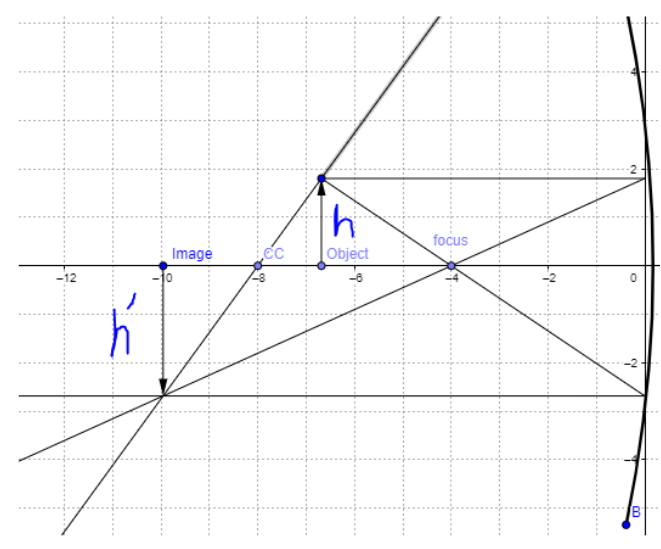
The linear magnification of a mirror can be defined as the ratio of the height of the image to the height of the object.
$m=\dfrac{{{h}'}}{h}$
Where, m is the magnification, $h$ is the height of the object and ${h}'$is the height of the image formed.
Again, with sign convention we can write,
$\dfrac{-{h}'}{h}=\dfrac{-v}{-u}$
So, we can write
$m=\dfrac{{{h}'}}{h}=-\dfrac{v}{u}$
Linear magnification tells us how bigger or smaller the image formed will be compared to that of the image.
Additional information:
For plane mirrors the focal length is always infinite. Only for a spherical mirror we can find a finite focal length.
Note:
The formula for magnification for mirror and lens will be different.
For lens it will be,
$m=\dfrac{{{h}'}}{h}=\dfrac{v}{u}$
Complete step by step answer:
A mirror is a glass coated with some reflecting material, which is the incoming light beam. It can be a plane mirror or a spherical mirror. Laws of reflection are the same for both types of mirrors.
The mirror equation gives the relation between the object distance, the image distance and the focal length of the mirror.
$\dfrac{1}{v}+\dfrac{1}{u}=\dfrac{1}{f}$
This equation is called the mirror equation where,
u is the distance of the object; v is the distance of the image and f is the focal length of the mirror.
The linear magnification of a mirror can be defined as the ratio of the height of the image to the height of the object.
$m=\dfrac{{{h}'}}{h}$
Where, m is the magnification, $h$ is the height of the object and ${h}'$is the height of the image formed.
Again, with sign convention we can write,
$\dfrac{-{h}'}{h}=\dfrac{-v}{-u}$
So, we can write
$m=\dfrac{{{h}'}}{h}=-\dfrac{v}{u}$
Linear magnification tells us how bigger or smaller the image formed will be compared to that of the image.
Additional information:
For plane mirrors the focal length is always infinite. Only for a spherical mirror we can find a finite focal length.
Note:
The formula for magnification for mirror and lens will be different.
For lens it will be,
$m=\dfrac{{{h}'}}{h}=\dfrac{v}{u}$
Recently Updated Pages
Master Class 12 Business Studies: Engaging Questions & Answers for Success

Master Class 12 Chemistry: Engaging Questions & Answers for Success
Master Class 12 Biology: Engaging Questions & Answers for Success
Class 12 Question and Answer - Your Ultimate Solutions Guide
Master Class 11 English: Engaging Questions & Answers for Success
Master Class 11 Social Science: Engaging Questions & Answers for Success
Trending doubts
Which are the Top 10 Largest Countries of the World?
Draw a labelled sketch of the human eye class 12 physics CBSE
Differentiate between homogeneous and heterogeneous class 12 chemistry CBSE
In order to find out the different types of gametes class 12 biology NEET_UG
Why is the cell called the structural and functional class 12 biology CBSE
Draw ray diagrams each showing i myopic eye and ii class 12 physics CBSE