




Define karyokinesis.
Answer
 Verified
645.9k+ views
Hint: The word Karyokinesis consists of two words- ‘karyo’ i.e. nucleus and ‘kinesis’ i.e. movement. Karyokinesis is followed by cytokinesis during cell division.
Complete answer:
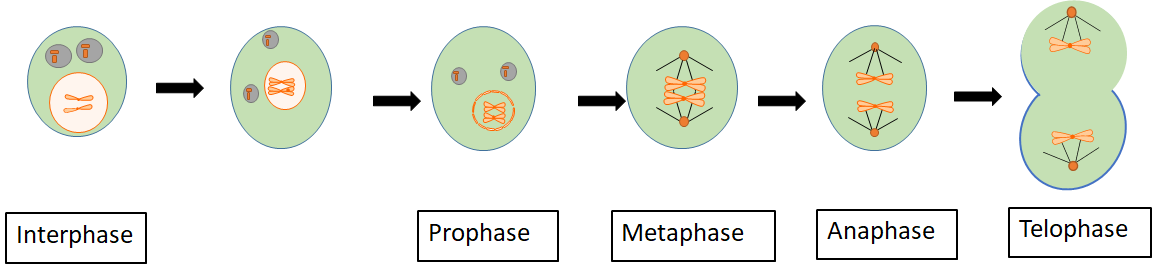
Karyokinesis is the process of the division of a cell nucleus during mitosis or meiosis. It is followed by the division of the cytoplasm which is known as cytokinesis. During cell division, the process of partition of a cell's nucleus into the daughter cells is called Karyokinesis. It takes place in a series of phases called prophase, prometaphase, metaphase, anaphase, and telophase.
Prophase- At the start of prophase, chromatin begins condensing into chromosomes. Mitotic spindles begin to form and the centrosomes begin to move in opposite directions.
Prometaphase- During this stage the nuclear envelope begins to break down, allowing spindle fibers to attach to the chromosomes. The mitotic spindles attach at a site called the kinetochore.
Metaphase- During this phase, the chromosomes align at the equator in an imaginary plane known as the metaphase plate.
Anaphase- During this stage, the spindle fibers attached to the kinetochore of the chromosomes pull the sister chromatids apart.
Telophase- This phase marks the end of nuclear division and the cell is generally elongated. It is also associated with the reappearance of organelles and the formation of two nuclei (one for each cell).
The eukaryotic cell cycle consists of four distinct phases: G1 phase, S phase (DNA synthesis phase), G2 phase (collectively known as interphase), and M phase (karyokinesis and cytokinesis).
Note: -The centrosomes is a membranous structure consisting of small tubular structures called centrioles, placed at right angles to each other. The center of the organelle is filled with PCM (Pericentriolar Material).
-Centrioles are absent in plant cells and most of the fungi.
-Meiosis involves two phases of karyokinesis.
Complete answer:
Karyokinesis is the process of the division of a cell nucleus during mitosis or meiosis. It is followed by the division of the cytoplasm which is known as cytokinesis. During cell division, the process of partition of a cell's nucleus into the daughter cells is called Karyokinesis. It takes place in a series of phases called prophase, prometaphase, metaphase, anaphase, and telophase.
Prophase- At the start of prophase, chromatin begins condensing into chromosomes. Mitotic spindles begin to form and the centrosomes begin to move in opposite directions.
Prometaphase- During this stage the nuclear envelope begins to break down, allowing spindle fibers to attach to the chromosomes. The mitotic spindles attach at a site called the kinetochore.
Metaphase- During this phase, the chromosomes align at the equator in an imaginary plane known as the metaphase plate.
Anaphase- During this stage, the spindle fibers attached to the kinetochore of the chromosomes pull the sister chromatids apart.
Telophase- This phase marks the end of nuclear division and the cell is generally elongated. It is also associated with the reappearance of organelles and the formation of two nuclei (one for each cell).
The eukaryotic cell cycle consists of four distinct phases: G1 phase, S phase (DNA synthesis phase), G2 phase (collectively known as interphase), and M phase (karyokinesis and cytokinesis).
Note: -The centrosomes is a membranous structure consisting of small tubular structures called centrioles, placed at right angles to each other. The center of the organelle is filled with PCM (Pericentriolar Material).
-Centrioles are absent in plant cells and most of the fungi.
-Meiosis involves two phases of karyokinesis.
Recently Updated Pages
10 examples of friction in our daily life

Draw a diagram of nephron and explain its structur class 11 biology CBSE
Write structures of the following compounds i 2 Chloro3methylpentane class 11 chemistry CBSE
What is BLO What is the full form of BLO class 8 social science CBSE
Explain the Treaty of Vienna of 1815 class 10 social science CBSE
A Paragraph on Pollution in about 100-150 Words
Trending doubts
One Metric ton is equal to kg A 10000 B 1000 C 100 class 11 physics CBSE
Draw a diagram showing the external features of fish class 11 biology CBSE
Name the Largest and the Smallest Cell in the Human Body ?
Show that Newtons second law is the real law of mo class 11 physics CBSE
Lysosomes are known as suicidal bags of cell why class 11 biology CBSE
Why are mitochondria called the powerhouse of the class 11 biology CBSE