




Define isomerism.
Answer
 Verified
643.2k+ views
Hint: Isomerism is a term that is related to the existence of two or more compounds differing in their chemical structure.
Isomers differ in structural or spatial arrangement of atoms in space.
In air pollution chemistry, they are very significant since even marginally distinct structures can elicit drastic variations in chemical and physical properties.
Complete step by step answer:
Let us first understand the concept of isomerism;
Isomerism is a phenomenon in which more than one compound has the same chemical formula but different chemical structures.
Chemical compounds that have identical chemical formulas but have different arrangements of atoms and differ in their properties are called isomers.
There are generally two types of isomers:
(a) Constitutional isomers
(b) Stereoisomers
constitutional isomers: Isomers that differ in connectivity are called constitutional isomers. They have the same parts but those parts are connected to each other in a different manner.
The simplest hydrocarbons- methane ($C{H_4}$), ethane (${C_2}{H_6}$ ) and propane ($C{H_3}C{H_2}C{H_3}$ ) have no constitutional isomers as there is no way to connect the carbon and hydrogen in a different way but after propane all other homologous members have constitutional isomers.
Stereoisomers: Isomers that have the chemical composition but differ in the orientation of atoms in space. We can further classify stereoisomerism into:
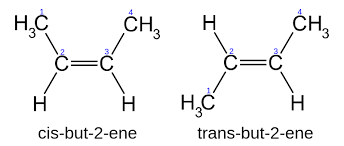
Geometrical isomerism: This type of isomerism arises in the compounds which have double bonds and have restricted rotation around double bonds. For example: cis but- 2- ene and trans but-2-ene.
Optical isomerism: This type of isomerism occurs in the compounds which contain the same kind of atoms that have the same molecular formula but have different bonding arrangements of atoms. Generally optical isomers are mirror images of each other. Only those carbon compounds are optical isomers that have non superimposable mirror images and can be found in the substances that have asymmetric carbon atoms means carbon atoms are attached to different groups. Examples of optical isomers:

Note: Only saturated compounds show chain isomerism. Unsaturated compounds show geometrical isomerism because in unsaturated compounds the positions of molecules are locked to each other due to the presence of ring structure or double bond. The geometrical isomers of unsaturated compounds in case of alkenes are cis or trans, E or Z alkenes.
Isomers differ in structural or spatial arrangement of atoms in space.
In air pollution chemistry, they are very significant since even marginally distinct structures can elicit drastic variations in chemical and physical properties.
Complete step by step answer:
Let us first understand the concept of isomerism;
Isomerism is a phenomenon in which more than one compound has the same chemical formula but different chemical structures.
Chemical compounds that have identical chemical formulas but have different arrangements of atoms and differ in their properties are called isomers.
There are generally two types of isomers:
(a) Constitutional isomers
(b) Stereoisomers
constitutional isomers: Isomers that differ in connectivity are called constitutional isomers. They have the same parts but those parts are connected to each other in a different manner.
The simplest hydrocarbons- methane ($C{H_4}$), ethane (${C_2}{H_6}$ ) and propane ($C{H_3}C{H_2}C{H_3}$ ) have no constitutional isomers as there is no way to connect the carbon and hydrogen in a different way but after propane all other homologous members have constitutional isomers.
Stereoisomers: Isomers that have the chemical composition but differ in the orientation of atoms in space. We can further classify stereoisomerism into:
Geometrical isomerism: This type of isomerism arises in the compounds which have double bonds and have restricted rotation around double bonds. For example: cis but- 2- ene and trans but-2-ene.
Optical isomerism: This type of isomerism occurs in the compounds which contain the same kind of atoms that have the same molecular formula but have different bonding arrangements of atoms. Generally optical isomers are mirror images of each other. Only those carbon compounds are optical isomers that have non superimposable mirror images and can be found in the substances that have asymmetric carbon atoms means carbon atoms are attached to different groups. Examples of optical isomers:
Note: Only saturated compounds show chain isomerism. Unsaturated compounds show geometrical isomerism because in unsaturated compounds the positions of molecules are locked to each other due to the presence of ring structure or double bond. The geometrical isomers of unsaturated compounds in case of alkenes are cis or trans, E or Z alkenes.
Recently Updated Pages
Which will be the least stable resonating structure class 11 chemistry CBSE

How many 5 digit telephone numbers can be construc-class-11-maths-CBSE
How do you find the angle of the resultant vector class 11 physics CBSE
Draw labelled diagram of the following i Gram seed class 11 biology CBSE
1 Quintal is equal to a 110 kg b 10 kg c 100kg d 1000 class 11 physics CBSE
What is the need and importance of classification class 11 biology CBSE
Trending doubts
Find the value of the expression given below sin 30circ class 11 maths CBSE
One Metric ton is equal to kg A 10000 B 1000 C 100 class 11 physics CBSE
10 examples of friction in our daily life
Draw a diagram of a plant cell and label at least eight class 11 biology CBSE
Difference between physical and chemical change class 11 chemistry CBSE
Proton was discovered by A Thomson B Rutherford C Chadwick class 11 chemistry CBSE