




Define Homologous organs.
Answer
 Verified
635.1k+ views
Hint: The living organisms are categorised into different groups on the basis of their common characteristics.
Hence , study of characteristics is important to categorise or classify them but on the other hand , these characteristics can also be used as evidence for evolution. If two organisms show similarities in structure or function , then they are supposed to be evolved from common ancestors and hence we can trace evolutionary relationships among organisms. We can do this by using study of HOMOLOGOUS ORGANS.
Complete answer:
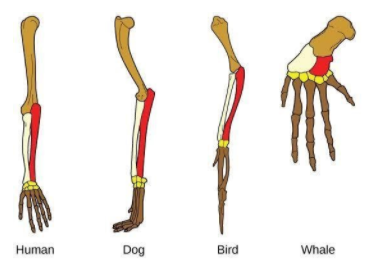
HOMOLOGOUS ORGANS:- The organs in different organisms which have similarity in their anatomy or basic plan but serve different functions are known as homologous organs.
This similarity in their anatomy is due to a phenomenon of common ancestor.
Examples of homologous organs are:-
• THE pattern or arrangement of bones of forelimbs in whales , bat , cheetah and human. These organisms are different species of Mammalia. The forelimbs of all of them have hummers , radius, ulna, carpals , metacarpals and phalanges in their forelimbs.
But forelimbs have different function in all of them as
Man:- they are used for holding objects
Cheetah :- they are used for running Whale:- they are used for swimming
Bat :- forelimbs are used for flying.
In this same structure is developed along different directions due to adaptations to different needs. This is called divergent evolution. Hence , homologous organs are result of divergent evolution
Note: Other example of homologous organs is :-
VERTEBRATE HEART AND BRAINS: -
The heart in various vertebrates ( fishes, amphibians, reptiles , birds and mammals shows similarity in the basic plan but they have varied degree of specialization according to the habitat in which they live , energy requirement and scale of division.
Homologous structures can also be traced in plants. One such example Is thorn of BOGAINVILLEA and tendril of Cucurbita.
Hence , study of characteristics is important to categorise or classify them but on the other hand , these characteristics can also be used as evidence for evolution. If two organisms show similarities in structure or function , then they are supposed to be evolved from common ancestors and hence we can trace evolutionary relationships among organisms. We can do this by using study of HOMOLOGOUS ORGANS.
Complete answer:
HOMOLOGOUS ORGANS:- The organs in different organisms which have similarity in their anatomy or basic plan but serve different functions are known as homologous organs.
This similarity in their anatomy is due to a phenomenon of common ancestor.
Examples of homologous organs are:-
• THE pattern or arrangement of bones of forelimbs in whales , bat , cheetah and human. These organisms are different species of Mammalia. The forelimbs of all of them have hummers , radius, ulna, carpals , metacarpals and phalanges in their forelimbs.
But forelimbs have different function in all of them as
Man:- they are used for holding objects
Cheetah :- they are used for running Whale:- they are used for swimming
Bat :- forelimbs are used for flying.
In this same structure is developed along different directions due to adaptations to different needs. This is called divergent evolution. Hence , homologous organs are result of divergent evolution
Note: Other example of homologous organs is :-
VERTEBRATE HEART AND BRAINS: -
The heart in various vertebrates ( fishes, amphibians, reptiles , birds and mammals shows similarity in the basic plan but they have varied degree of specialization according to the habitat in which they live , energy requirement and scale of division.
Homologous structures can also be traced in plants. One such example Is thorn of BOGAINVILLEA and tendril of Cucurbita.
Recently Updated Pages
Master Class 11 English: Engaging Questions & Answers for Success

Master Class 11 Social Science: Engaging Questions & Answers for Success
Master Class 11 Maths: Engaging Questions & Answers for Success
Master Class 11 Biology: Engaging Questions & Answers for Success
Master Class 11 Physics: Engaging Questions & Answers for Success
Master Class 11 Chemistry: Engaging Questions & Answers for Success
Trending doubts
Explain the Treaty of Vienna of 1815 class 10 social science CBSE
What is the Total Duration of Football Match?
First Cotton Mill of India
In which year voting age was reduced from 21 to 18?
10 examples of evaporation in daily life with explanations
What planets have no moons Which one has only one moon class 10 physics CBSE