




Define \[f:\left[ -\dfrac{1}{2},\infty \right)\to R\]by \[f\left( x \right)=\sqrt{1+2x},x\in \left[ -\dfrac{1}{2},\infty \right),\]then compute \[\underset{x\to -{{\dfrac{1}{2}}^{+}}}{\mathop{\lim }}\,f\left( x \right)\]. Hence find \[\underset{x\to -\dfrac{1}{2}}{\mathop{\lim }}\,f\left( x \right)\].
Answer
 Verified
611.7k+ views
Hint: In order to define the function, we need to find the points of discontinuity of the function, this can be found by putting \[f\left( x \right)=\sqrt{1+2x}\] equal to zero. Then, finding limits of \[f\left( x \right)\] at values of \[x\] slightly greater than \[-\dfrac{1}{2}\] and that at \[-\dfrac{1}{2}\].
Formula used:
In order to draw the graph, the various points are considered and plotted. The domain for the function is \[\left[ -\dfrac{1}{2},\infty \right),\left\{ x\left| x \right.\ge -\dfrac{1}{2} \right\}\] as the interval over which function is defined is given as \[f:\left[ -\dfrac{1}{2},\infty \right)\to R\] in the question.
To find the, \[\underset{x\to a}{\mathop{\lim }}\,f\left( x \right)\]
\[\underset{x\to {{a}^{+}}}{\mathop{\lim }}\,f\left( x \right)\] and \[\underset{x\to {{a}^{-}}}{\mathop{\lim }}\,f\left( x \right)\] should exist and coincide.
Complete step by step solution:
Equating \[f\left( x \right)\] to zero will give the roots
\[\sqrt{1+2x}=0\]
Squaring both sides
\[\begin{align}
& 1+2x=0 \\
& x=-\dfrac{1}{2} \\
\end{align}\]
So, the function is discontinuous at the point \[x=-\dfrac{1}{2}\]
If we plot a graph using these points,
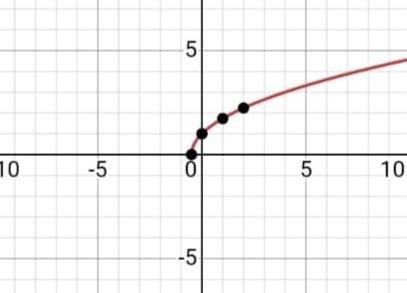
The domain of the function is found by finding where the equation is defined. The range is the set of values that correspond to the domain.
So, the domain is \[\left[ -\dfrac{1}{2},\infty \right),\left\{ x\left| x \right.\ge -\dfrac{1}{2} \right\}\]
And the range is: \[\left[ 0,\infty \right),\left\{ y\left| y \right.\ge 0 \right\}\]
Now, in order to find \[\underset{x\to -{{\dfrac{1}{2}}^{+}}}{\mathop{\lim }}\,f\left( x \right)\]
We solve it in this manner,
\[x\leftrightarrow -\dfrac{1}{2}+h\]
Where \[h\to 0\]
\[\begin{align}
& \Rightarrow \underset{h\to 0}{\mathop{\lim }}\,f\left( -\dfrac{1}{2}+h \right) \\
& \Rightarrow \underset{h\to 0}{\mathop{\lim }}\,\sqrt{1+2\left( -\dfrac{1}{2}+h \right)} \\
& \Rightarrow \underset{h\to 0}{\mathop{\lim }}\,\sqrt{1-1+h} \\
& \Rightarrow 0 \\
\end{align}\]
Now, the range is from\[\left[ -\dfrac{1}{2},\infty \right)\], now as the left hand limit does not lie in the range. The left hand limit does not exist.
Now for \[\underset{x\to -\dfrac{1}{2}}{\mathop{\lim }}\,f\left( x \right)\] to exist, the left hand limit and the right hand limit should coincide. However, it is not so, in this case. So, the limit \[\underset{x\to -\dfrac{1}{2}}{\mathop{\lim }}\,f\left( x \right)\] does not exist.
Note: The function is discontinuous at \[x=-\dfrac{1}{2}\] means that the curve is not continuous at this point or makes a jump or is broken .If the interval contained the values less than \[-\dfrac{1}{2}\], then the left hand limit would have existed and also the \[\underset{x\to -\dfrac{1}{2}}{\mathop{\lim }}\,f\left( x \right)\].
Formula used:
In order to draw the graph, the various points are considered and plotted. The domain for the function is \[\left[ -\dfrac{1}{2},\infty \right),\left\{ x\left| x \right.\ge -\dfrac{1}{2} \right\}\] as the interval over which function is defined is given as \[f:\left[ -\dfrac{1}{2},\infty \right)\to R\] in the question.
To find the, \[\underset{x\to a}{\mathop{\lim }}\,f\left( x \right)\]
\[\underset{x\to {{a}^{+}}}{\mathop{\lim }}\,f\left( x \right)\] and \[\underset{x\to {{a}^{-}}}{\mathop{\lim }}\,f\left( x \right)\] should exist and coincide.
Complete step by step solution:
Equating \[f\left( x \right)\] to zero will give the roots
\[\sqrt{1+2x}=0\]
Squaring both sides
\[\begin{align}
& 1+2x=0 \\
& x=-\dfrac{1}{2} \\
\end{align}\]
So, the function is discontinuous at the point \[x=-\dfrac{1}{2}\]
If we plot a graph using these points,
| x | y |
| -0.5 | 0 |
| 0 | 1 |
| 1 | 1.73 |
| 2 | 2.24 |
The domain of the function is found by finding where the equation is defined. The range is the set of values that correspond to the domain.
So, the domain is \[\left[ -\dfrac{1}{2},\infty \right),\left\{ x\left| x \right.\ge -\dfrac{1}{2} \right\}\]
And the range is: \[\left[ 0,\infty \right),\left\{ y\left| y \right.\ge 0 \right\}\]
Now, in order to find \[\underset{x\to -{{\dfrac{1}{2}}^{+}}}{\mathop{\lim }}\,f\left( x \right)\]
We solve it in this manner,
\[x\leftrightarrow -\dfrac{1}{2}+h\]
Where \[h\to 0\]
\[\begin{align}
& \Rightarrow \underset{h\to 0}{\mathop{\lim }}\,f\left( -\dfrac{1}{2}+h \right) \\
& \Rightarrow \underset{h\to 0}{\mathop{\lim }}\,\sqrt{1+2\left( -\dfrac{1}{2}+h \right)} \\
& \Rightarrow \underset{h\to 0}{\mathop{\lim }}\,\sqrt{1-1+h} \\
& \Rightarrow 0 \\
\end{align}\]
Now, the range is from\[\left[ -\dfrac{1}{2},\infty \right)\], now as the left hand limit does not lie in the range. The left hand limit does not exist.
Now for \[\underset{x\to -\dfrac{1}{2}}{\mathop{\lim }}\,f\left( x \right)\] to exist, the left hand limit and the right hand limit should coincide. However, it is not so, in this case. So, the limit \[\underset{x\to -\dfrac{1}{2}}{\mathop{\lim }}\,f\left( x \right)\] does not exist.
Note: The function is discontinuous at \[x=-\dfrac{1}{2}\] means that the curve is not continuous at this point or makes a jump or is broken .If the interval contained the values less than \[-\dfrac{1}{2}\], then the left hand limit would have existed and also the \[\underset{x\to -\dfrac{1}{2}}{\mathop{\lim }}\,f\left( x \right)\].
Recently Updated Pages
Which of the following graphs shows the variation of class 12 physics CBSE

Draw a labelled diagram of the human male reproductive class 12 biology CBSE
Describe the experiment to compare the emf of two cells class 12 physics CBSE
What is standard hydrogen electrode
What is conventional current and electric current class 12 physics CBSE
2Bromopentane is treated with an alcoholic KOH solution class 12 chemistry CBSE
Trending doubts
Draw a labelled sketch of the human eye class 12 physics CBSE
Which are the Top 10 Largest Countries of the World?
A member of Simon commission later became Prime Minister class 12 social science CBSE
Differentiate between homogeneous and heterogeneous class 12 chemistry CBSE
Draw ray diagrams each showing i myopic eye and ii class 12 physics CBSE
Which is the correct genotypic ratio of mendel dihybrid class 12 biology CBSE