




Define ellipse as a set of all points in the plane and derive its equation in the standard form as $\dfrac{{{x}^{2}}}{{{a}^{2}}}+\dfrac{{{y}^{2}}}{{{b}^{2}}}=1$, $\left( a>b \right)$.
Answer
 Verified
584.7k+ views
Hint: We start solving the problem by recalling the definition of an ellipse using the locus of the points. We then assume the sum of the constant distance between the point and foci as 2a. We then use the formula of the distance between two points and square on both sides and make necessary arrangements to the equations in terms of the sum of ${{x}^{2}}$ and ${{y}^{2}}$. We then assume ${{a}^{2}}-{{c}^{2}}={{b}^{2}}$ and necessary calculations to complete the desired equation.
Complete step by step answer:
According to the problem, we need to define what is an ellipse and derive the equation of the ellipse in its standard form $\dfrac{{{x}^{2}}}{{{a}^{2}}}+\dfrac{{{y}^{2}}}{{{b}^{2}}}=1$, $\left( a>b \right)$.
We know that the ellipse is defined as the locus of all the points such that the sum of the distances from the point in the locus to the foci is constant, as shown in the figure.
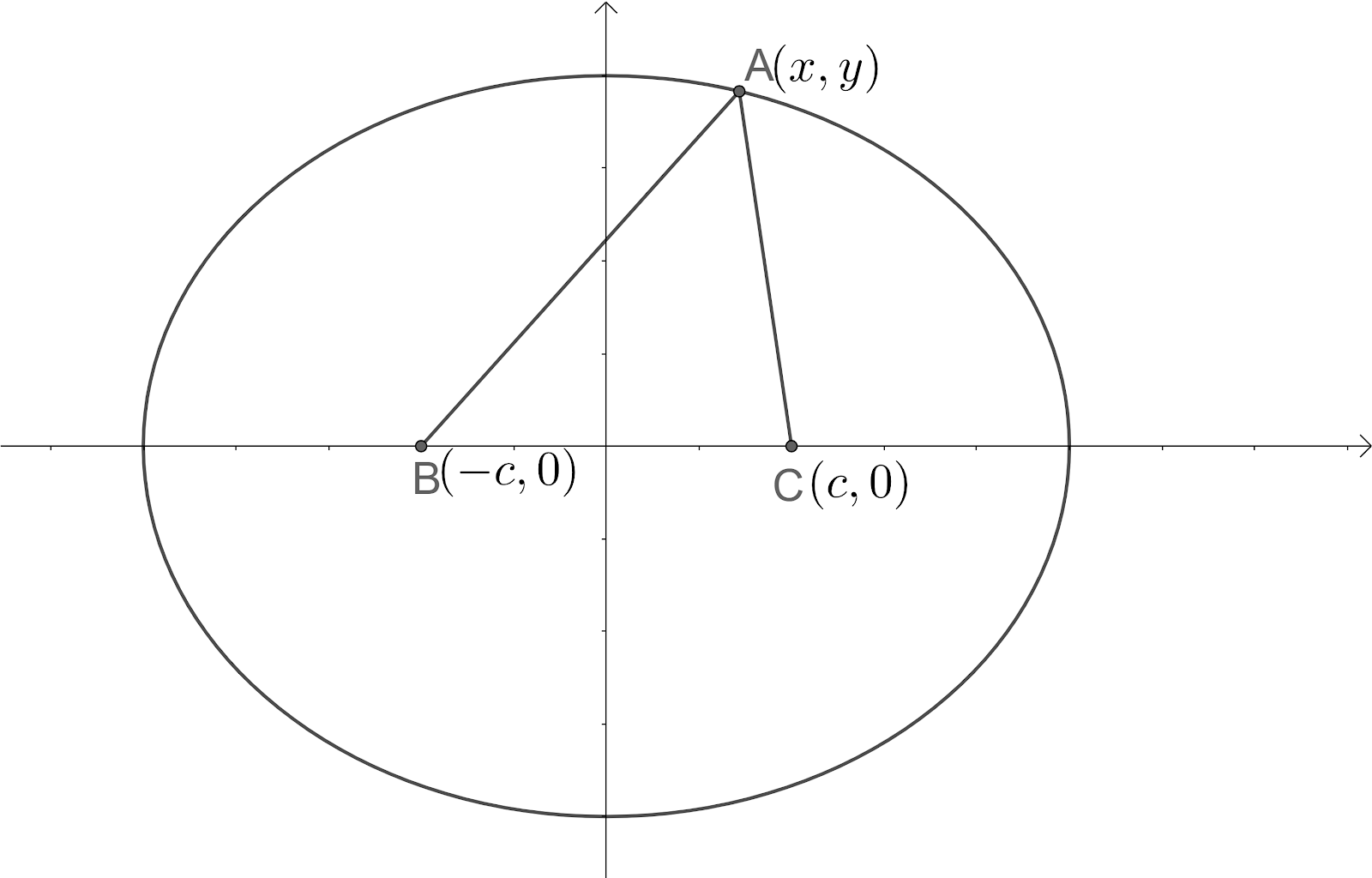
Let us assume the sum of the distances from the focus to the point representing the locus be 2a.
So, we get $AB+AC=2a$.
We know that the distance between the two points $\left( {{x}_{1}},{{y}_{1}} \right)$ and $\left( {{x}_{2}},{{y}_{2}} \right)$ is $\sqrt{{{\left( {{x}_{1}}-{{x}_{2}} \right)}^{2}}+{{\left( {{y}_{1}}-{{y}_{2}} \right)}^{2}}}$.
So, we have $\sqrt{{{\left( x+c \right)}^{2}}+{{\left( y-0 \right)}^{2}}}+\sqrt{{{\left( x-c \right)}^{2}}+{{\left( y-0 \right)}^{2}}}=2a$.
$\Rightarrow \sqrt{{{\left( x+c \right)}^{2}}+{{y}^{2}}}+\sqrt{{{\left( x-c \right)}^{2}}+{{y}^{2}}}=2a$.
$\Rightarrow \sqrt{{{\left( x+c \right)}^{2}}+{{y}^{2}}}=2a-\sqrt{{{\left( x-c \right)}^{2}}+{{y}^{2}}}$.
Let us square on both sides.
$\Rightarrow {{\left( \sqrt{{{\left( x+c \right)}^{2}}+{{y}^{2}}} \right)}^{2}}={{\left( 2a-\sqrt{{{\left( x-c \right)}^{2}}+{{y}^{2}}} \right)}^{2}}$.
$\Rightarrow {{\left( x+c \right)}^{2}}+{{y}^{2}}=4{{a}^{2}}+{{\left( x-c \right)}^{2}}+{{y}^{2}}-4a\sqrt{{{\left( x-c \right)}^{2}}+{{y}^{2}}}$.
$\Rightarrow {{\left( x+c \right)}^{2}}-{{\left( x-c \right)}^{2}}+{{y}^{2}}-{{y}^{2}}-4{{a}^{2}}=-4a\sqrt{{{\left( x-c \right)}^{2}}+{{y}^{2}}}$.
We know that ${{\left( a+b \right)}^{2}}-{{\left( a-b \right)}^{2}}=4ab$.
$\Rightarrow 4xc-4{{a}^{2}}=-4a\sqrt{{{\left( x-c \right)}^{2}}+{{y}^{2}}}$.
$\Rightarrow xc-{{a}^{2}}=-a\sqrt{{{\left( x-c \right)}^{2}}+{{y}^{2}}}$.
Let us square on both sides.
$\Rightarrow {{\left( xc-{{a}^{2}} \right)}^{2}}={{\left( -a\sqrt{{{\left( x-c \right)}^{2}}+{{y}^{2}}} \right)}^{2}}$.
$\Rightarrow {{x}^{2}}{{c}^{2}}+{{a}^{4}}-2{{a}^{2}}xc={{a}^{2}}\left( {{\left( x-c \right)}^{2}}+{{y}^{2}} \right)$.
$\Rightarrow {{x}^{2}}{{c}^{2}}+{{a}^{4}}-2{{a}^{2}}xc={{a}^{2}}\left( {{x}^{2}}+{{c}^{2}}-2xc+{{y}^{2}} \right)$.
$\Rightarrow {{x}^{2}}{{c}^{2}}+{{a}^{4}}-2{{a}^{2}}xc={{a}^{2}}{{x}^{2}}+{{a}^{2}}{{c}^{2}}-2{{a}^{2}}xc+{{a}^{2}}{{y}^{2}}$.
$\Rightarrow {{a}^{4}}-{{a}^{2}}{{c}^{2}}-2{{a}^{2}}xc-2{{a}^{2}}xc={{a}^{2}}{{x}^{2}}-{{x}^{2}}{{c}^{2}}+{{a}^{2}}{{y}^{2}}$.
$\Rightarrow {{a}^{2}}\left( {{a}^{2}}-{{c}^{2}} \right)={{x}^{2}}\left( {{a}^{2}}-{{c}^{2}} \right)+{{a}^{2}}{{y}^{2}}$.
Let us assume ${{a}^{2}}-{{c}^{2}}={{b}^{2}}$.
$\Rightarrow {{x}^{2}}{{b}^{2}}+{{y}^{2}}{{a}^{2}}={{a}^{2}}{{b}^{2}}$.
Let us divide both sides with ${{a}^{2}}{{b}^{2}}$.
$\Rightarrow \dfrac{{{x}^{2}}{{b}^{2}}}{{{a}^{2}}{{b}^{2}}}+\dfrac{{{y}^{2}}{{a}^{2}}}{{{a}^{2}}{{b}^{2}}}=\dfrac{{{a}^{2}}{{b}^{2}}}{{{a}^{2}}{{b}^{2}}}$.
$\Rightarrow \dfrac{{{x}^{2}}}{{{a}^{2}}}+\dfrac{{{y}^{2}}}{{{b}^{2}}}=1$.
So, we have found the equation of the ellipse as $\dfrac{{{x}^{2}}}{{{a}^{2}}}+\dfrac{{{y}^{2}}}{{{b}^{2}}}=1$.
Note:
Here we have assumed ${{b}^{2}}={{a}^{2}}-{{c}^{2}}$ which tells us the value of a is greater than the value of b. Here we derived the standard equation of the ellipse by assuming origin as centre of the ellipse and x-axis as the major axis and the y-axis as the minor axis of the ellipse. We should not make mistakes while applying the square and calculating the distance between the points. Similarly, we can also expect the problem to derive the equation of parabola and hyperbola
Complete step by step answer:
According to the problem, we need to define what is an ellipse and derive the equation of the ellipse in its standard form $\dfrac{{{x}^{2}}}{{{a}^{2}}}+\dfrac{{{y}^{2}}}{{{b}^{2}}}=1$, $\left( a>b \right)$.
We know that the ellipse is defined as the locus of all the points such that the sum of the distances from the point in the locus to the foci is constant, as shown in the figure.
Let us assume the sum of the distances from the focus to the point representing the locus be 2a.
So, we get $AB+AC=2a$.
We know that the distance between the two points $\left( {{x}_{1}},{{y}_{1}} \right)$ and $\left( {{x}_{2}},{{y}_{2}} \right)$ is $\sqrt{{{\left( {{x}_{1}}-{{x}_{2}} \right)}^{2}}+{{\left( {{y}_{1}}-{{y}_{2}} \right)}^{2}}}$.
So, we have $\sqrt{{{\left( x+c \right)}^{2}}+{{\left( y-0 \right)}^{2}}}+\sqrt{{{\left( x-c \right)}^{2}}+{{\left( y-0 \right)}^{2}}}=2a$.
$\Rightarrow \sqrt{{{\left( x+c \right)}^{2}}+{{y}^{2}}}+\sqrt{{{\left( x-c \right)}^{2}}+{{y}^{2}}}=2a$.
$\Rightarrow \sqrt{{{\left( x+c \right)}^{2}}+{{y}^{2}}}=2a-\sqrt{{{\left( x-c \right)}^{2}}+{{y}^{2}}}$.
Let us square on both sides.
$\Rightarrow {{\left( \sqrt{{{\left( x+c \right)}^{2}}+{{y}^{2}}} \right)}^{2}}={{\left( 2a-\sqrt{{{\left( x-c \right)}^{2}}+{{y}^{2}}} \right)}^{2}}$.
$\Rightarrow {{\left( x+c \right)}^{2}}+{{y}^{2}}=4{{a}^{2}}+{{\left( x-c \right)}^{2}}+{{y}^{2}}-4a\sqrt{{{\left( x-c \right)}^{2}}+{{y}^{2}}}$.
$\Rightarrow {{\left( x+c \right)}^{2}}-{{\left( x-c \right)}^{2}}+{{y}^{2}}-{{y}^{2}}-4{{a}^{2}}=-4a\sqrt{{{\left( x-c \right)}^{2}}+{{y}^{2}}}$.
We know that ${{\left( a+b \right)}^{2}}-{{\left( a-b \right)}^{2}}=4ab$.
$\Rightarrow 4xc-4{{a}^{2}}=-4a\sqrt{{{\left( x-c \right)}^{2}}+{{y}^{2}}}$.
$\Rightarrow xc-{{a}^{2}}=-a\sqrt{{{\left( x-c \right)}^{2}}+{{y}^{2}}}$.
Let us square on both sides.
$\Rightarrow {{\left( xc-{{a}^{2}} \right)}^{2}}={{\left( -a\sqrt{{{\left( x-c \right)}^{2}}+{{y}^{2}}} \right)}^{2}}$.
$\Rightarrow {{x}^{2}}{{c}^{2}}+{{a}^{4}}-2{{a}^{2}}xc={{a}^{2}}\left( {{\left( x-c \right)}^{2}}+{{y}^{2}} \right)$.
$\Rightarrow {{x}^{2}}{{c}^{2}}+{{a}^{4}}-2{{a}^{2}}xc={{a}^{2}}\left( {{x}^{2}}+{{c}^{2}}-2xc+{{y}^{2}} \right)$.
$\Rightarrow {{x}^{2}}{{c}^{2}}+{{a}^{4}}-2{{a}^{2}}xc={{a}^{2}}{{x}^{2}}+{{a}^{2}}{{c}^{2}}-2{{a}^{2}}xc+{{a}^{2}}{{y}^{2}}$.
$\Rightarrow {{a}^{4}}-{{a}^{2}}{{c}^{2}}-2{{a}^{2}}xc-2{{a}^{2}}xc={{a}^{2}}{{x}^{2}}-{{x}^{2}}{{c}^{2}}+{{a}^{2}}{{y}^{2}}$.
$\Rightarrow {{a}^{2}}\left( {{a}^{2}}-{{c}^{2}} \right)={{x}^{2}}\left( {{a}^{2}}-{{c}^{2}} \right)+{{a}^{2}}{{y}^{2}}$.
Let us assume ${{a}^{2}}-{{c}^{2}}={{b}^{2}}$.
$\Rightarrow {{x}^{2}}{{b}^{2}}+{{y}^{2}}{{a}^{2}}={{a}^{2}}{{b}^{2}}$.
Let us divide both sides with ${{a}^{2}}{{b}^{2}}$.
$\Rightarrow \dfrac{{{x}^{2}}{{b}^{2}}}{{{a}^{2}}{{b}^{2}}}+\dfrac{{{y}^{2}}{{a}^{2}}}{{{a}^{2}}{{b}^{2}}}=\dfrac{{{a}^{2}}{{b}^{2}}}{{{a}^{2}}{{b}^{2}}}$.
$\Rightarrow \dfrac{{{x}^{2}}}{{{a}^{2}}}+\dfrac{{{y}^{2}}}{{{b}^{2}}}=1$.
So, we have found the equation of the ellipse as $\dfrac{{{x}^{2}}}{{{a}^{2}}}+\dfrac{{{y}^{2}}}{{{b}^{2}}}=1$.
Note:
Here we have assumed ${{b}^{2}}={{a}^{2}}-{{c}^{2}}$ which tells us the value of a is greater than the value of b. Here we derived the standard equation of the ellipse by assuming origin as centre of the ellipse and x-axis as the major axis and the y-axis as the minor axis of the ellipse. We should not make mistakes while applying the square and calculating the distance between the points. Similarly, we can also expect the problem to derive the equation of parabola and hyperbola
Recently Updated Pages
Master Class 10 Computer Science: Engaging Questions & Answers for Success

Master Class 10 General Knowledge: Engaging Questions & Answers for Success
Master Class 10 English: Engaging Questions & Answers for Success
Master Class 10 Social Science: Engaging Questions & Answers for Success
Master Class 10 Maths: Engaging Questions & Answers for Success
Master Class 10 Science: Engaging Questions & Answers for Success
Trending doubts
What is the median of the first 10 natural numbers class 10 maths CBSE
Which women's tennis player has 24 Grand Slam singles titles?
Who is the Brand Ambassador of Incredible India?
Why is there a time difference of about 5 hours between class 10 social science CBSE
Write a letter to the principal requesting him to grant class 10 english CBSE
A moving boat is observed from the top of a 150 m high class 10 maths CBSE