




Define displacement. State its unit.
(A). Displacement is the vectorical sum of the distances travelled by the body. The standard unit of displacement in the international System of Units (S.I.) is the kilometer (km).
(B). Displacement is the total distance travelled by the body. The standard unit of displacement in the international System of Units (S.I.) is the kilometer (km).
(C). Displacement is the total distance travelled by the body. The standard unit of displacement in the international System of Units (S.I.) is the kilometer (m).
(D). Displacement is the vectorical sum of the distances travelled by the body. The standard unit of displacement in the international System of Units (S.I.) is the kilometer (m).
Answer
 Verified
643.2k+ views
Hint: Displacement is the length of shortest path joining initial and final position of body. Displacement is also a vector quantity. It's S.I. unit is m.
Complete Step By Step Solution:
Displacement is the vectorial sum of the distances travelled by the body. It means if a body travels from O to A and then goes from A to B as shown in the figure, the total displacement of body will be the vectorial sum of vector OA and vector AB i.e. vector joining B and O and will we headed towards B. Hence vector OB will be the resultant displacement not the sum of magnitude of OA and AB. Displacement is the length of the shortest path joining the initial and final position of the body.
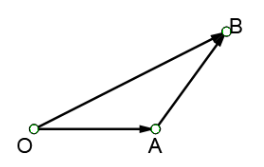
The S.I. unit of displacement is m.
Additional Information:
Displacement is always less than or equal to the total distance travelled. This is because the magnitude of a vector sum of two vectors is always less than or equal to the sum of magnitude of individual vectors. Displacement is equal to distance when the object travels in a straight path i.e. when angle between two vectors is 180 degree. The rate of change of displacement is called velocity. The rate of change of velocity is called acceleration. Hence derivative of displacement- time graph gives velocity and derivative of velocity- time graph gives acceleration.
Note: Displacement cannot be greater than the total distance travelled. The S.I. unit of displacement is often mistaken to be km as it is commonly used in our daily life, but actual S.I. unit is m. The direction of displacement is from initial position to final position.
Complete Step By Step Solution:
Displacement is the vectorial sum of the distances travelled by the body. It means if a body travels from O to A and then goes from A to B as shown in the figure, the total displacement of body will be the vectorial sum of vector OA and vector AB i.e. vector joining B and O and will we headed towards B. Hence vector OB will be the resultant displacement not the sum of magnitude of OA and AB. Displacement is the length of the shortest path joining the initial and final position of the body.
The S.I. unit of displacement is m.
Additional Information:
Displacement is always less than or equal to the total distance travelled. This is because the magnitude of a vector sum of two vectors is always less than or equal to the sum of magnitude of individual vectors. Displacement is equal to distance when the object travels in a straight path i.e. when angle between two vectors is 180 degree. The rate of change of displacement is called velocity. The rate of change of velocity is called acceleration. Hence derivative of displacement- time graph gives velocity and derivative of velocity- time graph gives acceleration.
Note: Displacement cannot be greater than the total distance travelled. The S.I. unit of displacement is often mistaken to be km as it is commonly used in our daily life, but actual S.I. unit is m. The direction of displacement is from initial position to final position.
Recently Updated Pages
Master Class 11 English: Engaging Questions & Answers for Success

Master Class 11 Social Science: Engaging Questions & Answers for Success
Master Class 11 Maths: Engaging Questions & Answers for Success
Master Class 11 Biology: Engaging Questions & Answers for Success
Master Class 11 Physics: Engaging Questions & Answers for Success
Master Class 11 Chemistry: Engaging Questions & Answers for Success
Trending doubts
One Metric ton is equal to kg A 10000 B 1000 C 100 class 11 physics CBSE
Difference Between Prokaryotic Cells and Eukaryotic Cells
1 ton equals to A 100 kg B 1000 kg C 10 kg D 10000 class 11 physics CBSE
Find the value of the expression given below sin 30circ class 11 maths CBSE
Two of the body parts which do not appear in MRI are class 11 biology CBSE
Draw a diagram of a plant cell and label at least eight class 11 biology CBSE