




Define capacitive reactance. Write its SI unit.
Answer
 Verified
664.8k+ views
Hint: A good capacitor completely blocks the passage of direct current (DC) through it but allows alternating current (AC) to pass through it. Reactance is the opposition to the current flow of an element in the circuit because of its capacitance. Its unit is similar to the unit of resistance.
Complete step by step answer:
It allows alternating current (AC) to flow through the external circuit in one direction and then in the opposite direction at a frequency which is equal to the frequency of applied voltage. But after some time, capacitive reactance also opposes the passage of alternating current (AC) like resistance. The measurement of capacitive reactance is also taken in ohms. But reactance of capacitors is more complex than resistance because of the electrical signal frequency. The capacitive reactance is denoted by Xc and given by the formula,
${ X }_{ c }=\dfrac { 1 }{ 2\pi fc }$ = $\dfrac { 0.159 }{ fC }$
Where ‘f’ is equal to frequency of the signal and ‘c’ is the capacitance of the capacitor.
Capacitive reactance varies inversely with respect to the applied voltage frequency. If the frequency is higher, the capacitance is less. And in the same way, if frequency is lesser, the capacitance is higher.
The capacitor blocks direct current because for a DC voltage f = 0, Xc = 1/0 = ∞.
The S.I unit of capacitance is farad, but the S.I unit of capacitive reactance is ohms. It does not have a fixed value like resistance but keeps varying according to the applied frequency. A complex impedance is found due to the presence of electrons in the form of charges on the capacitor plates passing from one to another rapidly.
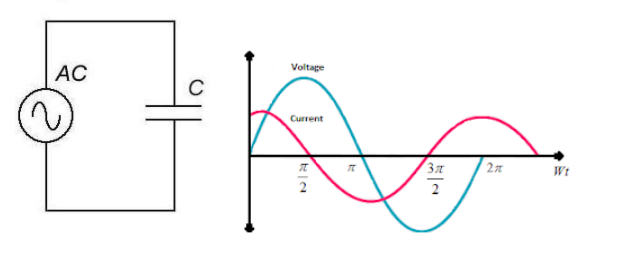
Note: A capacitor in the circuit retards current flow by causing the alternating voltage to lag behind the alternating current (AC) and the measurement of this opposition is called the reactance. This forms the complex impedance of the capacitor.
Complete step by step answer:
It allows alternating current (AC) to flow through the external circuit in one direction and then in the opposite direction at a frequency which is equal to the frequency of applied voltage. But after some time, capacitive reactance also opposes the passage of alternating current (AC) like resistance. The measurement of capacitive reactance is also taken in ohms. But reactance of capacitors is more complex than resistance because of the electrical signal frequency. The capacitive reactance is denoted by Xc and given by the formula,
${ X }_{ c }=\dfrac { 1 }{ 2\pi fc }$ = $\dfrac { 0.159 }{ fC }$
Where ‘f’ is equal to frequency of the signal and ‘c’ is the capacitance of the capacitor.
Capacitive reactance varies inversely with respect to the applied voltage frequency. If the frequency is higher, the capacitance is less. And in the same way, if frequency is lesser, the capacitance is higher.
The capacitor blocks direct current because for a DC voltage f = 0, Xc = 1/0 = ∞.
The S.I unit of capacitance is farad, but the S.I unit of capacitive reactance is ohms. It does not have a fixed value like resistance but keeps varying according to the applied frequency. A complex impedance is found due to the presence of electrons in the form of charges on the capacitor plates passing from one to another rapidly.
Note: A capacitor in the circuit retards current flow by causing the alternating voltage to lag behind the alternating current (AC) and the measurement of this opposition is called the reactance. This forms the complex impedance of the capacitor.
Recently Updated Pages
Which of the following graphs shows the variation of class 12 physics CBSE

Draw a labelled diagram of the human male reproductive class 12 biology CBSE
Describe the experiment to compare the emf of two cells class 12 physics CBSE
What is standard hydrogen electrode
What is conventional current and electric current class 12 physics CBSE
2Bromopentane is treated with an alcoholic KOH solution class 12 chemistry CBSE
Trending doubts
Draw a labelled sketch of the human eye class 12 physics CBSE
Which are the Top 10 Largest Countries of the World?
Differentiate between homogeneous and heterogeneous class 12 chemistry CBSE
Draw ray diagrams each showing i myopic eye and ii class 12 physics CBSE
Which is the correct genotypic ratio of mendel dihybrid class 12 biology CBSE
What is the Full Form of PVC, PET, HDPE, LDPE, PP and PS ?