




Define binding energy and obtain an expression of binding energy of a satellite revolving in a circular orbit around the earth.
Answer
 Verified
640.5k+ views
Hint: In order to calculate the binding energy, we first need to find the total energy of the satellite (which is negative since it’s a bound system) and then find the additional amount of energy required to make it 0 i.e. its energy at infinity.
Complete step by step answer:
Binding energy is the minimum amount of energy required to free an object from a bound system and escape from its region of influence (i.e. escape to infinity). In the given case, it is the energy required by the satellite to leave its orbit around the earth and escape to infinity.
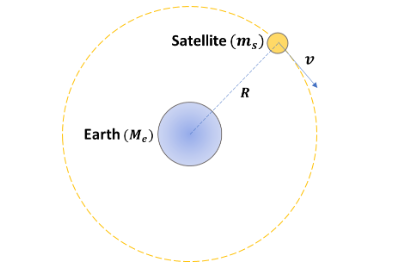
To begin, let us consider the earth-satellite system as given in the diagram below. The earth has a mass of $M_e$ and that of a satellite is $m_s$. The distance between their center of masses is $R$. The satellite is moving at a speed of $v$ in a fixed orbit.
Therefore, the kinetic energy (K) of the satellite is given by,
$K = \dfrac{1}{2}m_s v^2$
Now, since it is in a stable circular orbit, the gravitational force must be equal to the centripetal force. Therefore,
$\dfrac{m_s v^2}{R} = \dfrac{G M_e m_s}{R^2}$
${m_s v^2} = \dfrac{G M_e m_s}{R}$
Substituting the above value in $K$, we get,
$K = \dfrac{1}{2} \dfrac{G M_e m_s}{R}$
And its potential energy (U) is given by,
$U = \int^R_{\infty} F dr$
where F is the force felt by the satellite at a given distance $r$. It is given by,
$F = \dfrac{G M_e m_s}{r^2}$
Hence,
$U = \int^R_{\infty} \dfrac{G M_e m_s}{r^2} dr$
$U = -\dfrac{G M_e m_s}{R}$
Therefore, the total energy ($E_0$) when in orbit is given by,
$E_0 = K + U$
$E_0 = \dfrac{1}{2} \dfrac{ G M_e m_s}{R} - \dfrac{G M_e m_s}{R}$
$E_0 = -\dfrac{1}{2} \dfrac{G M_e m_s}{R}$
Now, when the satellite escapes to infinity, we assume that it loses all its kinetic energy, and since it is at infinite distance from earth, its potential energy is zero. Therefore, its total energy at infinity ($E_{\infty}$) is given by,
$E_{\infty} = 0$
Finally, the binding energy (B.E.) will be the difference of the two total energies, i.e.,
$B.E.={{E}_{\infty }}-{{E}_{0}}$
$B.E. = \dfrac{1}{2} \dfrac{G M_e m_s}{R}$
Note:
The assumption of kinetic energy becoming zero after escaping to infinity is made to find the minimum binding energy. If it is asked that the object retains some velocity even at infinity, then the respective amount of kinetic energy must be added to the binding energy.
Complete step by step answer:
Binding energy is the minimum amount of energy required to free an object from a bound system and escape from its region of influence (i.e. escape to infinity). In the given case, it is the energy required by the satellite to leave its orbit around the earth and escape to infinity.
To begin, let us consider the earth-satellite system as given in the diagram below. The earth has a mass of $M_e$ and that of a satellite is $m_s$. The distance between their center of masses is $R$. The satellite is moving at a speed of $v$ in a fixed orbit.
Therefore, the kinetic energy (K) of the satellite is given by,
$K = \dfrac{1}{2}m_s v^2$
Now, since it is in a stable circular orbit, the gravitational force must be equal to the centripetal force. Therefore,
$\dfrac{m_s v^2}{R} = \dfrac{G M_e m_s}{R^2}$
${m_s v^2} = \dfrac{G M_e m_s}{R}$
Substituting the above value in $K$, we get,
$K = \dfrac{1}{2} \dfrac{G M_e m_s}{R}$
And its potential energy (U) is given by,
$U = \int^R_{\infty} F dr$
where F is the force felt by the satellite at a given distance $r$. It is given by,
$F = \dfrac{G M_e m_s}{r^2}$
Hence,
$U = \int^R_{\infty} \dfrac{G M_e m_s}{r^2} dr$
$U = -\dfrac{G M_e m_s}{R}$
Therefore, the total energy ($E_0$) when in orbit is given by,
$E_0 = K + U$
$E_0 = \dfrac{1}{2} \dfrac{ G M_e m_s}{R} - \dfrac{G M_e m_s}{R}$
$E_0 = -\dfrac{1}{2} \dfrac{G M_e m_s}{R}$
Now, when the satellite escapes to infinity, we assume that it loses all its kinetic energy, and since it is at infinite distance from earth, its potential energy is zero. Therefore, its total energy at infinity ($E_{\infty}$) is given by,
$E_{\infty} = 0$
Finally, the binding energy (B.E.) will be the difference of the two total energies, i.e.,
$B.E.={{E}_{\infty }}-{{E}_{0}}$
$B.E. = \dfrac{1}{2} \dfrac{G M_e m_s}{R}$
Note:
The assumption of kinetic energy becoming zero after escaping to infinity is made to find the minimum binding energy. If it is asked that the object retains some velocity even at infinity, then the respective amount of kinetic energy must be added to the binding energy.
Recently Updated Pages
Master Class 12 Economics: Engaging Questions & Answers for Success

Master Class 12 English: Engaging Questions & Answers for Success
Master Class 12 Social Science: Engaging Questions & Answers for Success
Master Class 12 Maths: Engaging Questions & Answers for Success
Master Class 12 Physics: Engaging Questions & Answers for Success
Master Class 9 General Knowledge: Engaging Questions & Answers for Success
Trending doubts
One Metric ton is equal to kg A 10000 B 1000 C 100 class 11 physics CBSE
Difference Between Prokaryotic Cells and Eukaryotic Cells
Two of the body parts which do not appear in MRI are class 11 biology CBSE
1 ton equals to A 100 kg B 1000 kg C 10 kg D 10000 class 11 physics CBSE
Draw a diagram of nephron and explain its structur class 11 biology CBSE
10 examples of friction in our daily life