




Define bicollateral vascular bundle
Answer
 Verified
623.7k+ views
Hint: Vascular bundles are called conducting vessels. They consist of xylem and phloem. Xylem helps in transport of water and minerals whereas phloem helps in transport of food material [glucose or starch].
Complete step-by-step answer:
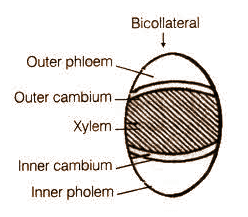
-Bicollateral vascular bundle: It is a special type of vascular bundle where two phloem poles separated from the central xylem or a type of conjoint vascular bundle where the xylem is situated in the middle of two phloem strands. Example: stem of Cucurbita, Solanaceae (the potato family).
-It is an open type of vascular bundle where a strip of vascular cambium is present between the peripheral phloem and xylem and another strip of cambium present between inner phloem and xylem.
-The peripheral phloem is termed as outer phloem whereas the inner or internal phloem is called inner phloem.
-Cambium is a layer of actively dividing cells which help during secondary growth.
-Cambial activity help in development of secondary xylem which make soft stem into hard or woody stem but in cucurbita secondary thickening occurs only by the outer cambium I,e cambium present between the outer phloem and xylem
-The xylem consists of tracheids, vessels elements, xylem parenchyma, xylem fiber, xylem sclerenchyma. -The first formed xylem is called protoxylem and later formed is called metaxylem.
-The phloem consists of Sieve elements, Companion cells, Phloem parenchyma, Phloem fibres and Sclereids. The first formed phloem is called protophloem and later formed is called secondary phloem.
Note: The closed type of vascular bundle where cambium is absent between xylem and phloem commonly found in Monocots plants. Such plants will not show secondary growth.
Complete step-by-step answer:
-Bicollateral vascular bundle: It is a special type of vascular bundle where two phloem poles separated from the central xylem or a type of conjoint vascular bundle where the xylem is situated in the middle of two phloem strands. Example: stem of Cucurbita, Solanaceae (the potato family).
-It is an open type of vascular bundle where a strip of vascular cambium is present between the peripheral phloem and xylem and another strip of cambium present between inner phloem and xylem.
-The peripheral phloem is termed as outer phloem whereas the inner or internal phloem is called inner phloem.
-Cambium is a layer of actively dividing cells which help during secondary growth.
-Cambial activity help in development of secondary xylem which make soft stem into hard or woody stem but in cucurbita secondary thickening occurs only by the outer cambium I,e cambium present between the outer phloem and xylem
-The xylem consists of tracheids, vessels elements, xylem parenchyma, xylem fiber, xylem sclerenchyma. -The first formed xylem is called protoxylem and later formed is called metaxylem.
-The phloem consists of Sieve elements, Companion cells, Phloem parenchyma, Phloem fibres and Sclereids. The first formed phloem is called protophloem and later formed is called secondary phloem.
Note: The closed type of vascular bundle where cambium is absent between xylem and phloem commonly found in Monocots plants. Such plants will not show secondary growth.
Recently Updated Pages
Difference Between Prokaryotic Cells and Eukaryotic Cells

If x a + bt + ct2 where x is in meters and t is in class 11 physics CBSE
A car covers the first half distance between two places class 11 physics CBSE
The resultant of two vectors overrightarrow P and overrightarrow class 11 physics CBSE
Find the value of cos 135 class 11 maths CBSE
A mass M is held in place by an applied force F and class 11 physics CBSE
Trending doubts
One Metric ton is equal to kg A 10000 B 1000 C 100 class 11 physics CBSE
Find the value of the expression given below sin 30circ class 11 maths CBSE
Draw a diagram of nephron and explain its structur class 11 biology CBSE
10 examples of friction in our daily life
Proton was discovered by A Thomson B Rutherford C Chadwick class 11 chemistry CBSE
Bond order ofO2 O2+ O2 and O22 is in order A O2 langle class 11 chemistry CBSE