




What is the decrease in weight of a body of mass $600{\text{ }}kg$ when it is taken in a mine of depth $5000{\text{ }}m$? [Radius of earth a $6400{\text{ }}km$, $g = 9.8{\text{ }}\dfrac{m}{{{s^2}}}$]
Answer
 Verified
500.4k+ views
Hint:When a body is taken at a depth from the surface of the Earth then the acceleration due to gravity also changes. Hence, we have to find the acceleration due to gravity at that depth. Then, we will find the weight of the body at that height and even get the decreased weight by subtracting it from the weight at the surface.
Complete step by step answer:
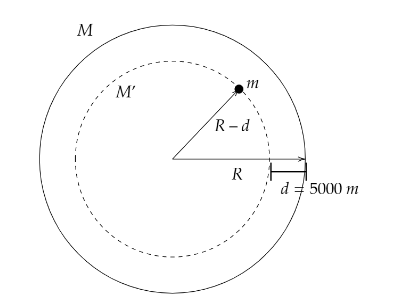
We know that the formula of acceleration due to gravity at the surface of Earth stands as,
$g = \dfrac{{GM}}{{{R^2}}} - - - - \left( 1 \right)$
Where $G = $ Universal Gravitational Constant, $M = $ Mass of the Earth and $R = $ radius of the Earth
If we take the body at a depth $d$ from the surface of the Earth, the mass that it encompasses will be $M'$. Let us consider Earth as spherical.
With mass $M$ the volume that it encloses is $\dfrac{4}{3}\pi {R^3} - - - - \left( 2 \right)$
With mass $M'$ the volume that it encloses is $\dfrac{4}{3}\pi {(R - d)^3} - - - - \left( 3 \right)$
Dividing $\left( 2 \right)$ by $\left( 3 \right)$ we get,
$\dfrac{M}{{M'}} = \dfrac{{\dfrac{4}{3}\pi {R^3}}}{{\dfrac{4}{3}\pi {{(R - d)}^3}}} \\
\Rightarrow \dfrac{M}{{M'}}= \dfrac{{{R^3}}}{{{{\left( {R - d} \right)}^3}}}$
Hence, we find the relation,
$M' = \dfrac{{{{\left( {R - d} \right)}^3}}}{{{R^3}}} \times M$
By using relation $\left( 1 \right)$ we get the acceleration due to gravity at depth $d$ as,
$g' = \dfrac{{GM'}}{{{{(R - d)}^2}}} \\
\Rightarrow g' = \dfrac{G}{{{{(R - d)}^2}}} \times \dfrac{{{{\left( {R - d} \right)}^3}}}{{{R^3}}} \times M \\
\Rightarrow g' = \dfrac{{GM}}{{{R^3}}} \times \left( {R - d} \right)$
Simplifying the equation we get,
$g' = \dfrac{{GM}}{{{R^2}}} \times \left( {1 - \dfrac{d}{R}} \right)$
Substituting the value of $g$ from equation $\left( 1 \right)$ we get,
$g' = g\left( {1 - \dfrac{d}{R}} \right)$
Now, by substituting the values given in the question, we find the weight at a depth $5000{\text{ }}m$,
$mg' = mg\left( {1 - \dfrac{d}{R}} \right) = 600 \times 9.8 \times \left( {1 - \dfrac{{5000}}{{6400000}}} \right) \approx 5875.40{\text{ }}N$
The initial weight at the surface of the Earth is,
$mg = 600 \times 9.8 = 5880{\text{ }}N$
The decreased weight,
$\therefore mg - mg' = 5880 - 5875.40 = 4.6{\text{ }}N$
Hence, the weight decreases by $4.6{\text{ }}N$ when we take the body to a mine of depth $5000{\text{ }}m$.
Note: It must be noted that we must consider the amount of mass of the earth whose radius would be the distance between the centre of the Earth and the position of the body in which it is placed. Weight of a body is the product of the acceleration due to gravity at that place to the mass of the body. Hence, the mass of a body never changes while the weight changes from place to place.
Complete step by step answer:
We know that the formula of acceleration due to gravity at the surface of Earth stands as,
$g = \dfrac{{GM}}{{{R^2}}} - - - - \left( 1 \right)$
Where $G = $ Universal Gravitational Constant, $M = $ Mass of the Earth and $R = $ radius of the Earth
If we take the body at a depth $d$ from the surface of the Earth, the mass that it encompasses will be $M'$. Let us consider Earth as spherical.
With mass $M$ the volume that it encloses is $\dfrac{4}{3}\pi {R^3} - - - - \left( 2 \right)$
With mass $M'$ the volume that it encloses is $\dfrac{4}{3}\pi {(R - d)^3} - - - - \left( 3 \right)$
Dividing $\left( 2 \right)$ by $\left( 3 \right)$ we get,
$\dfrac{M}{{M'}} = \dfrac{{\dfrac{4}{3}\pi {R^3}}}{{\dfrac{4}{3}\pi {{(R - d)}^3}}} \\
\Rightarrow \dfrac{M}{{M'}}= \dfrac{{{R^3}}}{{{{\left( {R - d} \right)}^3}}}$
Hence, we find the relation,
$M' = \dfrac{{{{\left( {R - d} \right)}^3}}}{{{R^3}}} \times M$
By using relation $\left( 1 \right)$ we get the acceleration due to gravity at depth $d$ as,
$g' = \dfrac{{GM'}}{{{{(R - d)}^2}}} \\
\Rightarrow g' = \dfrac{G}{{{{(R - d)}^2}}} \times \dfrac{{{{\left( {R - d} \right)}^3}}}{{{R^3}}} \times M \\
\Rightarrow g' = \dfrac{{GM}}{{{R^3}}} \times \left( {R - d} \right)$
Simplifying the equation we get,
$g' = \dfrac{{GM}}{{{R^2}}} \times \left( {1 - \dfrac{d}{R}} \right)$
Substituting the value of $g$ from equation $\left( 1 \right)$ we get,
$g' = g\left( {1 - \dfrac{d}{R}} \right)$
Now, by substituting the values given in the question, we find the weight at a depth $5000{\text{ }}m$,
$mg' = mg\left( {1 - \dfrac{d}{R}} \right) = 600 \times 9.8 \times \left( {1 - \dfrac{{5000}}{{6400000}}} \right) \approx 5875.40{\text{ }}N$
The initial weight at the surface of the Earth is,
$mg = 600 \times 9.8 = 5880{\text{ }}N$
The decreased weight,
$\therefore mg - mg' = 5880 - 5875.40 = 4.6{\text{ }}N$
Hence, the weight decreases by $4.6{\text{ }}N$ when we take the body to a mine of depth $5000{\text{ }}m$.
Note: It must be noted that we must consider the amount of mass of the earth whose radius would be the distance between the centre of the Earth and the position of the body in which it is placed. Weight of a body is the product of the acceleration due to gravity at that place to the mass of the body. Hence, the mass of a body never changes while the weight changes from place to place.
Recently Updated Pages
Master Class 11 Computer Science: Engaging Questions & Answers for Success

Master Class 11 Business Studies: Engaging Questions & Answers for Success
Master Class 11 Economics: Engaging Questions & Answers for Success
Master Class 11 English: Engaging Questions & Answers for Success
Master Class 11 Maths: Engaging Questions & Answers for Success
Master Class 11 Biology: Engaging Questions & Answers for Success
Trending doubts
One Metric ton is equal to kg A 10000 B 1000 C 100 class 11 physics CBSE
There are 720 permutations of the digits 1 2 3 4 5 class 11 maths CBSE
Discuss the various forms of bacteria class 11 biology CBSE
Draw a diagram of a plant cell and label at least eight class 11 biology CBSE
State the laws of reflection of light
Explain zero factorial class 11 maths CBSE