




What is decomposition? Explain decomposition cycle in a terrestrial ecosystem. Draw its diagrammatic representation.
Answer
 Verified
661.2k+ views
Hint: Decomposition is a natural process. The cycle of decomposition solely depends on the various natural elements and factors of the ecosystem.
Complete answer:
Decomposition is a natural process by which dead/decaying organic substances are broken down into simpler organic or inorganic matter such as carbon dioxide, water, simple sugars and mineral salts. It occurs with the help of physical, chemical and biological processes. Bodies of living organisms begin to decompose shortly after death. Decomposition occurring solely by biotic substances is called biodegradation which occurs typically with the help of microorganisms. Abiotic decomposition is the degradation of a substance by chemical or physical processes, e.g., hydrolysis.
The decomposition cycle in terrestrial environment
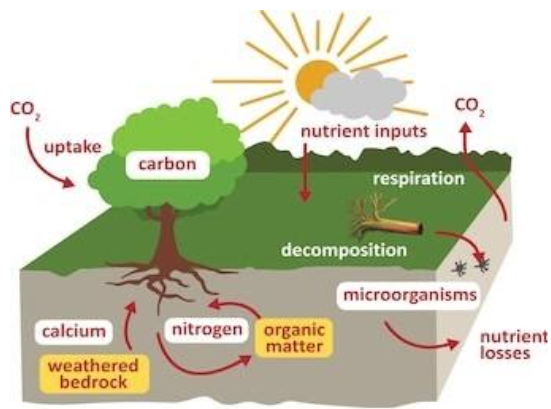
1) Decomposition is the process through which the complex and larger organic molecules are transformed to simple molecules by the activity of the microorganisms.
2) The producers are the autotrophic organisms which can produce the food with the help of light energy and chlorophyll pigments. The food is prepared and utilized by the consumers. The energy is passed on to the primary consumers, then to the secondary consumers and then finally to tertiary consumers.
3) After the death of plants and the consumers, the organic materials are broken down by the decomposers. The decomposers include the bacteria, fungi and other microbes. The nutrients in the body of the plants and the animals are recycled back to the soil.
4) This process of decomposition involves various cycles like nitrification, ammonification, decomposition of carbon compounds, etc.
Note:Decomposition is a key process in maintaining soil fertility because it provides growth of symbiotic bacteria for plants.Decomposers make vital nutrients available to an ecosystem's primary producers
Complete answer:
Decomposition is a natural process by which dead/decaying organic substances are broken down into simpler organic or inorganic matter such as carbon dioxide, water, simple sugars and mineral salts. It occurs with the help of physical, chemical and biological processes. Bodies of living organisms begin to decompose shortly after death. Decomposition occurring solely by biotic substances is called biodegradation which occurs typically with the help of microorganisms. Abiotic decomposition is the degradation of a substance by chemical or physical processes, e.g., hydrolysis.
The decomposition cycle in terrestrial environment
1) Decomposition is the process through which the complex and larger organic molecules are transformed to simple molecules by the activity of the microorganisms.
2) The producers are the autotrophic organisms which can produce the food with the help of light energy and chlorophyll pigments. The food is prepared and utilized by the consumers. The energy is passed on to the primary consumers, then to the secondary consumers and then finally to tertiary consumers.
3) After the death of plants and the consumers, the organic materials are broken down by the decomposers. The decomposers include the bacteria, fungi and other microbes. The nutrients in the body of the plants and the animals are recycled back to the soil.
4) This process of decomposition involves various cycles like nitrification, ammonification, decomposition of carbon compounds, etc.
Note:Decomposition is a key process in maintaining soil fertility because it provides growth of symbiotic bacteria for plants.Decomposers make vital nutrients available to an ecosystem's primary producers
Recently Updated Pages
Master Class 10 Computer Science: Engaging Questions & Answers for Success

Differentiate between voluntary action and reflex class 10 biology CBSE
The uses of bleaching powder are A It is used bleaching class 10 chemistry CBSE
Fill in the blanks with abstract nouns of the words class 10 english CBSE
How many threedigit numbers are there class 10 maths CBSE
What is a reflex arc class 10 biology CBSE
Trending doubts
Explain the Treaty of Vienna of 1815 class 10 social science CBSE
10 examples of evaporation in daily life with explanations
What is the full form of POSCO class 10 social science CBSE
Make a sketch of the human nerve cell What function class 10 biology CBSE
In which year voting age was reduced from 21 to 18?
The capital of British India was transferred from Calcutta class 10 social science CBSE