



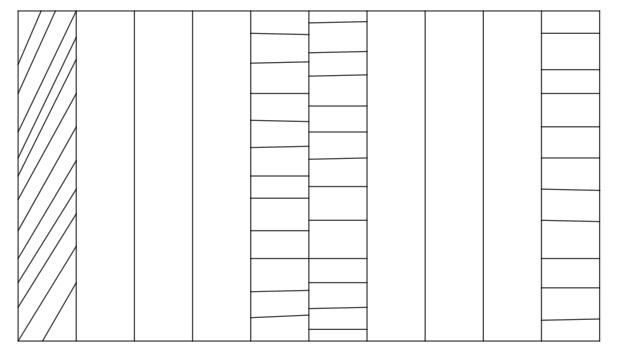
What is the decimal fraction shown by the shaded part of the figure given below?
(a) 2.5
(b) 0.5
(c) 0.6
(d) 0.4
Answer
 Verified
613.2k+ views
Hint: We will count the total number of partitions in the rectangle given in the figure. Then we will count the number of shaded regions among those partitions. We will form a fraction of the shaded parts out of the total parts by using the given information. Then we will convert this fraction into its decimal form to obtain the required answer.
Complete step by step answer:
From the figure, we can see that there are a total 10 partitions of the rectangle. The number of shaded regions among these partitions is 4. To form a fraction of the shaded parts out of the total parts of the rectangle we will put the number of shaded parts in the numerator and the number of total parts in the denominator. Now, we will write this in the form of a fraction, as follows,
$\text{decimal fraction shown by the shaded part = }\dfrac{\text{number of shaded partitions}}{\text{number of total partitions}}$
We will substitute the number of shaded partitions as 4 and the number of total partitions as 10. Substituting these values, we will get
$\text{decimal fraction shown by the shaded part = }\dfrac{\text{4}}{\text{10}}$
Now, we will convert this fraction into its decimal form. We get the following,
$\dfrac{4}{10}=0.4$
So, the correct answer is “Option D”.
Note: We should be able to put the correct data in the numerator and the denominator while forming fractions. It is essential that we are comfortable in converting fractions into their decimal forms and vice versa. The figures of the type given in the question seem easy to comprehend. But it is possible that the pattern used in shading may confuse us while counting the regions. Checking the answer for this type of question is always useful.
Complete step by step answer:
From the figure, we can see that there are a total 10 partitions of the rectangle. The number of shaded regions among these partitions is 4. To form a fraction of the shaded parts out of the total parts of the rectangle we will put the number of shaded parts in the numerator and the number of total parts in the denominator. Now, we will write this in the form of a fraction, as follows,
$\text{decimal fraction shown by the shaded part = }\dfrac{\text{number of shaded partitions}}{\text{number of total partitions}}$
We will substitute the number of shaded partitions as 4 and the number of total partitions as 10. Substituting these values, we will get
$\text{decimal fraction shown by the shaded part = }\dfrac{\text{4}}{\text{10}}$
Now, we will convert this fraction into its decimal form. We get the following,
$\dfrac{4}{10}=0.4$
So, the correct answer is “Option D”.
Note: We should be able to put the correct data in the numerator and the denominator while forming fractions. It is essential that we are comfortable in converting fractions into their decimal forms and vice versa. The figures of the type given in the question seem easy to comprehend. But it is possible that the pattern used in shading may confuse us while counting the regions. Checking the answer for this type of question is always useful.
Recently Updated Pages
Master Class 9 General Knowledge: Engaging Questions & Answers for Success

Master Class 9 Maths: Engaging Questions & Answers for Success
Master Class 9 Science: Engaging Questions & Answers for Success
Master Class 9 English: Engaging Questions & Answers for Success
Master Class 9 Social Science: Engaging Questions & Answers for Success
Class 9 Question and Answer - Your Ultimate Solutions Guide
Trending doubts
Find the sum of series 1 + 2 + 3 + 4 + 5 + + 100 class 9 maths CBSE
Difference Between Plant Cell and Animal Cell
Fill the blanks with the suitable prepositions 1 The class 9 english CBSE
What is pollution? How many types of pollution? Define it
Name 10 Living and Non living things class 9 biology CBSE
What is the full form of pH?