



\[D\] and \[E\] are points on the sides \[CA\] and \[CB\] respectively of a \[\Delta ABC\] right angled at \[C\]. Prove that \[A{E^2} + B{D^2} = A{B^2} + D{E^2}\].
Answer
 Verified
634.2k+ views
Hint: The given triangle is a right angle triangle, after joining the given points we will get three more right angle triangles.
So we can apply Pythagoras theorem for all the right angled triangles and we get four identities. Putting the values in the left hand side we can derive the right hand side.
Complete step-by-step answer:
It is given that a \[\Delta ABC\] is right angled at \[C\].
Also we have, \[D\] and \[E\] are points on the sides \[CA\] and \[CB\] respectively.
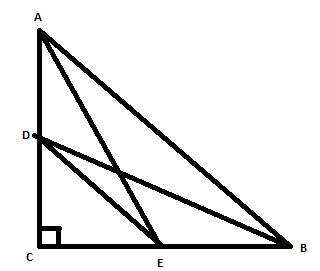
We need to prove that, \[A{E^2} + B{D^2} = A{B^2} + D{E^2}\].
Let us join the points \[D\] with \[E\] and \[B\] and the point \[E\] and \[A\].
Since \[\Delta ABC\] is a right angled triangle and \[\angle ACB = 90^\circ \] .
We can apply Pythagoras theorem for the right angled triangle ABC,
We get,
\[A{B^2} = A{C^2} + B{C^2} \ldots \ldots \left( 1 \right)\]
Since \[\Delta BCD\] is a right angled triangle and \[\angle DCB = 90^\circ \] .
We can apply Pythagoras theorem for the right angled triangle \[BCD\],
We get,
\[B{D^2} = D{C^2} + B{C^2} \ldots \ldots \left( 2 \right)\]
Since \[\Delta ACE\] is a right angled triangle and \[\angle ACE = 90^\circ \] .
We can apply Pythagoras theorem for the right angled triangle \[ACE\],
We get,
\[A{E^2} = A{C^2} + C{E^2} \ldots \ldots \left( 3 \right)\]
Since \[\Delta DCE\] is a right angled triangle and \[\angle DCE = 90^\circ \] .
We can apply Pythagoras theorem for the right angled triangle \[DCE\],
We get,
\[D{E^2} = D{C^2} + C{E^2} \ldots \ldots \left( 4 \right)\]
Putting the values from (3) and (2), we have,
L.H.S. =
\[ \Rightarrow A{E^2} + B{D^2}\]
Using the triangle diagram,
\[ \Rightarrow A{C^2} + C{E^2} + D{C^2} + B{C^2}\]
Rearranging the terms,
\[ \Rightarrow (A{C^2} + B{C^2}) + (C{E^2} + D{C^2})\]
Again using the triangle diagram,
\[ \Rightarrow A{B^2} + D{E^2}\]
= R.H.S.
Hence, \[A{E^2} + B{D^2} = A{B^2} + D{E^2}\].
Note: In this question we may go wrong on substituting sides of the triangle in to get the required result. So, be concentrated on that calculation when we use that method.
Pythagoras theorem states that,
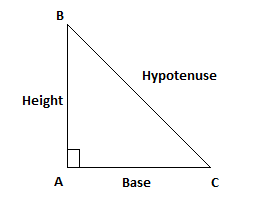
If ABC is a right angled triangle then,
\[{{\text{(Hypotenuse)}}^{\text{2}}}{\text{ = (Height}}{{\text{)}}^{\text{2}}}{\text{ + (Base}}{{\text{)}}^{\text{2}}}\]
\[A{C^2} = A{B^2} + B{C^2}\]
So we can apply Pythagoras theorem for all the right angled triangles and we get four identities. Putting the values in the left hand side we can derive the right hand side.
Complete step-by-step answer:
It is given that a \[\Delta ABC\] is right angled at \[C\].
Also we have, \[D\] and \[E\] are points on the sides \[CA\] and \[CB\] respectively.
We need to prove that, \[A{E^2} + B{D^2} = A{B^2} + D{E^2}\].
Let us join the points \[D\] with \[E\] and \[B\] and the point \[E\] and \[A\].
Since \[\Delta ABC\] is a right angled triangle and \[\angle ACB = 90^\circ \] .
We can apply Pythagoras theorem for the right angled triangle ABC,
We get,
\[A{B^2} = A{C^2} + B{C^2} \ldots \ldots \left( 1 \right)\]
Since \[\Delta BCD\] is a right angled triangle and \[\angle DCB = 90^\circ \] .
We can apply Pythagoras theorem for the right angled triangle \[BCD\],
We get,
\[B{D^2} = D{C^2} + B{C^2} \ldots \ldots \left( 2 \right)\]
Since \[\Delta ACE\] is a right angled triangle and \[\angle ACE = 90^\circ \] .
We can apply Pythagoras theorem for the right angled triangle \[ACE\],
We get,
\[A{E^2} = A{C^2} + C{E^2} \ldots \ldots \left( 3 \right)\]
Since \[\Delta DCE\] is a right angled triangle and \[\angle DCE = 90^\circ \] .
We can apply Pythagoras theorem for the right angled triangle \[DCE\],
We get,
\[D{E^2} = D{C^2} + C{E^2} \ldots \ldots \left( 4 \right)\]
Putting the values from (3) and (2), we have,
L.H.S. =
\[ \Rightarrow A{E^2} + B{D^2}\]
Using the triangle diagram,
\[ \Rightarrow A{C^2} + C{E^2} + D{C^2} + B{C^2}\]
Rearranging the terms,
\[ \Rightarrow (A{C^2} + B{C^2}) + (C{E^2} + D{C^2})\]
Again using the triangle diagram,
\[ \Rightarrow A{B^2} + D{E^2}\]
= R.H.S.
Hence, \[A{E^2} + B{D^2} = A{B^2} + D{E^2}\].
Note: In this question we may go wrong on substituting sides of the triangle in to get the required result. So, be concentrated on that calculation when we use that method.
Pythagoras theorem states that,
If ABC is a right angled triangle then,
\[{{\text{(Hypotenuse)}}^{\text{2}}}{\text{ = (Height}}{{\text{)}}^{\text{2}}}{\text{ + (Base}}{{\text{)}}^{\text{2}}}\]
\[A{C^2} = A{B^2} + B{C^2}\]

Recently Updated Pages
Master Class 12 Economics: Engaging Questions & Answers for Success

Master Class 12 Biology: Engaging Questions & Answers for Success
Master Class 11 English: Engaging Questions & Answers for Success
Master Class 11 Physics: Engaging Questions & Answers for Success
Master Class 11 Computer Science: Engaging Questions & Answers for Success
Master Class 11 Chemistry: Engaging Questions & Answers for Success
Trending doubts
Difference Between Plant Cell and Animal Cell
Fill the blanks with the suitable prepositions 1 The class 9 english CBSE
What is pollution? How many types of pollution? Define it
What is the full form of pH?
Name 10 Living and Non living things class 9 biology CBSE
How do you solve for x in the equation xy x + y class 9 maths CBSE