




D and E are points on sides $AB$ and $AC$ respectively of $\Delta ABC$ such that $ar\left( DBC \right)=ar\left( EBC \right)$ . Prove that $DE\parallel BC$ .
Answer
 Verified
608.7k+ views
Hint: We can solve this type of problem by making use of the properties of triangles. There is a property of triangles which states that if two triangles share the same base and have the same area then they must lie between two same parallel lines. This property can be used to prove that $DE\parallel BC$ .
Complete step by step answer:
A triangle is a 2D figure, that is it can be drawn on a plane. A triangle is a polygon which has three sides. Based on the correlation between the sides, triangles are classified into three groups, which are equilateral, isosceles and scalar.
We are given two points $D$ and $E$ on sides $AB$ and $AC$ of $\Delta ABC$. Also, the area of the two triangles is same i.e., $ar\left( DBC \right)=ar\left( EBC \right)$
We now join the two points D and C and on the other hand we join two points E and B by two line segments.
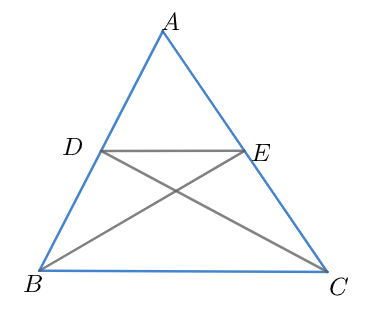
From the above picture we can see that the two triangles $\Delta DBC$ and $\Delta EBC$ share the same base $BC$ . From the properties of triangles, we already know that if two triangles share the same base and have the same area then they must lie between two same parallel lines. This gets us to the point that DE is parallel to BC i.e., $DE\parallel BC$ .
Thus, we have proved the required given.
Note: We can also solve this problem using simple intuition. We are given that the bases and areas of the two triangles are the same. This means that their heights corresponding to those bases must also be the same. This means that D and E are situated at the same height from the base BC, or$DE\parallel BC$ .
Complete step by step answer:
A triangle is a 2D figure, that is it can be drawn on a plane. A triangle is a polygon which has three sides. Based on the correlation between the sides, triangles are classified into three groups, which are equilateral, isosceles and scalar.
We are given two points $D$ and $E$ on sides $AB$ and $AC$ of $\Delta ABC$. Also, the area of the two triangles is same i.e., $ar\left( DBC \right)=ar\left( EBC \right)$
We now join the two points D and C and on the other hand we join two points E and B by two line segments.
From the above picture we can see that the two triangles $\Delta DBC$ and $\Delta EBC$ share the same base $BC$ . From the properties of triangles, we already know that if two triangles share the same base and have the same area then they must lie between two same parallel lines. This gets us to the point that DE is parallel to BC i.e., $DE\parallel BC$ .
Thus, we have proved the required given.
Note: We can also solve this problem using simple intuition. We are given that the bases and areas of the two triangles are the same. This means that their heights corresponding to those bases must also be the same. This means that D and E are situated at the same height from the base BC, or$DE\parallel BC$ .
Recently Updated Pages
Master Class 10 Computer Science: Engaging Questions & Answers for Success

Differentiate between voluntary action and reflex class 10 biology CBSE
The uses of bleaching powder are A It is used bleaching class 10 chemistry CBSE
Fill in the blanks with abstract nouns of the words class 10 english CBSE
How many threedigit numbers are there class 10 maths CBSE
What is a reflex arc class 10 biology CBSE
Trending doubts
Explain the Treaty of Vienna of 1815 class 10 social science CBSE
In basketball, how many quarters are played in an NBA game?
10 examples of evaporation in daily life with explanations
Which country is known as "The land of Fire and Ice"?
What is the full form of POSCO class 10 social science CBSE
In which year voting age was reduced from 21 to 18?