




What is cumene? How will you convert it to phenol?
Answer
 Verified
565.5k+ views
Hint: We know that isopropyl benzene is known as cumene. Cumene is its common name. Most of the worldwide phenol and acetone are produced by the cumene process which is also known as Hock. This is the economical reaction that converts two very cheap starting materials into the most valuable product phenol, acetone.
Complete Step By Step Answer:
To solve this problem first, we will collect information about cumene. Cumene is the common name of the organic compound isopropyl benzene.
Now we will discuss that how isopropylbenzene/cumene is prepared in the lab-
Cumene preparation-
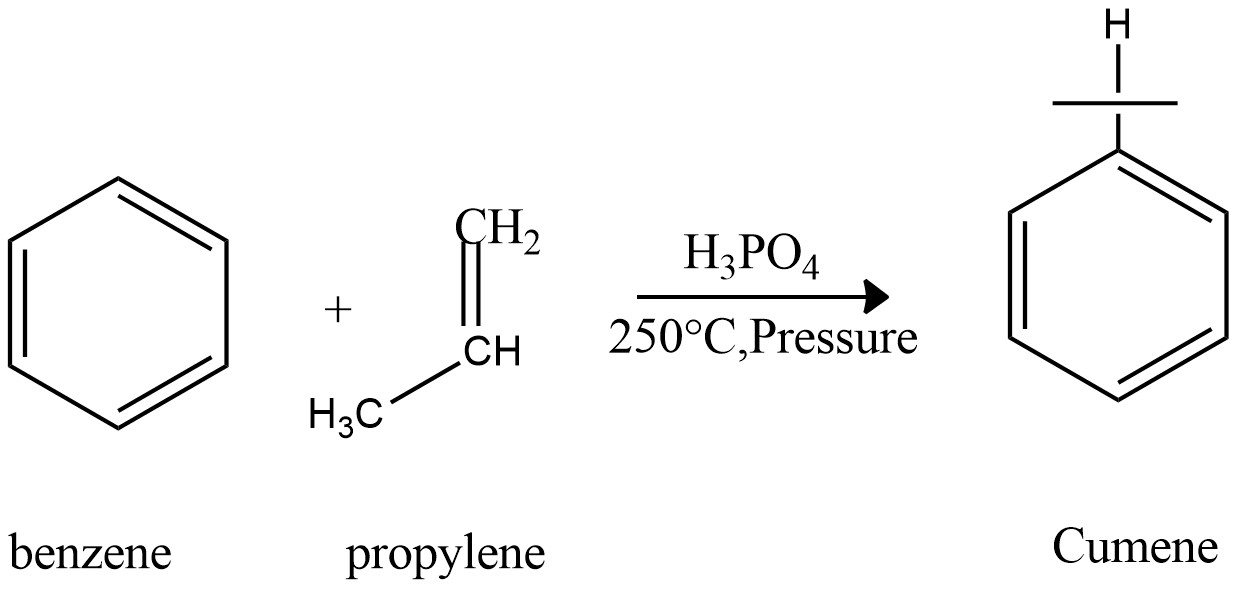
For the preparation of cumene, we take starting material benzene and propylene, and the reaction proceeds via Friedel crafts alkylation reaction in the presence of Lewis acid. Phosphoric acid is used as catalytic Lewis acid. This reaction takes place at high pressure and high temperature
Now we will see that how phenol and by-product acetone is prepared from cumene
Step 1:
Cumene is oxidized in air to form cumene radical.
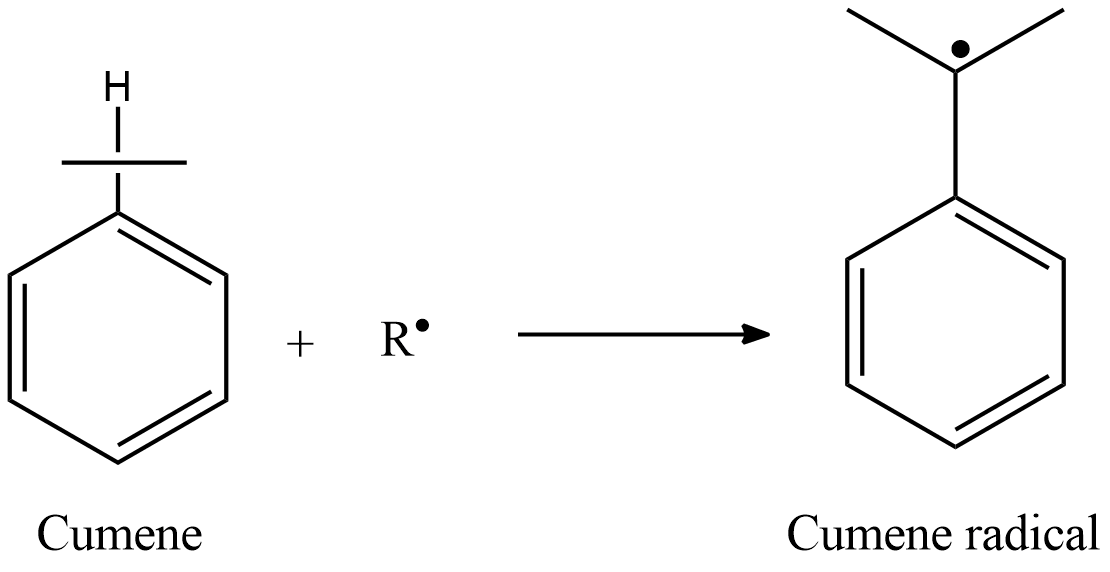
Here R represents the alkyl radical. Now we will see step 2, where this cumene radical reacts with $ {O_2} $ .
Step 2:
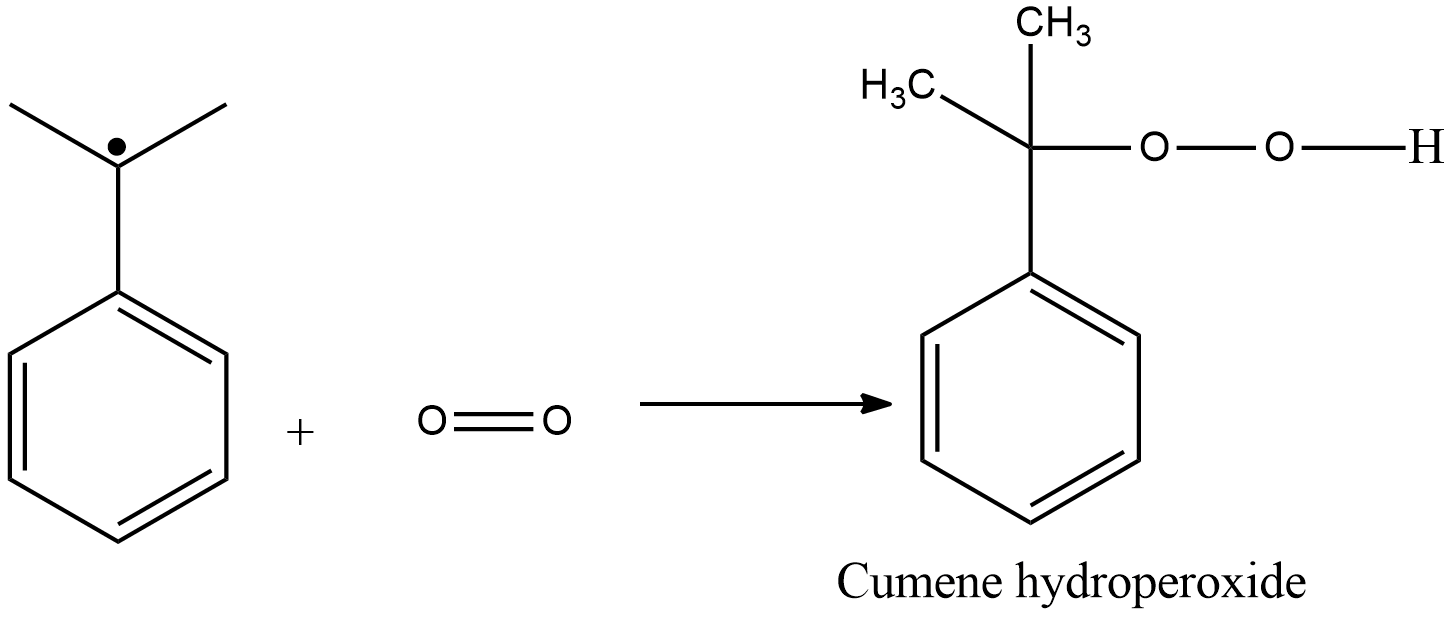
Reaction with $ {O_2} $ cumene radical produces cumene hydroperoxide. In the next step, cumene hydroperoxide converts into phenol on treatment with dilute acid. Acetone is produced as a by-product.
Step 3:
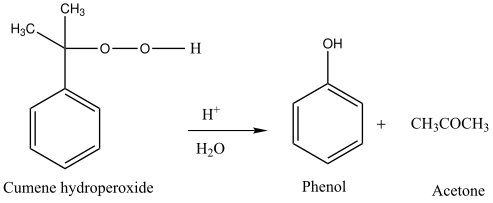
This is how cumene converts into phenol. Acetone is a by-product in this reaction but is obtained in a high amount.
Note:
In Friedel craft alkylation reaction of benzene and propylene phosphoric acid is used as catalytic lewis acid instead of aluminum halides. This process is very economical to produce phenol if there is enough demand for acetone which is formed in this reaction as a by-product in large amounts.
Complete Step By Step Answer:
To solve this problem first, we will collect information about cumene. Cumene is the common name of the organic compound isopropyl benzene.
Now we will discuss that how isopropylbenzene/cumene is prepared in the lab-
Cumene preparation-
For the preparation of cumene, we take starting material benzene and propylene, and the reaction proceeds via Friedel crafts alkylation reaction in the presence of Lewis acid. Phosphoric acid is used as catalytic Lewis acid. This reaction takes place at high pressure and high temperature
Now we will see that how phenol and by-product acetone is prepared from cumene
Step 1:
Cumene is oxidized in air to form cumene radical.
Here R represents the alkyl radical. Now we will see step 2, where this cumene radical reacts with $ {O_2} $ .
Step 2:
Reaction with $ {O_2} $ cumene radical produces cumene hydroperoxide. In the next step, cumene hydroperoxide converts into phenol on treatment with dilute acid. Acetone is produced as a by-product.
Step 3:
This is how cumene converts into phenol. Acetone is a by-product in this reaction but is obtained in a high amount.
Note:
In Friedel craft alkylation reaction of benzene and propylene phosphoric acid is used as catalytic lewis acid instead of aluminum halides. This process is very economical to produce phenol if there is enough demand for acetone which is formed in this reaction as a by-product in large amounts.
Recently Updated Pages
If x a + bt + ct2 where x is in meters and t is in class 11 physics CBSE

A car covers the first half distance between two places class 11 physics CBSE
The resultant of two vectors overrightarrow P and overrightarrow class 11 physics CBSE
Find the value of cos 135 class 11 maths CBSE
A mass M is held in place by an applied force F and class 11 physics CBSE
A solution of glucose in water is labelled as 10 dfracwv class 11 chemistry CBSE
Trending doubts
One Metric ton is equal to kg A 10000 B 1000 C 100 class 11 physics CBSE
Find the value of the expression given below sin 30circ class 11 maths CBSE
What do you mean by retardation What is its SI uni class 11 physics CBSE
Draw a diagram of nephron and explain its structur class 11 biology CBSE
10 examples of friction in our daily life
Difference between physical and chemical change class 11 chemistry CBSE