




Cuboidal epithelium is found in:
(a) Kidney tubule
(b) Trachea
(c) Oesophagus
(d) All of the above
Answer
 Verified
579.9k+ views
Hint: Epithelial tissues comprise compactly packed cells with a little intercellular matrix. These cells have a free surface that faces either a body fluid or the outside environment and thus provides a covering or lining for some part of the body.
Complete solution:
Epithelial tissues are of two types: Simple and Compound Epithelium
Simple epithelium is divided into three types based on structural modification of cells namely, Squamous epithelium, Cuboidal epithelium, and Columnar epithelium.
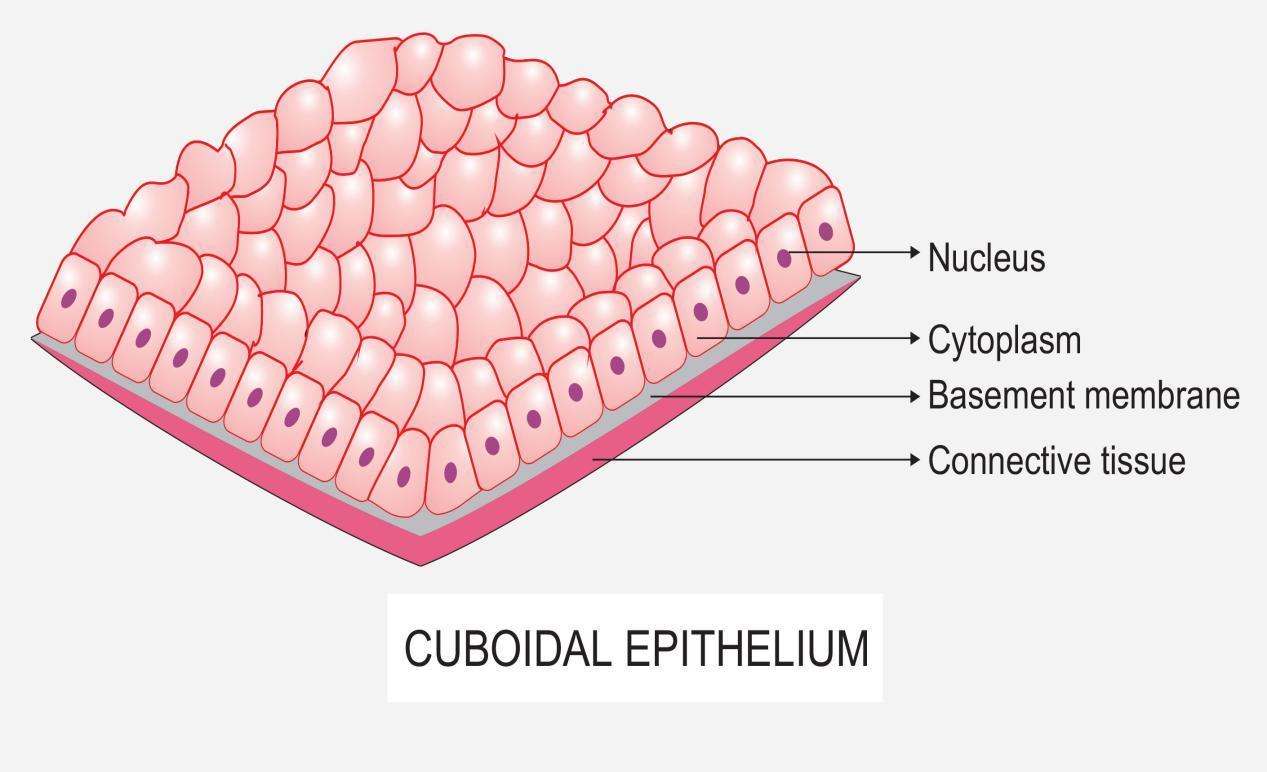
Cuboidal epithelium is composed of a single layer of cube-like cells. This is commonly found in the ducts of glands and tubular parts of nephrons in kidneys.
Its main functions include secretion and absorption. The epithelium of the proximal convoluted tubule (PCT) of the nephron in the kidney has microvilli.
Squamous epithelial tissue is made up of a single thin layer of flattened cells with irregular boundaries. They are found in the walls of blood vessels and air sacs of the lungs.
The columnar epithelium is composed of a single layer of tall and slender cells. Their nuclei are located at the base. The free surface may have microvilli. They are found in the lining of the stomach and intestine and help in secretion and absorption.
A stratified epithelial tissue consists of several stacked layers of cells.
So, the correct answer is ‘Kidney tubule’.
Note:
-The trachea is lined by pseudostratified columnar epithelial cells. These cells are ciliated as their free surface bear cilia.
-The pseudostratified columnar epithelium is a type of epithelium consisting of a single layer of cells that gives the appearance of being multiple layers because the nuclei of the cells are present at different levels.
-Oesophagus is lined by a tough stratified squamous epithelium without keratin.
Complete solution:
Epithelial tissues are of two types: Simple and Compound Epithelium
Simple epithelium is divided into three types based on structural modification of cells namely, Squamous epithelium, Cuboidal epithelium, and Columnar epithelium.
Cuboidal epithelium is composed of a single layer of cube-like cells. This is commonly found in the ducts of glands and tubular parts of nephrons in kidneys.
Its main functions include secretion and absorption. The epithelium of the proximal convoluted tubule (PCT) of the nephron in the kidney has microvilli.
Squamous epithelial tissue is made up of a single thin layer of flattened cells with irregular boundaries. They are found in the walls of blood vessels and air sacs of the lungs.
The columnar epithelium is composed of a single layer of tall and slender cells. Their nuclei are located at the base. The free surface may have microvilli. They are found in the lining of the stomach and intestine and help in secretion and absorption.
A stratified epithelial tissue consists of several stacked layers of cells.
So, the correct answer is ‘Kidney tubule’.
Note:
-The trachea is lined by pseudostratified columnar epithelial cells. These cells are ciliated as their free surface bear cilia.
-The pseudostratified columnar epithelium is a type of epithelium consisting of a single layer of cells that gives the appearance of being multiple layers because the nuclei of the cells are present at different levels.
-Oesophagus is lined by a tough stratified squamous epithelium without keratin.
Recently Updated Pages
Master Class 11 English: Engaging Questions & Answers for Success

Master Class 11 Social Science: Engaging Questions & Answers for Success
Master Class 11 Maths: Engaging Questions & Answers for Success
Master Class 11 Biology: Engaging Questions & Answers for Success
Master Class 11 Physics: Engaging Questions & Answers for Success
Master Class 11 Chemistry: Engaging Questions & Answers for Success
Trending doubts
One Metric ton is equal to kg A 10000 B 1000 C 100 class 11 physics CBSE
Difference Between Prokaryotic Cells and Eukaryotic Cells
Find the value of the expression given below sin 30circ class 11 maths CBSE
Two of the body parts which do not appear in MRI are class 11 biology CBSE
Draw a diagram of a plant cell and label at least eight class 11 biology CBSE
10 examples of friction in our daily life