




How many cubic metres of earth must be dug out to sink a well 21m deep and 6m diameter?
Answer
 Verified
562.5k+ views
Hint: We are given the depth and the diameter of a well and we are asked to find the cubic meters of earth required to sink the well with the given measurements. If we understand the question well, we can make this out that the cubic meters of earth that will sink the well is actually the volume of the well itself. And we know that the well is in the shape of a cylinder. We know that the volume of a cylinder is given by the formula, \[\pi {{r}^{2}}h\]. Here, ‘r’ is the radius of the well and ‘h’ is the height or depth of the well. Hence, we will have the required value.
Complete step by step answer:
According to the given question, we are given that a well which is 21m deep and is 6m in diameter is to be sunk. And so we are asked to find the cubic metres of earth that will sink the well with the given measurements.
Firstly, we will write what all is given in the question,
The depth or the height of the well is 21m
Diameter of the well is 6m
So, the radius is,
\[\Rightarrow \dfrac{6}{2}=3m\]
If we carefully read the question, we make this out that the volume of the earth to be dug out in order to sink the well is equal to the volume of the well itself. So, now we will have to find the volume of the well.
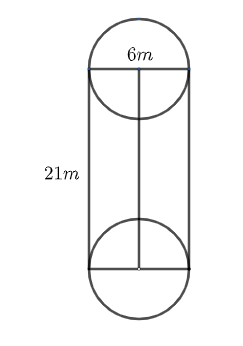
We know that the well is in the shape of a cylinder and so the volume of the cylinder can be found using the formula,
\[\text{Volume of cylinder}=\pi {{r}^{2}}h\]
We will substitute the values in the above formula and we get,
\[\Rightarrow \dfrac{22}{7}\times 3\times 3\times 21\]
\[\Rightarrow 22\times 9\times 3\]
\[\Rightarrow 22\times 27\]
We get the volume as,
\[\Rightarrow 594{{m}^{3}}\]
Therefore, the volume of the earth to be dug out to sink the well is \[594{{m}^{3}}\].
Note: The question should be read twice or thrice until the question is very much familiar and clear as well. The earth and the well under consideration are not two separate entities, it is rather the earth which when dug out will give us the well with the given measurements. Also, the value of the diameter should not be put directly for the radius, the value needs to be halved in order to become a radius.
Complete step by step answer:
According to the given question, we are given that a well which is 21m deep and is 6m in diameter is to be sunk. And so we are asked to find the cubic metres of earth that will sink the well with the given measurements.
Firstly, we will write what all is given in the question,
The depth or the height of the well is 21m
Diameter of the well is 6m
So, the radius is,
\[\Rightarrow \dfrac{6}{2}=3m\]
If we carefully read the question, we make this out that the volume of the earth to be dug out in order to sink the well is equal to the volume of the well itself. So, now we will have to find the volume of the well.
We know that the well is in the shape of a cylinder and so the volume of the cylinder can be found using the formula,
\[\text{Volume of cylinder}=\pi {{r}^{2}}h\]
We will substitute the values in the above formula and we get,
\[\Rightarrow \dfrac{22}{7}\times 3\times 3\times 21\]
\[\Rightarrow 22\times 9\times 3\]
\[\Rightarrow 22\times 27\]
We get the volume as,
\[\Rightarrow 594{{m}^{3}}\]
Therefore, the volume of the earth to be dug out to sink the well is \[594{{m}^{3}}\].
Note: The question should be read twice or thrice until the question is very much familiar and clear as well. The earth and the well under consideration are not two separate entities, it is rather the earth which when dug out will give us the well with the given measurements. Also, the value of the diameter should not be put directly for the radius, the value needs to be halved in order to become a radius.
Recently Updated Pages
Master Class 11 English: Engaging Questions & Answers for Success

Master Class 11 Social Science: Engaging Questions & Answers for Success
Master Class 11 Maths: Engaging Questions & Answers for Success
Master Class 11 Biology: Engaging Questions & Answers for Success
Master Class 11 Physics: Engaging Questions & Answers for Success
Master Class 11 Chemistry: Engaging Questions & Answers for Success