




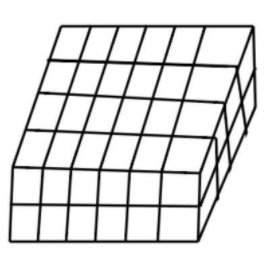
How many cubes are in this rectangular prism (cuboid)? And hence, calculate the volume of the cuboid.
(Volume of 1 cube = 1 cubic units)
Answer
 Verified
609k+ views
Hint – In this particular question the number of the cubes is the sum of the total cubes in layer one and in the layer two as it is clear from the figure that there are two layer present in the diagram so first count the number of cubes in the first layer so by symmetry the number of cubes in the second layer is also same so use these concepts to reach the solution of the question.
Complete step-by-step solution -
As we see from the above figure there are two layers present in the figure so the number of cubes in both of the layers are the same.
So the total number of cubes present in the above figure (i.e. in rectangular prism) = twice of the cubes present in the first layer of the rectangular prism.
So the total number of cubes present in the rectangular prism = 2 $ \times $ cubes present in the first layer of the rectangular prism............... (1)
Now as we see that in the first layer there are 4 rows and 6 columns so the cubes present in the first layer are the product of the number of rows and number of columns.
So the cubes present in the first layer = 4(6) = 24 cubes.
Now from equation (1) we have,
So the total number of cubes present in the rectangular prism = 2 $ \times $ 24 = 48 cubes.
Now it is given that the volume of the 1 cube = 1 cubic meter.
So the volume of the 48 cubes = 1(48) = 48 cubic meter.
So this is the required volume of the cuboid.
Hence option (C) is the correct answer.
Note – Whenever we face such types of questions the key concept we have to remember is that if the volume of the one cube is x cubic meter then the volume of the n cubes is the multiplication of the number of cubes (i.e. n) and the x cubic meter, so simply count the number of cubes in the given figure and then using that formula calculate the volume of the cuboid.
Complete step-by-step solution -
As we see from the above figure there are two layers present in the figure so the number of cubes in both of the layers are the same.
So the total number of cubes present in the above figure (i.e. in rectangular prism) = twice of the cubes present in the first layer of the rectangular prism.
So the total number of cubes present in the rectangular prism = 2 $ \times $ cubes present in the first layer of the rectangular prism............... (1)
Now as we see that in the first layer there are 4 rows and 6 columns so the cubes present in the first layer are the product of the number of rows and number of columns.
So the cubes present in the first layer = 4(6) = 24 cubes.
Now from equation (1) we have,
So the total number of cubes present in the rectangular prism = 2 $ \times $ 24 = 48 cubes.
Now it is given that the volume of the 1 cube = 1 cubic meter.
So the volume of the 48 cubes = 1(48) = 48 cubic meter.
So this is the required volume of the cuboid.
Hence option (C) is the correct answer.
Note – Whenever we face such types of questions the key concept we have to remember is that if the volume of the one cube is x cubic meter then the volume of the n cubes is the multiplication of the number of cubes (i.e. n) and the x cubic meter, so simply count the number of cubes in the given figure and then using that formula calculate the volume of the cuboid.
Recently Updated Pages
Master Class 10 English: Engaging Questions & Answers for Success

Master Class 10 Social Science: Engaging Questions & Answers for Success
Master Class 10 Computer Science: Engaging Questions & Answers for Success
Class 10 Question and Answer - Your Ultimate Solutions Guide
Master Class 10 General Knowledge: Engaging Questions & Answers for Success
Master Class 10 Maths: Engaging Questions & Answers for Success
Trending doubts
A boat goes 24 km upstream and 28 km downstream in class 10 maths CBSE
State and explain Ohms law class 10 physics CBSE
Write a letter to the editor of a newspaper explaining class 10 english CBSE
Distinguish between soap and detergent class 10 chemistry CBSE
a Why did Mendel choose pea plants for his experiments class 10 biology CBSE
What is a "free hit" awarded for in limited-overs cricket?