




Cross-pollination is favoured by
(a) Self-sterility
(b) Dichogamy
(c) Herkogamy and heterostyly
(d) All of these
Answer
 Verified
609k+ views
Hint: Cross-pollination is when a plant of another type is pollinated by one plant. A common technique used by hermaphroditic angiosperms to minimize sexual interference is one characteristic. Self incompatibility is another trait.
Complete answer:
The genetic material of the two plants is mixed in cross-pollination and the resulting seeds from that pollination would have characteristics of both varieties and are a new variety.
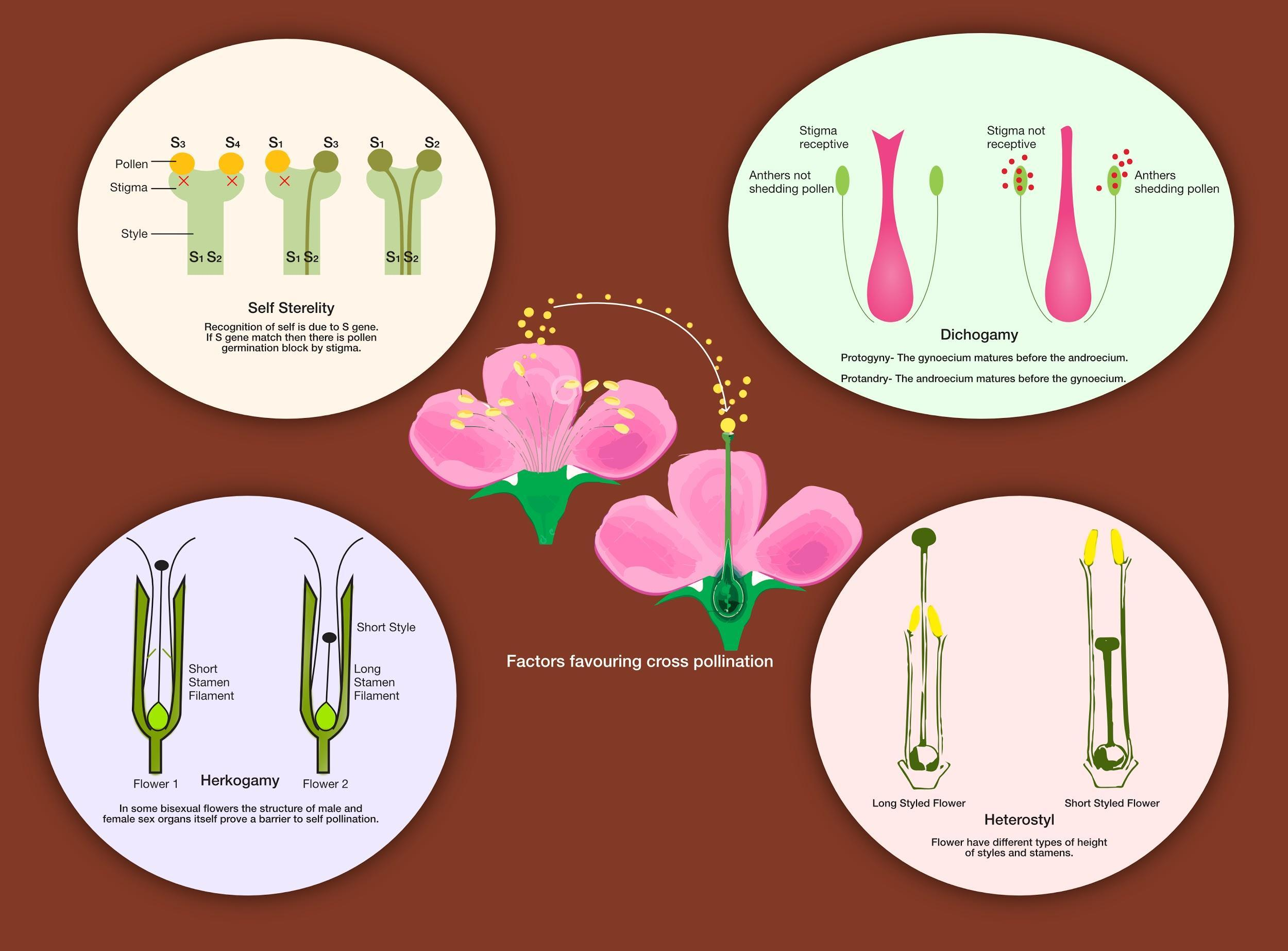
By cross-pollination, many numbers of species are pollinated. Unisexuality, dichogamy, self-sterility, mechanical and structural barrier, and heterostyle are the variables favoring cross-pollination.
- To avoid self-fertilization and improve family diversification, self-sterility in plants is enhanced.
- Dichogamy is the ripening of a flower's stamens and pistils at various times in order to avoid self-fertilization.
- Herkogamy is a common technique used by hermaphroditic angiosperms to minimize the role of male (anthers) and female (stigma) sexual interference.
- Heterostyly in flowers is a rare type of polymorphism and herkogamy. Two or three morphological forms of flowers in a heterostyle species occur in the population. All these avoid and favour cross-pollination from self-pollination.
So, the correct answer is, ‘(d) All of these’.
Note: Cross-pollination is the movement of pollen from one flower's anther to another flower's stigma to another of the same species' separate individuals.
Self-sterility or self-incompatibility is the phenomenon in which a plant is unable to conduct successful self-fertilization, i.e. by inhibiting pollen germination or the growth of pollen tubes on the pistil, prevents self-pollen from fertilizing the ovules. As fertilization does not occur, there is no creation of seeds.
Complete answer:
The genetic material of the two plants is mixed in cross-pollination and the resulting seeds from that pollination would have characteristics of both varieties and are a new variety.
By cross-pollination, many numbers of species are pollinated. Unisexuality, dichogamy, self-sterility, mechanical and structural barrier, and heterostyle are the variables favoring cross-pollination.
- To avoid self-fertilization and improve family diversification, self-sterility in plants is enhanced.
- Dichogamy is the ripening of a flower's stamens and pistils at various times in order to avoid self-fertilization.
- Herkogamy is a common technique used by hermaphroditic angiosperms to minimize the role of male (anthers) and female (stigma) sexual interference.
- Heterostyly in flowers is a rare type of polymorphism and herkogamy. Two or three morphological forms of flowers in a heterostyle species occur in the population. All these avoid and favour cross-pollination from self-pollination.
So, the correct answer is, ‘(d) All of these’.
Note: Cross-pollination is the movement of pollen from one flower's anther to another flower's stigma to another of the same species' separate individuals.
Self-sterility or self-incompatibility is the phenomenon in which a plant is unable to conduct successful self-fertilization, i.e. by inhibiting pollen germination or the growth of pollen tubes on the pistil, prevents self-pollen from fertilizing the ovules. As fertilization does not occur, there is no creation of seeds.
Recently Updated Pages
Master Class 12 Business Studies: Engaging Questions & Answers for Success

Master Class 12 Chemistry: Engaging Questions & Answers for Success
Master Class 12 Biology: Engaging Questions & Answers for Success
Class 12 Question and Answer - Your Ultimate Solutions Guide
Master Class 11 English: Engaging Questions & Answers for Success
Master Class 11 Social Science: Engaging Questions & Answers for Success
Trending doubts
Which are the Top 10 Largest Countries of the World?
Draw a labelled sketch of the human eye class 12 physics CBSE
The end of compass needle which points towards north class 12 physics CBSE
Differentiate between homogeneous and heterogeneous class 12 chemistry CBSE
Why is the cell called the structural and functional class 12 biology CBSE
When was the first election held in India a 194748 class 12 sst CBSE