




Crossing over takes place attiring stage/phase
A. S-phase
B. Zygotene stage
C. Pachytene stage
D. G2-phase
Answer
 Verified
590.4k+ views
Hint: Prophase 1 is the first stage of meiosis. It comprises five different steps, namely, Leptotene, Zygotene, Pachytene, Diplotene, and Diakinesis. The interphase has a G1 phase for cell growth, followed by the S phase for DNA synthesis, followed by a G2 phase for cell growth.
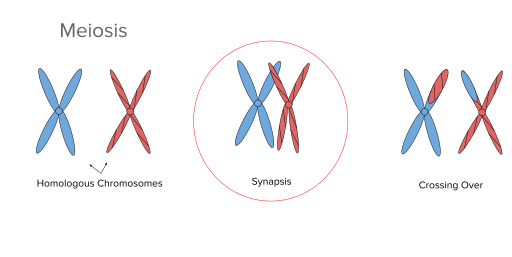
Complete step by step answer:Crossing over takes place during the stage pachytene of prophase I part of meiosis II. Chiasmata formation takes place during this phase, between the non-sister chromatids of homologous chromosomes. S-phase, also known as the synthetic phase, is the phase of DNA synthesis or DNA replication. During S-phase, the amount of DNA per cell becomes double. The second stage is Zygotene of prophase I. During zygotene, the chromosome starts to pair together, and this process of pairing is called synapsis. Such a chromosome is known as homologous chromosomes. Synapsis is coupled with the formation of a complex structure known as the synaptonemal complex. The number of chromosomes remains constant in the G2 phase.
Crossing over or Chromosomal crossover is the process of exchange of genetic material in sexual reproduction between the non-sister chromatids of two homologous chromosomes. This results in recombinant chromosomes. This is the final phase of genetic recombination. It occurs in the pachytene stage of prophase I, during synapsis. The crossover generally occurs when the matching regions on matching chromosomes break and then reconnect to another chromosome.
So, the correct answer is option C.
Additional Information:
In theory, crossing over was first described by Thomas Hunt Morgan. The term chiasma is linked to chromosomal crossover. Morgan implied the importance of cytological interpretation of chiasmata to the results of his experimental research on the heredity of Drosophila. The physical demonstration of crossing over was first given in 1931 by Harriet Creighton and Barbara McClintock.
Note:The crossing-over value is the linked frequency of the extent crossing over between two gene loci or markers. Recombination in a particular region of a linkage structure (chromosome) tends to be constant for a fixed set of genetic and environmental conditions. Similarly, it is also constant for the crossing-over value used in the production of genetic maps.
Complete step by step answer:Crossing over takes place during the stage pachytene of prophase I part of meiosis II. Chiasmata formation takes place during this phase, between the non-sister chromatids of homologous chromosomes. S-phase, also known as the synthetic phase, is the phase of DNA synthesis or DNA replication. During S-phase, the amount of DNA per cell becomes double. The second stage is Zygotene of prophase I. During zygotene, the chromosome starts to pair together, and this process of pairing is called synapsis. Such a chromosome is known as homologous chromosomes. Synapsis is coupled with the formation of a complex structure known as the synaptonemal complex. The number of chromosomes remains constant in the G2 phase.
Crossing over or Chromosomal crossover is the process of exchange of genetic material in sexual reproduction between the non-sister chromatids of two homologous chromosomes. This results in recombinant chromosomes. This is the final phase of genetic recombination. It occurs in the pachytene stage of prophase I, during synapsis. The crossover generally occurs when the matching regions on matching chromosomes break and then reconnect to another chromosome.
So, the correct answer is option C.
Additional Information:
In theory, crossing over was first described by Thomas Hunt Morgan. The term chiasma is linked to chromosomal crossover. Morgan implied the importance of cytological interpretation of chiasmata to the results of his experimental research on the heredity of Drosophila. The physical demonstration of crossing over was first given in 1931 by Harriet Creighton and Barbara McClintock.
Note:The crossing-over value is the linked frequency of the extent crossing over between two gene loci or markers. Recombination in a particular region of a linkage structure (chromosome) tends to be constant for a fixed set of genetic and environmental conditions. Similarly, it is also constant for the crossing-over value used in the production of genetic maps.
Recently Updated Pages
Master Class 11 Social Science: Engaging Questions & Answers for Success

Master Class 11 Physics: Engaging Questions & Answers for Success
Master Class 11 Maths: Engaging Questions & Answers for Success
Master Class 11 Economics: Engaging Questions & Answers for Success
Master Class 11 Computer Science: Engaging Questions & Answers for Success
Master Class 11 Chemistry: Engaging Questions & Answers for Success
Trending doubts
One Metric ton is equal to kg A 10000 B 1000 C 100 class 11 physics CBSE
There are 720 permutations of the digits 1 2 3 4 5 class 11 maths CBSE
1 Quintal is equal to a 110 kg b 10 kg c 100kg d 1000 class 11 physics CBSE
State and prove Bernoullis theorem class 11 physics CBSE
Difference Between Prokaryotic Cells and Eukaryotic Cells
Discuss the various forms of bacteria class 11 biology CBSE