




Why is crossing over so important to a species?
Answer
 Verified
519.6k+ views
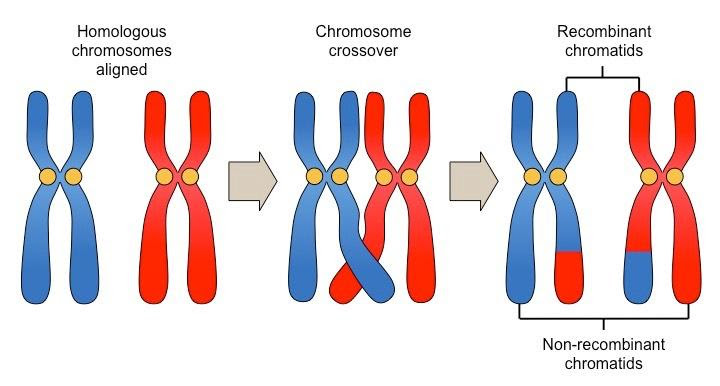
Hint: Crossing over is an event that occurs in the pachytene substage of meiosis-I division during the production of gametes in sexually reproducing organisms. It is defined as the exchange of genes in between homologous chromosomes that ultimately result in the expression of a mixture of traits in the offspring which differ from the parents. The importance of crossing over is related to mutation and genetic variation.
Complete answer:
The phenomenon of crossing over helps to introduce variations in the species. In crossing over, the parental traits combine between each other to produce a combination of traits which are expressed in the offspring. Each homologous chromosome in the pair comes from either parent which gets segregated into four gametes.
If crossing over had not occurred, then the two gametes would contain entirely paternal genes and the other two would contain only the maternal characters. This would ultimately result in a phenomenon known as homozygosity. Eventually the species would lead its genetic diversity, would become reproductively unfit and ultimately become extinct.
In fact, the variations that are introduced in the offspring along with the fact that we don’t look exactly the same like our mother or father and resemble a combination of them along with our certain new characters, is a result of crossing over.
The variations that are introduced in the offspring due to crossing over and mutations ultimately help in ‘natural selection’ of the organisms. The offspring that are born with helpful variations are selected by nature. They survive more successfully in the environment and are better adapted to it, reproduce more and hence maintain the race.
Thus, crossing over is a very important phenomenon that is responsible for our ‘uniqueness’ and from the evolutionary point of view also.
Note:
It should be noted that crossing over and another term, genetic recombination, go hand-in-hand. Genetic recombination is the process where exchange of genetic material occurs in between the chromosomes. The only major difference is that crossing over occurs only in between homologous chromosomes and genetic recombination can occur in between any two chromosomes. So, genetic recombination occurs during crossing over. But that does not necessarily mean that all genetic recombination occurs during crossing over.
Complete answer:
The phenomenon of crossing over helps to introduce variations in the species. In crossing over, the parental traits combine between each other to produce a combination of traits which are expressed in the offspring. Each homologous chromosome in the pair comes from either parent which gets segregated into four gametes.
If crossing over had not occurred, then the two gametes would contain entirely paternal genes and the other two would contain only the maternal characters. This would ultimately result in a phenomenon known as homozygosity. Eventually the species would lead its genetic diversity, would become reproductively unfit and ultimately become extinct.
In fact, the variations that are introduced in the offspring along with the fact that we don’t look exactly the same like our mother or father and resemble a combination of them along with our certain new characters, is a result of crossing over.
The variations that are introduced in the offspring due to crossing over and mutations ultimately help in ‘natural selection’ of the organisms. The offspring that are born with helpful variations are selected by nature. They survive more successfully in the environment and are better adapted to it, reproduce more and hence maintain the race.
Thus, crossing over is a very important phenomenon that is responsible for our ‘uniqueness’ and from the evolutionary point of view also.
Note:
It should be noted that crossing over and another term, genetic recombination, go hand-in-hand. Genetic recombination is the process where exchange of genetic material occurs in between the chromosomes. The only major difference is that crossing over occurs only in between homologous chromosomes and genetic recombination can occur in between any two chromosomes. So, genetic recombination occurs during crossing over. But that does not necessarily mean that all genetic recombination occurs during crossing over.
Recently Updated Pages
Master Class 12 Economics: Engaging Questions & Answers for Success

Master Class 12 English: Engaging Questions & Answers for Success
Master Class 12 Social Science: Engaging Questions & Answers for Success
Master Class 12 Maths: Engaging Questions & Answers for Success
Master Class 12 Physics: Engaging Questions & Answers for Success
Master Class 11 Social Science: Engaging Questions & Answers for Success
Trending doubts
One Metric ton is equal to kg A 10000 B 1000 C 100 class 11 physics CBSE
Difference Between Prokaryotic Cells and Eukaryotic Cells
Find the value of the expression given below sin 30circ class 11 maths CBSE
Two of the body parts which do not appear in MRI are class 11 biology CBSE
Draw a diagram of nephron and explain its structur class 11 biology CBSE
10 examples of friction in our daily life