




CP and Cd are conjugate diameters of the ellipse; \[\dfrac{{{x}^{2}}}{{{a}^{2}}}+\dfrac{{{y}^{2}}}{{{b}^{2}}}\]; prove that the locus of the orthocentre of the triangle CPD is the curve \[2{{\left( {{b}^{2}}{{y}^{2}}+{{a}^{2}}{{x}^{2}} \right)}^{3}}=\left( {{a}^{2}}-{{b}^{2}} \right)\left( {{b}^{2}}{{y}^{2}}-{{a}^{2}}{{x}^{2}} \right)\].
Answer
 Verified
603k+ views
Hint: Use concept of conjugate diameter i.e. difference between angle of two points on conjugate diameter is \[\pm \dfrac{\pi }{2}\]. Suppose parametric coordinates of P and D then proceed.
Complete step-by-step answer:
We have given ellipse; \[\dfrac{{{x}^{2}}}{{{a}^{2}}}+\dfrac{{{y}^{2}}}{{{b}^{2}}}=1-(1)\]
Here, we need to assume points of conjugate diameters.
Let \[\varphi \] be the eccentric angle of point P, then coordinates of P = \[\left( a\cos \varphi ,b\sin \varphi \right)\]
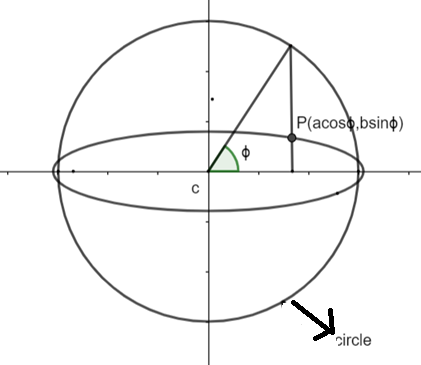
Eccentric Angle is the angle between the major axis and line joining to a circle at a point where perpendicular from any point to the major axis of ellipse is extended to circle as shown in diagram.
Since CP and CD are conjugate diameters. Hence, tangent at P is parallel to CD as per the definition of conjugate diameter.
Imp points: -
1. We need to know the relation between two conjugate diameters i.e. If \[\left( a\cos \theta ,b\sin \theta \right)\] be the coordinates of the extremity of a diameter, then \[\left( -a\sin \theta ,b\cos \theta \right)\] will be the coordinates of the extremity of its conjugate.
It means \[\theta -\varphi =\pm \dfrac{\pi }{2}\]
If \[\theta \] is an eccentric angle for eccentricity of a diameter and \[\varphi \] is eccentric angle of extremity of other diameter.
Hence, \[\vartriangle CPD\]can be represented as
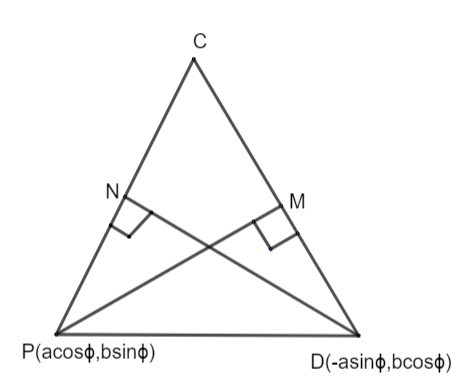
Since, C, P, D are on a circle and \[PM\bot CD\], where CD is parallel to the tangent at point P. Hence, PM is normal at point P.
Similarly, DN is normal to point D.
Hence, equation of both normals PM and DN respectively are: -
\[ax\sec \varphi -by\cos ec\varphi ={{a}^{2}}-{{b}^{2}}-(2)\]
2. (Standard formula for normal through \[a\sin \varphi ,b\cos \varphi \])
\[-ax\cos ec\varphi -by\sec \varphi ={{a}^{2}}-{{b}^{2}}-(3)\]
The locus of the orthocentre of \[\vartriangle CPD\]is obtained by eliminating \[\varphi \]between (2) and (3).
Apply cross multiplication in following manner: -
\[\dfrac{\sec \varphi }{\left( by-ax \right)\left( {{a}^{2}}-{{b}^{2}} \right)}=\dfrac{\cos ec\varphi }{\left( by+ax \right)\left( {{a}^{2}}-{{b}^{2}} \right)}=\dfrac{-1}{\left( {{b}^{2}}{{y}^{2}}+{{a}^{2}}{{x}^{2}} \right)}\]
From the above equation we can unite.
\[\begin{align}
& \sec \varphi =\dfrac{\left( by-ax \right)\left( {{a}^{2}}-{{b}^{2}} \right)}{-\left( {{b}^{2}}{{y}^{2}}+{{a}^{2}}{{x}^{2}} \right)} \\
& \cos ec\varphi =\dfrac{\left( by+ax \right)\left( {{a}^{2}}-{{b}^{2}} \right)}{-\left( {{b}^{2}}{{y}^{2}}+{{a}^{2}}{{x}^{2}} \right)} \\
\end{align}\]
As we know the relation \[{{\sin }^{2}}\varphi +{{\cos }^{2}}\varphi =1\]
\[\begin{align}
& 1=\dfrac{{{\left( {{b}^{2}}{{y}^{2}}+{{a}^{2}}{{x}^{2}} \right)}^{2}}}{{{\left( by-ax \right)}^{2}}{{\left( {{a}^{2}}-{{b}^{2}} \right)}^{2}}}+\dfrac{{{\left( {{b}^{2}}{{y}^{2}}+{{a}^{2}}{{x}^{2}} \right)}^{2}}}{{{\left( by+ax \right)}^{2}}{{\left( {{a}^{2}}-{{b}^{2}} \right)}^{2}}} \\
& \dfrac{{{\left( {{b}^{2}}{{y}^{2}}+{{a}^{2}}{{x}^{2}} \right)}^{2}}}{{{\left( by+ax \right)}^{2}}{{\left( {{a}^{2}}-{{b}^{2}} \right)}^{2}}}\left( \dfrac{1}{{{\left( by-ax \right)}^{2}}}+\dfrac{1}{{{\left( by+ax \right)}^{2}}} \right)=1 \\
& \dfrac{{{\left( {{b}^{2}}{{y}^{2}}+{{a}^{2}}{{x}^{2}} \right)}^{2}}}{{{\left( {{a}^{2}}-{{b}^{2}} \right)}^{2}}}\times \dfrac{{{\left( by-ax \right)}^{2}}+{{\left( by+ax \right)}^{2}}}{{{\left( {{b}^{2}}{{y}^{2}}-{{a}^{2}}{{x}^{2}} \right)}^{2}}}=1 \\
& 2{{\left( {{b}^{2}}{{y}^{2}}+{{a}^{2}}{{x}^{2}} \right)}^{3}}={{\left( {{a}^{2}}-{{b}^{2}} \right)}^{2}}{{\left( {{b}^{2}}{{y}^{2}}-{{a}^{2}}{{x}^{2}} \right)}^{2}} \\
\end{align}\]
Hence, proved.
Note: Calculation part is the most important point to take care of.
Need to remember the definition of the term auxiliary circle and how to unite polar with the help of poles. Direct formulas will take less time and are more flexible.
Complete step-by-step answer:
We have given ellipse; \[\dfrac{{{x}^{2}}}{{{a}^{2}}}+\dfrac{{{y}^{2}}}{{{b}^{2}}}=1-(1)\]
Here, we need to assume points of conjugate diameters.
Let \[\varphi \] be the eccentric angle of point P, then coordinates of P = \[\left( a\cos \varphi ,b\sin \varphi \right)\]
Eccentric Angle is the angle between the major axis and line joining to a circle at a point where perpendicular from any point to the major axis of ellipse is extended to circle as shown in diagram.
Since CP and CD are conjugate diameters. Hence, tangent at P is parallel to CD as per the definition of conjugate diameter.
Imp points: -
1. We need to know the relation between two conjugate diameters i.e. If \[\left( a\cos \theta ,b\sin \theta \right)\] be the coordinates of the extremity of a diameter, then \[\left( -a\sin \theta ,b\cos \theta \right)\] will be the coordinates of the extremity of its conjugate.
It means \[\theta -\varphi =\pm \dfrac{\pi }{2}\]
If \[\theta \] is an eccentric angle for eccentricity of a diameter and \[\varphi \] is eccentric angle of extremity of other diameter.
Hence, \[\vartriangle CPD\]can be represented as
Since, C, P, D are on a circle and \[PM\bot CD\], where CD is parallel to the tangent at point P. Hence, PM is normal at point P.
Similarly, DN is normal to point D.
Hence, equation of both normals PM and DN respectively are: -
\[ax\sec \varphi -by\cos ec\varphi ={{a}^{2}}-{{b}^{2}}-(2)\]
2. (Standard formula for normal through \[a\sin \varphi ,b\cos \varphi \])
\[-ax\cos ec\varphi -by\sec \varphi ={{a}^{2}}-{{b}^{2}}-(3)\]
The locus of the orthocentre of \[\vartriangle CPD\]is obtained by eliminating \[\varphi \]between (2) and (3).
Apply cross multiplication in following manner: -
\[\dfrac{\sec \varphi }{\left( by-ax \right)\left( {{a}^{2}}-{{b}^{2}} \right)}=\dfrac{\cos ec\varphi }{\left( by+ax \right)\left( {{a}^{2}}-{{b}^{2}} \right)}=\dfrac{-1}{\left( {{b}^{2}}{{y}^{2}}+{{a}^{2}}{{x}^{2}} \right)}\]
From the above equation we can unite.
\[\begin{align}
& \sec \varphi =\dfrac{\left( by-ax \right)\left( {{a}^{2}}-{{b}^{2}} \right)}{-\left( {{b}^{2}}{{y}^{2}}+{{a}^{2}}{{x}^{2}} \right)} \\
& \cos ec\varphi =\dfrac{\left( by+ax \right)\left( {{a}^{2}}-{{b}^{2}} \right)}{-\left( {{b}^{2}}{{y}^{2}}+{{a}^{2}}{{x}^{2}} \right)} \\
\end{align}\]
As we know the relation \[{{\sin }^{2}}\varphi +{{\cos }^{2}}\varphi =1\]
\[\begin{align}
& 1=\dfrac{{{\left( {{b}^{2}}{{y}^{2}}+{{a}^{2}}{{x}^{2}} \right)}^{2}}}{{{\left( by-ax \right)}^{2}}{{\left( {{a}^{2}}-{{b}^{2}} \right)}^{2}}}+\dfrac{{{\left( {{b}^{2}}{{y}^{2}}+{{a}^{2}}{{x}^{2}} \right)}^{2}}}{{{\left( by+ax \right)}^{2}}{{\left( {{a}^{2}}-{{b}^{2}} \right)}^{2}}} \\
& \dfrac{{{\left( {{b}^{2}}{{y}^{2}}+{{a}^{2}}{{x}^{2}} \right)}^{2}}}{{{\left( by+ax \right)}^{2}}{{\left( {{a}^{2}}-{{b}^{2}} \right)}^{2}}}\left( \dfrac{1}{{{\left( by-ax \right)}^{2}}}+\dfrac{1}{{{\left( by+ax \right)}^{2}}} \right)=1 \\
& \dfrac{{{\left( {{b}^{2}}{{y}^{2}}+{{a}^{2}}{{x}^{2}} \right)}^{2}}}{{{\left( {{a}^{2}}-{{b}^{2}} \right)}^{2}}}\times \dfrac{{{\left( by-ax \right)}^{2}}+{{\left( by+ax \right)}^{2}}}{{{\left( {{b}^{2}}{{y}^{2}}-{{a}^{2}}{{x}^{2}} \right)}^{2}}}=1 \\
& 2{{\left( {{b}^{2}}{{y}^{2}}+{{a}^{2}}{{x}^{2}} \right)}^{3}}={{\left( {{a}^{2}}-{{b}^{2}} \right)}^{2}}{{\left( {{b}^{2}}{{y}^{2}}-{{a}^{2}}{{x}^{2}} \right)}^{2}} \\
\end{align}\]
Hence, proved.
Note: Calculation part is the most important point to take care of.
Need to remember the definition of the term auxiliary circle and how to unite polar with the help of poles. Direct formulas will take less time and are more flexible.
Recently Updated Pages
Master Class 11 Social Science: Engaging Questions & Answers for Success

Master Class 11 Physics: Engaging Questions & Answers for Success
Master Class 11 Maths: Engaging Questions & Answers for Success
Master Class 11 Economics: Engaging Questions & Answers for Success
Master Class 11 Computer Science: Engaging Questions & Answers for Success
Master Class 11 Chemistry: Engaging Questions & Answers for Success
Trending doubts
One Metric ton is equal to kg A 10000 B 1000 C 100 class 11 physics CBSE
There are 720 permutations of the digits 1 2 3 4 5 class 11 maths CBSE
1 Quintal is equal to a 110 kg b 10 kg c 100kg d 1000 class 11 physics CBSE
State and prove Bernoullis theorem class 11 physics CBSE
Difference Between Prokaryotic Cells and Eukaryotic Cells
Which among the following are examples of coming together class 11 social science CBSE