




Count the tally marks.

\[\begin{align}
& \text{A}.\text{ 4} \\
& \text{B}.\text{ 5} \\
& \text{C}.\text{ 6} \\
& \text{D}.\text{ 3} \\
\end{align}\]
Answer
 Verified
611.7k+ views
Hint: In this question, we are given a tally mark and we have to count it. For doing this, we will first understand the meaning of tally marks and how to count them with the help of an example. After that, we will observe the diagram given and then count the tally marks to obtain our final answer.
Complete step-by-step solution:
Here, we have to count the tally marks for the given diagram:

For this, let us first understand the meaning of tally marks and learn how to count them.
When the observations in the given data are large, it may not be easy to find the frequencies by simply counting, so, we make the use of bass (|, \) called the tally marks. Two symbols, which are used in tally marks are |, \. Tallies are usually marked in bunches of five. '|' is used for 1, '||' is used for 2, '|||' is used for 3 and '||||' is used for 4. For the first four tallies, as we have seen they are marked by vertical lines. The fifth tally in a bunch is marked diagonally across the earlier 4.
Let us understand tally marks more clearly with the help of examples. We are given the result of tossed coins 20 times and we have to find the frequency for heads and tails. Data is given as:
H, T, T, H, T, T, T, H, T, H, H, H, T, H, H, T, H, T, T, T.
Let us draw tally marks for them.
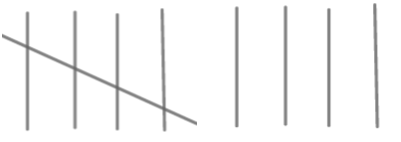
Heads:
Tails:
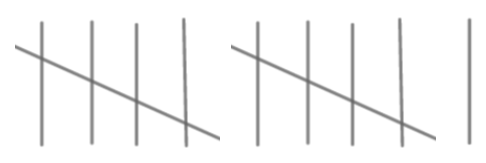
As we can see, for heads four lines are cut by a diagonal line which means 5 are for the first set. After that, there are four more vertical lines which means the total count is $5+4 = 9.$ Similarly, for two sets of fives for tails along with one extra vertical line, we get frequency as $5+5+1 = 11.$
Coming back to the question, we have to tell count for:
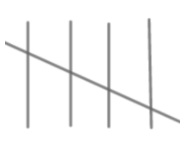
As we can see, there are four vertical lines representing count as four. But there is also a diagonal line cutting them and hence, it represents the fifth count. So, the total count for this tally mark becomes five.
Hence, option B is the correct answer.
Note: Students should note that we put diagonal across 4 bars to make our count of tally marks easier as four bars are easy to count but for more, counting bars can become difficult. Hence, we convert them into sets of five for easier counting. Students should make sure the diagonal is always made from the top left corner to the bottom right corner only.
Complete step-by-step solution:
Here, we have to count the tally marks for the given diagram:
For this, let us first understand the meaning of tally marks and learn how to count them.
When the observations in the given data are large, it may not be easy to find the frequencies by simply counting, so, we make the use of bass (|, \) called the tally marks. Two symbols, which are used in tally marks are |, \. Tallies are usually marked in bunches of five. '|' is used for 1, '||' is used for 2, '|||' is used for 3 and '||||' is used for 4. For the first four tallies, as we have seen they are marked by vertical lines. The fifth tally in a bunch is marked diagonally across the earlier 4.
Let us understand tally marks more clearly with the help of examples. We are given the result of tossed coins 20 times and we have to find the frequency for heads and tails. Data is given as:
H, T, T, H, T, T, T, H, T, H, H, H, T, H, H, T, H, T, T, T.
Let us draw tally marks for them.
Heads:
Tails:
As we can see, for heads four lines are cut by a diagonal line which means 5 are for the first set. After that, there are four more vertical lines which means the total count is $5+4 = 9.$ Similarly, for two sets of fives for tails along with one extra vertical line, we get frequency as $5+5+1 = 11.$
Coming back to the question, we have to tell count for:
As we can see, there are four vertical lines representing count as four. But there is also a diagonal line cutting them and hence, it represents the fifth count. So, the total count for this tally mark becomes five.
Hence, option B is the correct answer.
Note: Students should note that we put diagonal across 4 bars to make our count of tally marks easier as four bars are easy to count but for more, counting bars can become difficult. Hence, we convert them into sets of five for easier counting. Students should make sure the diagonal is always made from the top left corner to the bottom right corner only.
Recently Updated Pages
Master Class 12 Economics: Engaging Questions & Answers for Success

Master Class 12 English: Engaging Questions & Answers for Success
Master Class 12 Social Science: Engaging Questions & Answers for Success
Master Class 12 Maths: Engaging Questions & Answers for Success
Master Class 12 Physics: Engaging Questions & Answers for Success
Master Class 10 English: Engaging Questions & Answers for Success
Trending doubts
Explain the Treaty of Vienna of 1815 class 10 social science CBSE
Why is it 530 pm in india when it is 1200 afternoon class 10 social science CBSE
What is the full form of POSCO class 10 social science CBSE
Define Potential, Developed, Stock and Reserved resources
The speaker of the Lok Sabha is elected by the APresident class 10 social science CBSE
Complete the sentence with the most appropriate word class 10 english CBSE