



How do you count single covalent bonds?
Answer
 Verified
615.6k+ views
Hint:In chemistry, covalent bonds are the bonds that are formed by sharing of electrons. They are also known as molecular bonds. When sharing of electrons takes place, then an electrostatic force of attraction and repulsion between the atoms takes place that is known as chemical bonding.
Complete step-by-step answer: There are three types of covalent bonds-
1.Single covalent bond
2.Double covalent bond
3.Triple covalent bond
In this question, we will only discuss the single covalent bonds.
Single covalent bonds are defined as the bonds that are formed when one pair of electrons is shared between the two participating atoms. These bonds are weaker than the double and triple bond but these bonds are the most stable bond.
Let us take an example-
\[HCl\] contain one hydrogen atom having one valence electron and one chlorine atom having seven valence electrons. Hence a single bond is formed when sharing of electrons takes place and therefore completes its octet.
One atom combines with another atom and forms a single bond that is covalent in nature. This bond is formed due to sharing of electrons and completes its octet.
To count the single covalent bond, we need to draw the structure of a molecule and then have to count every single bond in the molecule. It includes $C-C$ covalent bonds, $C-H$ covalent bonds, $C-X$ ($X$ is a halogen) covalent bond and so on.
For example- ethane
Let us draw the structure of ethane
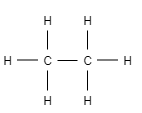
Here you can see, one $C-C$single covalent bond and six $C-H$single covalent bond. If we add all these single covalent bonds together then it results into seven covalent bonds.
Note:Properties of covalent bond-
-These bonds are formed between the non metallic elements. For example- hydrogen, oxygen.
-The compounds that have covalent bonds have low melting point and low boiling point.
-Compounds that have covalent bonds are not soluble in water.
-Compounds that have covalent bonds do not conduct electricity because of lack of free electrons.
Complete step-by-step answer: There are three types of covalent bonds-
1.Single covalent bond
2.Double covalent bond
3.Triple covalent bond
In this question, we will only discuss the single covalent bonds.
Single covalent bonds are defined as the bonds that are formed when one pair of electrons is shared between the two participating atoms. These bonds are weaker than the double and triple bond but these bonds are the most stable bond.
Let us take an example-
\[HCl\] contain one hydrogen atom having one valence electron and one chlorine atom having seven valence electrons. Hence a single bond is formed when sharing of electrons takes place and therefore completes its octet.
One atom combines with another atom and forms a single bond that is covalent in nature. This bond is formed due to sharing of electrons and completes its octet.
To count the single covalent bond, we need to draw the structure of a molecule and then have to count every single bond in the molecule. It includes $C-C$ covalent bonds, $C-H$ covalent bonds, $C-X$ ($X$ is a halogen) covalent bond and so on.
For example- ethane
Let us draw the structure of ethane
Here you can see, one $C-C$single covalent bond and six $C-H$single covalent bond. If we add all these single covalent bonds together then it results into seven covalent bonds.
Note:Properties of covalent bond-
-These bonds are formed between the non metallic elements. For example- hydrogen, oxygen.
-The compounds that have covalent bonds have low melting point and low boiling point.
-Compounds that have covalent bonds are not soluble in water.
-Compounds that have covalent bonds do not conduct electricity because of lack of free electrons.
Recently Updated Pages
If x a + bt + ct2 where x is in meters and t is in class 11 physics CBSE

A car covers the first half distance between two places class 11 physics CBSE
The resultant of two vectors overrightarrow P and overrightarrow class 11 physics CBSE
Find the value of cos 135 class 11 maths CBSE
A mass M is held in place by an applied force F and class 11 physics CBSE
A solution of glucose in water is labelled as 10 dfracwv class 11 chemistry CBSE
Trending doubts
One Metric ton is equal to kg A 10000 B 1000 C 100 class 11 physics CBSE
Find the value of the expression given below sin 30circ class 11 maths CBSE
What do you mean by retardation What is its SI uni class 11 physics CBSE
Draw a diagram of nephron and explain its structur class 11 biology CBSE
10 examples of friction in our daily life
Difference between physical and chemical change class 11 chemistry CBSE