




Cotton is a
A)Surface fibre
B)Hard fibre
C)Bast fibre
D)Stem fibre
Answer
 Verified
572.1k+ views
Hint: It occurs above the stems, leaves, fruits, and seeds because of this covering of fibre, seeds of several species appear woolly. It is found on the seeds of each compound of simple, flat, and twisted hairs developed as an outgrowth from the "hull" or seed coat.
Complete answer:
-The fibres which occur upon stems, leaves, fruits and seeds are the plant surface fibres. Mostly seen on one of the most economically important plants that are cotton.
-Most of the world's textiles in today's time depending on cotton. Therefore, it is a part of daily life. The surface fibres are the most important fibres of the plant in the world. The single epidermal cells have outgrowths that produce fibres. So, the fibres are the hairs that grow out of the seed coat.
Composition of fibre-
1)Cuticle - it is a mixture of cutaneous and pectineus substance
2)Outer cellular layer - generally original cell wall.
3)Layer of secondary deposits composed of cellulose
4)The densest part of the fibre is the wall of the lumen.it is the spiral structures surrounding the central cavity.
5)Filled with structureless substances is the lumen. They are nitrogenous in nature.
Additional Information: -Fibres are maturing within the" boll". Generally, after four months, the Boll begins to slit open and exposed fibres.
-There are about 10,000 to 20,000 fibres in each seed. The fibres start to lose their water when the boll matches and dies. The fibres appear as a flattened twisted tube when they collapse. The degree of the twist depends on the environment a plant is grown.
-Unripe fibres - twists are absent and have thin also known as dead cotton and they have a little value in the market.
-The twist helps the fibre to cling to each other and also improve their spinning qualities.
Hard fibre - it is generally found on the monocotyledonous plants that are a vegetable fibre.it is mostly obtained from the supporting tissue of large leaves from the tropical and subtropical plants. It is a fibre made from leaves and fruits.
Bast fibres - it is collected from the phloem or skin of certain dicotyledonous plants. This fibre suppose the conductive cells of the phloem and also provide strength to the stem
So, the correct answer is,” Surface fibre”.
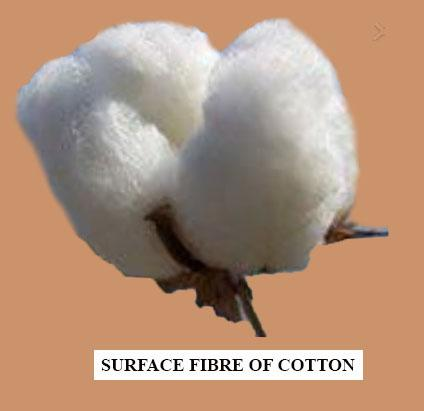
Note: -Cotton is grown in a protective capsule around the seeds. It has a soft and fluffy staple fibre. It belongs to the genus Gossypium in the family of Malvaceae.
-The surface fibre is made up of pure cellulose. The bolls tend to increase the dispersion of the seeds under natural conditions. The surface fibres of the cotton are produced from the epidermal seed coat.
Complete answer:
-The fibres which occur upon stems, leaves, fruits and seeds are the plant surface fibres. Mostly seen on one of the most economically important plants that are cotton.
-Most of the world's textiles in today's time depending on cotton. Therefore, it is a part of daily life. The surface fibres are the most important fibres of the plant in the world. The single epidermal cells have outgrowths that produce fibres. So, the fibres are the hairs that grow out of the seed coat.
Composition of fibre-
1)Cuticle - it is a mixture of cutaneous and pectineus substance
2)Outer cellular layer - generally original cell wall.
3)Layer of secondary deposits composed of cellulose
4)The densest part of the fibre is the wall of the lumen.it is the spiral structures surrounding the central cavity.
5)Filled with structureless substances is the lumen. They are nitrogenous in nature.
Additional Information: -Fibres are maturing within the" boll". Generally, after four months, the Boll begins to slit open and exposed fibres.
-There are about 10,000 to 20,000 fibres in each seed. The fibres start to lose their water when the boll matches and dies. The fibres appear as a flattened twisted tube when they collapse. The degree of the twist depends on the environment a plant is grown.
-Unripe fibres - twists are absent and have thin also known as dead cotton and they have a little value in the market.
-The twist helps the fibre to cling to each other and also improve their spinning qualities.
Hard fibre - it is generally found on the monocotyledonous plants that are a vegetable fibre.it is mostly obtained from the supporting tissue of large leaves from the tropical and subtropical plants. It is a fibre made from leaves and fruits.
Bast fibres - it is collected from the phloem or skin of certain dicotyledonous plants. This fibre suppose the conductive cells of the phloem and also provide strength to the stem
So, the correct answer is,” Surface fibre”.
Note: -Cotton is grown in a protective capsule around the seeds. It has a soft and fluffy staple fibre. It belongs to the genus Gossypium in the family of Malvaceae.
-The surface fibre is made up of pure cellulose. The bolls tend to increase the dispersion of the seeds under natural conditions. The surface fibres of the cotton are produced from the epidermal seed coat.
Recently Updated Pages
Master Class 11 Computer Science: Engaging Questions & Answers for Success

Master Class 11 Business Studies: Engaging Questions & Answers for Success
Master Class 11 Economics: Engaging Questions & Answers for Success
Master Class 11 English: Engaging Questions & Answers for Success
Master Class 11 Maths: Engaging Questions & Answers for Success
Master Class 11 Biology: Engaging Questions & Answers for Success
Trending doubts
One Metric ton is equal to kg A 10000 B 1000 C 100 class 11 physics CBSE
There are 720 permutations of the digits 1 2 3 4 5 class 11 maths CBSE
Discuss the various forms of bacteria class 11 biology CBSE
Draw a diagram of a plant cell and label at least eight class 11 biology CBSE
State the laws of reflection of light
Explain zero factorial class 11 maths CBSE