




What is the correct electronic configuration of the central atom in $K_{ 4 }[Fe(CN)_{ 6 }]$ on crystal field theory?
(A.) ${ t }_{ 2g }^{ 4 }{ e }_{ g }^{ 2 }$
(B.) ${ t }_{ 2g }^{ 6 }{ e }_{ g }^{ 0 }$
(C.) ${ e }^{ 3 }{ t }_{ 2 }^{ 3 }$
(D.) ${ e }^{ 4 }{ t }_{ 2 }^{ 2 }$
Answer
 Verified
654.6k+ views
Hint: To find the correct answer first try to find the oxidation state of Fe in this complex and then write its electronic configuration. Here you have to remember that ${ CN }^{ - }$ is a strong ligand that would pair up the electrons present in the d-orbitals.
Complete step by step solution:
Let’s find the correct answer to this question,
First, we need to calculate the oxidation state of iron -
4(+1) + x + 6(-1) = 0
+4 + x -6 = 0
x = +2
In $K_{ 4 }[Fe(CN)_{ 6 }]$,
Electronic configuration of Fe in ground state = [Ar]$3d^{ 6 }4s^{ 2 }$
Electronic configuration of Fe in excited state = ${ Fe }^{ 2+ }$= [Ar]$3d^{ 6 }4s^{ 0 }$
We can represent them as:
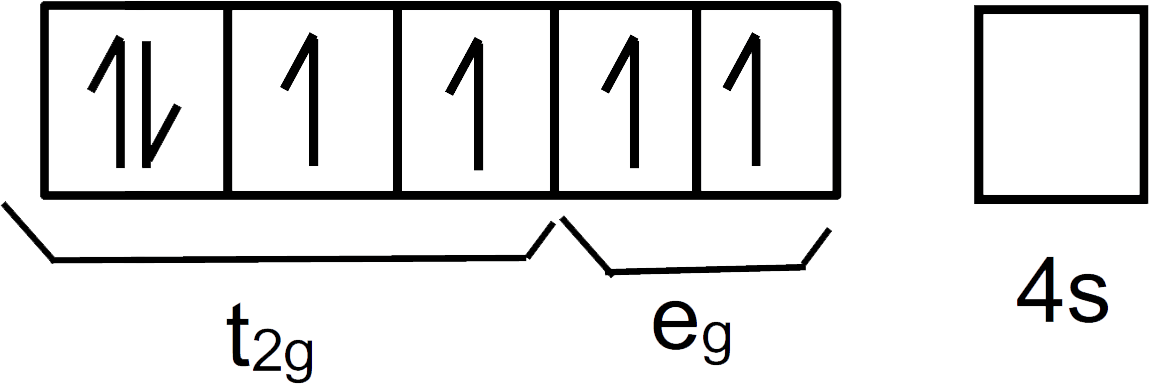
In this compound ${ CN }^{ - }$ is a strong field ligand that would pair up the electrons present in the d-orbitals.
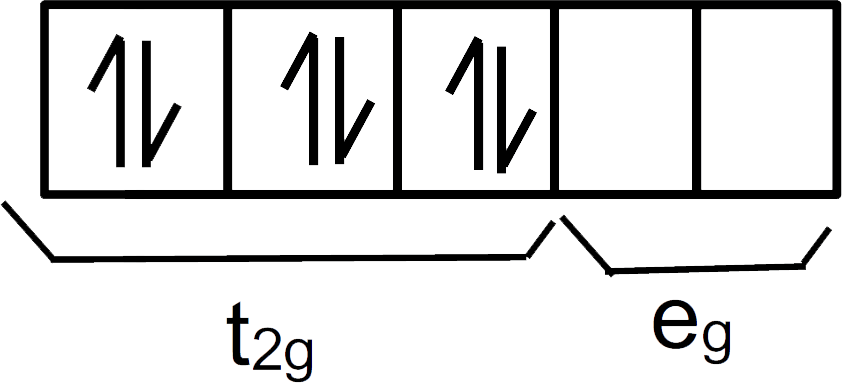
We can see there are 3 pairs of electrons in ${ t }_{ 2g }$ and 0 pairs of electrons in ${ e }_{ g }$.
So, the correct electronic configuration of the central atom in $K_{ 4 }[Fe(CN)_{ 6 }]$ on crystal field theory is ${ t }_{ 2g }^{ 6 }{ e }_{ g }^{ 0 }$
So, the correct answer is “Option B”.
Additional Information: ${ t }_{ 2g }$ and ${ e }_{ g }$ refer to symmetry classes to which the d-orbitals belong in octahedral complexes.
In the crystal field model, the normally degenerate 3d orbitals split into two groups, a doubly degenerate set of two orbitals and lower energy triply degenerate set. When analyzed by mathematical group theory, the wave functions for these two groups fall into different symmetry groups, designated ${ e }_{ g }$ and ${ t }_{ 2g }$ respectively.
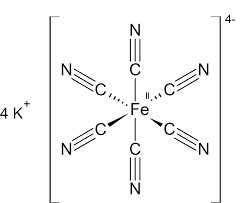
Note: Solid potassium ferrocyanide, both as the hydrate and anhydrous salts, has a complicated polymeric structure. We can also draw the structure of this complex $K_{ 4 }[Fe(CN)_{ 6 }]$ as,
Complete step by step solution:
Let’s find the correct answer to this question,
First, we need to calculate the oxidation state of iron -
4(+1) + x + 6(-1) = 0
+4 + x -6 = 0
x = +2
In $K_{ 4 }[Fe(CN)_{ 6 }]$,
Electronic configuration of Fe in ground state = [Ar]$3d^{ 6 }4s^{ 2 }$
Electronic configuration of Fe in excited state = ${ Fe }^{ 2+ }$= [Ar]$3d^{ 6 }4s^{ 0 }$
We can represent them as:
In this compound ${ CN }^{ - }$ is a strong field ligand that would pair up the electrons present in the d-orbitals.
We can see there are 3 pairs of electrons in ${ t }_{ 2g }$ and 0 pairs of electrons in ${ e }_{ g }$.
So, the correct electronic configuration of the central atom in $K_{ 4 }[Fe(CN)_{ 6 }]$ on crystal field theory is ${ t }_{ 2g }^{ 6 }{ e }_{ g }^{ 0 }$
So, the correct answer is “Option B”.
Additional Information: ${ t }_{ 2g }$ and ${ e }_{ g }$ refer to symmetry classes to which the d-orbitals belong in octahedral complexes.
In the crystal field model, the normally degenerate 3d orbitals split into two groups, a doubly degenerate set of two orbitals and lower energy triply degenerate set. When analyzed by mathematical group theory, the wave functions for these two groups fall into different symmetry groups, designated ${ e }_{ g }$ and ${ t }_{ 2g }$ respectively.
Note: Solid potassium ferrocyanide, both as the hydrate and anhydrous salts, has a complicated polymeric structure. We can also draw the structure of this complex $K_{ 4 }[Fe(CN)_{ 6 }]$ as,
Recently Updated Pages
Which will be the least stable resonating structure class 11 chemistry CBSE

How many 5 digit telephone numbers can be construc-class-11-maths-CBSE
How do you find the angle of the resultant vector class 11 physics CBSE
Draw labelled diagram of the following i Gram seed class 11 biology CBSE
1 Quintal is equal to a 110 kg b 10 kg c 100kg d 1000 class 11 physics CBSE
What is the need and importance of classification class 11 biology CBSE
Trending doubts
One Metric ton is equal to kg A 10000 B 1000 C 100 class 11 physics CBSE
Find the value of the expression given below sin 30circ class 11 maths CBSE
Draw a diagram of nephron and explain its structur class 11 biology CBSE
10 examples of friction in our daily life
Proton was discovered by A Thomson B Rutherford C Chadwick class 11 chemistry CBSE
The teeth used for biting and cutting food are called class 11 biology CBSE