



Correct ${\text{B}} - {\text{F}}$ bond length follows the sequence:
A) ${\text{B}}{{\text{F}}_3} < {\text{B}}{{\text{F}}_2}{\text{OH}} < {\text{B}}{{\text{F}}_2}{\text{N}}{{\text{H}}_2} < {\text{BF}}_4^ - $
B) \[{\text{B}}{{\text{F}}_2}{\text{N}}{{\text{H}}_2} < {\text{B}}{{\text{F}}_2}{\text{OH}} < {\text{B}}{{\text{F}}_3} < {\text{BF}}_4^ - \]
C) \[{\text{B}}{{\text{F}}_3} < {\text{BF}}_4^ - < {\text{B}}{{\text{F}}_2}{\text{OH}} < {\text{B}}{{\text{F}}_2}{\text{N}}{{\text{H}}_2}\]
D) \[{\text{B}}{{\text{F}}_3} < {\text{B}}{{\text{F}}_2}{\text{N}}{{\text{H}}_2} < {\text{B}}{{\text{F}}_2}{\text{OH}} < {\text{BF}}_4^ - \]
Answer
 Verified
620.1k+ views
Hint:We know that ${\text{B}}{{\text{F}}_3}$ undergoes back bonding. This leads to double bond character in ${\text{B}}{{\text{F}}_3}$. \[{\text{B}}{{\text{F}}_2}{\text{OH}}\] and \[{\text{B}}{{\text{F}}_2}{\text{N}}{{\text{H}}_2}\] have oxygen and nitrogen atoms which are electronegative atoms and oxygen is more electronegative than nitrogen.
Complete answer :
We are given four species: ${\text{B}}{{\text{F}}_3}$, ${\text{BF}}_4^ - $, ${\text{B}}{{\text{F}}_2}{\text{OH}}$ and \[{\text{B}}{{\text{F}}_2}{\text{N}}{{\text{H}}_2}\]. The structures of ${\text{B}}{{\text{F}}_3}$, ${\text{BF}}_4^ - $, ${\text{B}}{{\text{F}}_2}{\text{OH}}$ and \[{\text{B}}{{\text{F}}_2}{\text{N}}{{\text{H}}_2}\] are as follows:
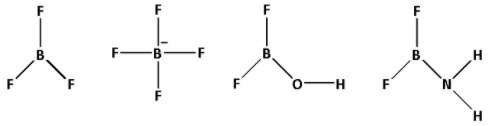
Consider ${\text{B}}{{\text{F}}_3}$: From the structure of ${\text{B}}{{\text{F}}_3}$, we can see that it is a $s{p^2}$ hybridised and a trigonal planar structure. Boron atom has a vacant $2p$ orbital and the fluorine atom has completely filled $2p$ orbital. Both the orbitals have the same energy and thus, back bonding occurs between boron and fluorine atoms. The lone pair of electrons from the completely filled $2p$ orbitals of fluorine atom are transferred to the vacant $2p$ orbitals of boron atom. This develops a double bond character between boron and fluorine and thus, the ${\text{B}} - {\text{F}}$ bond length becomes shorter. Thus, ${\text{B}}{{\text{F}}_3}$ has the shortest bond length.
Consider ${\text{BF}}_4^ - $:- From the structure of ${\text{BF}}_4^ - $, we can see that it is a $s{p^3}$ hybridised and a tetrahedral structure. The boron atom does not have any vacant $2p$ orbital left. Thus, no back bonding occurs between boron and fluorine atoms. Thus, ${\text{B}} - {\text{F}}$ bond in ${\text{BF}}_4^ - $ are purely single bonds. Thus, the ${\text{B}} - {\text{F}}$ bond length in ${\text{BF}}_4^ - $ is higher than that in ${\text{B}}{{\text{F}}_3}$.
Consider ${\text{B}}{{\text{F}}_2}{\text{OH}}$ and \[{\text{B}}{{\text{F}}_2}{\text{N}}{{\text{H}}_2}\]: \[{\text{B}}{{\text{F}}_2}{\text{OH}}\] and \[{\text{B}}{{\text{F}}_2}{\text{N}}{{\text{H}}_2}\] have oxygen and nitrogen atoms which are electronegative atoms and oxygen is more electronegative than nitrogen. A more electronegative atom has a greater tendency to pull the bond forming electron pair towards itself. Thus, the ${\text{B}} - {\text{F}}$ bond length in \[{\text{B}}{{\text{F}}_2}{\text{N}}{{\text{H}}_2}\] is higher than that in ${\text{B}}{{\text{F}}_2}{\text{OH}}$. But the ${\text{B}} - {\text{F}}$ bond length in ${\text{B}}{{\text{F}}_2}{\text{OH}}$ and \[{\text{B}}{{\text{F}}_2}{\text{N}}{{\text{H}}_2}\] is more than the double bond length and less than the single bond length.
Thus, the order of ${\text{B}} - {\text{F}}$ bond length is ${\text{B}}{{\text{F}}_3} < {\text{B}}{{\text{F}}_2}{\text{OH}} < {\text{B}}{{\text{F}}_2}{\text{N}}{{\text{H}}_2} < {\text{BF}}_4^ - $.
Thus, the correct option is (A) ${\text{B}}{{\text{F}}_3} < {\text{B}}{{\text{F}}_2}{\text{OH}} < {\text{B}}{{\text{F}}_2}{\text{N}}{{\text{H}}_2} < {\text{BF}}_4^ - $.
Note:The back bonding occurs when one atom has a vacant orbital and the other atom has a lone pair of electrons. Both the atoms involved in back bonding must have the orbitals of the same energy. Also, a more electronegative atom has a greater tendency to attract the electron pair involved in bonding towards itself and thus, reducing the bond length.
Complete answer :
We are given four species: ${\text{B}}{{\text{F}}_3}$, ${\text{BF}}_4^ - $, ${\text{B}}{{\text{F}}_2}{\text{OH}}$ and \[{\text{B}}{{\text{F}}_2}{\text{N}}{{\text{H}}_2}\]. The structures of ${\text{B}}{{\text{F}}_3}$, ${\text{BF}}_4^ - $, ${\text{B}}{{\text{F}}_2}{\text{OH}}$ and \[{\text{B}}{{\text{F}}_2}{\text{N}}{{\text{H}}_2}\] are as follows:
Consider ${\text{B}}{{\text{F}}_3}$: From the structure of ${\text{B}}{{\text{F}}_3}$, we can see that it is a $s{p^2}$ hybridised and a trigonal planar structure. Boron atom has a vacant $2p$ orbital and the fluorine atom has completely filled $2p$ orbital. Both the orbitals have the same energy and thus, back bonding occurs between boron and fluorine atoms. The lone pair of electrons from the completely filled $2p$ orbitals of fluorine atom are transferred to the vacant $2p$ orbitals of boron atom. This develops a double bond character between boron and fluorine and thus, the ${\text{B}} - {\text{F}}$ bond length becomes shorter. Thus, ${\text{B}}{{\text{F}}_3}$ has the shortest bond length.
Consider ${\text{BF}}_4^ - $:- From the structure of ${\text{BF}}_4^ - $, we can see that it is a $s{p^3}$ hybridised and a tetrahedral structure. The boron atom does not have any vacant $2p$ orbital left. Thus, no back bonding occurs between boron and fluorine atoms. Thus, ${\text{B}} - {\text{F}}$ bond in ${\text{BF}}_4^ - $ are purely single bonds. Thus, the ${\text{B}} - {\text{F}}$ bond length in ${\text{BF}}_4^ - $ is higher than that in ${\text{B}}{{\text{F}}_3}$.
Consider ${\text{B}}{{\text{F}}_2}{\text{OH}}$ and \[{\text{B}}{{\text{F}}_2}{\text{N}}{{\text{H}}_2}\]: \[{\text{B}}{{\text{F}}_2}{\text{OH}}\] and \[{\text{B}}{{\text{F}}_2}{\text{N}}{{\text{H}}_2}\] have oxygen and nitrogen atoms which are electronegative atoms and oxygen is more electronegative than nitrogen. A more electronegative atom has a greater tendency to pull the bond forming electron pair towards itself. Thus, the ${\text{B}} - {\text{F}}$ bond length in \[{\text{B}}{{\text{F}}_2}{\text{N}}{{\text{H}}_2}\] is higher than that in ${\text{B}}{{\text{F}}_2}{\text{OH}}$. But the ${\text{B}} - {\text{F}}$ bond length in ${\text{B}}{{\text{F}}_2}{\text{OH}}$ and \[{\text{B}}{{\text{F}}_2}{\text{N}}{{\text{H}}_2}\] is more than the double bond length and less than the single bond length.
Thus, the order of ${\text{B}} - {\text{F}}$ bond length is ${\text{B}}{{\text{F}}_3} < {\text{B}}{{\text{F}}_2}{\text{OH}} < {\text{B}}{{\text{F}}_2}{\text{N}}{{\text{H}}_2} < {\text{BF}}_4^ - $.
Thus, the correct option is (A) ${\text{B}}{{\text{F}}_3} < {\text{B}}{{\text{F}}_2}{\text{OH}} < {\text{B}}{{\text{F}}_2}{\text{N}}{{\text{H}}_2} < {\text{BF}}_4^ - $.
Note:The back bonding occurs when one atom has a vacant orbital and the other atom has a lone pair of electrons. Both the atoms involved in back bonding must have the orbitals of the same energy. Also, a more electronegative atom has a greater tendency to attract the electron pair involved in bonding towards itself and thus, reducing the bond length.
Recently Updated Pages
Basicity of sulphurous acid and sulphuric acid are

Master Class 12 Economics: Engaging Questions & Answers for Success
Master Class 12 Biology: Engaging Questions & Answers for Success
Master Class 11 English: Engaging Questions & Answers for Success
Master Class 11 Physics: Engaging Questions & Answers for Success
Master Class 11 Computer Science: Engaging Questions & Answers for Success
Trending doubts
Difference Between Plant Cell and Animal Cell
Fill the blanks with the suitable prepositions 1 The class 9 english CBSE
What is pollution? How many types of pollution? Define it
What is the full form of pH?
What is the Full Form of ICSE, CBSE and SSC
Name 10 Living and Non living things class 9 biology CBSE