




Corpus Luteum secretes
A. LH
B. Estrogen
C. Progesterone
D. FSH
Answer
 Verified
606k+ views
Hint: The endocrine system comprises endocrine glands that secrete hormones released directly to the bloodstream. The female ovary is also a gland that secrete different hormones that are involved during the reproduction and menstruation process.
Complete Answer:
- A yellow hormone secreting body found in the female reproductive system is the Corpus Luteum. It forms inside the ovary at the follicle site, where the ovary gets matured and releases the ovum and the whole process is considered as ovulation.
- The Corpus Luteum is formed from lutein cells that develop just after the ovulation process, during which the lipid and the yellow pigment accumulate inside the granulosa cells that line the follicle. The Corpus Luteum size is highly variable. It involves the secretion of estrogen and progesterone, it causes some changes in the uterus so that it becomes more suitable for the fertilization process but if the egg does not get fertilized the Corpus Luteum becomes inactive and menstruation occurs after 10-14 days.
- Now, the Corpus Luteum forms from the cells and granulosa in the postovulatory follicle. The function of this gland is to secrete progesterone, maintain the promoting of uterine quiescence during pregnancy, as well as preparation of uterus implantation. This gland also secrete moderate amounts of estrogen that further inhibits the release of gonadotropin releasing hormone and this results in the secretion of follicle stimulating hormone and the gonadotropin releasing hormone.
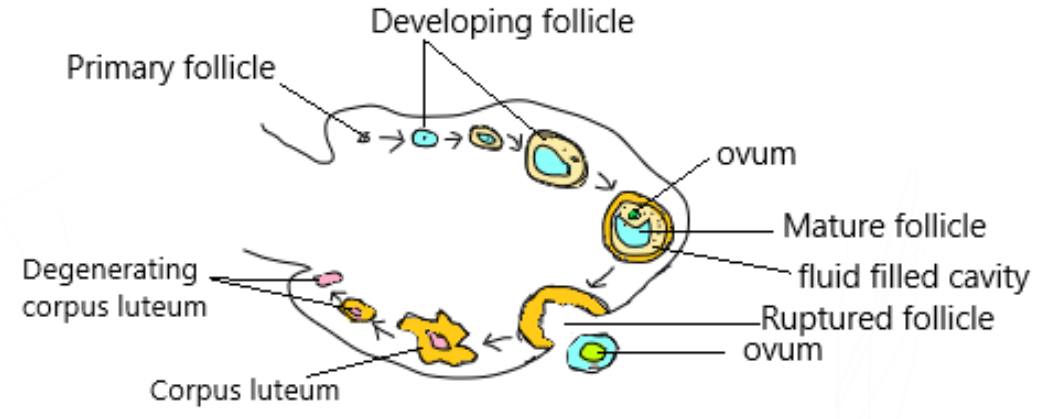
Fig: Development of corpus luteum
Thus, the correct answer is C Progesterone.
Note: The structure of the Corpus Luteum starts after maturation of egg pops out of the follicle. This hormone is essential for conception and pregnancy to last. The fertilization to occur or not depends on this cell and if cysts formation takes place in this cell it causes very painful symptoms.
Complete Answer:
- A yellow hormone secreting body found in the female reproductive system is the Corpus Luteum. It forms inside the ovary at the follicle site, where the ovary gets matured and releases the ovum and the whole process is considered as ovulation.
- The Corpus Luteum is formed from lutein cells that develop just after the ovulation process, during which the lipid and the yellow pigment accumulate inside the granulosa cells that line the follicle. The Corpus Luteum size is highly variable. It involves the secretion of estrogen and progesterone, it causes some changes in the uterus so that it becomes more suitable for the fertilization process but if the egg does not get fertilized the Corpus Luteum becomes inactive and menstruation occurs after 10-14 days.
- Now, the Corpus Luteum forms from the cells and granulosa in the postovulatory follicle. The function of this gland is to secrete progesterone, maintain the promoting of uterine quiescence during pregnancy, as well as preparation of uterus implantation. This gland also secrete moderate amounts of estrogen that further inhibits the release of gonadotropin releasing hormone and this results in the secretion of follicle stimulating hormone and the gonadotropin releasing hormone.
Fig: Development of corpus luteum
Thus, the correct answer is C Progesterone.
Note: The structure of the Corpus Luteum starts after maturation of egg pops out of the follicle. This hormone is essential for conception and pregnancy to last. The fertilization to occur or not depends on this cell and if cysts formation takes place in this cell it causes very painful symptoms.
Recently Updated Pages
Master Class 11 Social Science: Engaging Questions & Answers for Success

Master Class 11 English: Engaging Questions & Answers for Success
Master Class 11 Maths: Engaging Questions & Answers for Success
Master Class 11 Chemistry: Engaging Questions & Answers for Success
Master Class 11 Biology: Engaging Questions & Answers for Success
Master Class 11 Physics: Engaging Questions & Answers for Success
Trending doubts
One Metric ton is equal to kg A 10000 B 1000 C 100 class 11 physics CBSE
Difference Between Prokaryotic Cells and Eukaryotic Cells
Draw a diagram of a plant cell and label at least eight class 11 biology CBSE
Two of the body parts which do not appear in MRI are class 11 biology CBSE
Which gas is abundant in air class 11 chemistry CBSE
10 examples of friction in our daily life