




Corals belong to the phylum
A. Porifera
B. Coelenterate
C. Mollusca
D. Echinodermata
Answer
 Verified
631.2k+ views
Hint: Corals are the colonies formed by small organisms, belonging to the kingdom Animalia. They are enclosed by calcium carbonate shells. They are mostly present in the marine environment. They can exist in a symbiotic relationship with marine algae.
Complete answer: Corals are a group of invertebrates present in the marine environment, belonging to the phylum Coelenterata or Cnidaria. It belongs to the class Anthozoa. They exist in colonies, with individual Polyp forms. They form diverse shapes in association with other individual polyps. They possess a hard calcium carbonate exoskeleton. The organisms includes in phylum cnidarians
are corals, hydra, jellyfish, portuguese men-of-war, sea anemones, sea pens, and sea fans, etc.
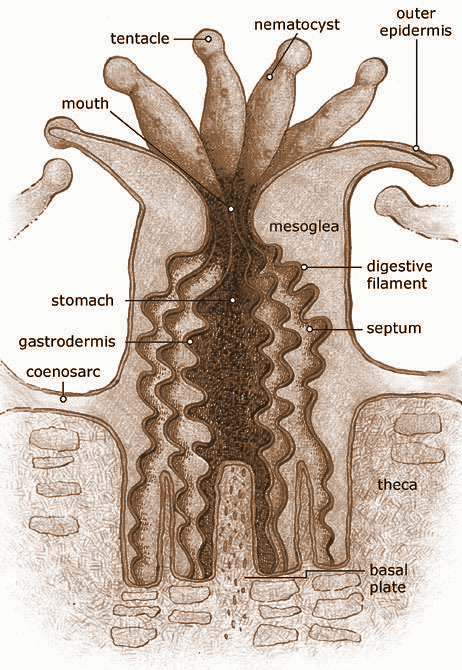
Considering the other given options:
-Porifera are the kingdom that includes sponges, which survive in the aquatic environment, both freshwater and marine. The body of these organisms is filled with pores, acting as a water-channel system. And are heterotrophic. They do not possess Medusa form to form coral reefs including the exoskeleton. Thus, A is not the correct option
-Mollusca is the phylum including invertebrate organisms and is the second-largest phylum. These are marine animals. The organisms included in the phylum are Octopus and Cuttlefish. The organisms forming colonies like coral reefs are absent in this phylum, hence option C is not the appropriate one.
-Echinodermata are also animals surviving in marine habitats. They are radially symmetrical and include animals such as starfish and sea urchins. Due to the absence of medusa formation, they are not able to form colonies such as reefs. Thus D is not the right option.
Therefore, the most appropriate option is B, i.e., Coelenterata.
Note: Corals constitute an important ecosystem in the environment. They survive in association with many other life forms. They occur in photosynthetic association with the marine algae and provide shelter to many fishes in the ecosystem.
Complete answer: Corals are a group of invertebrates present in the marine environment, belonging to the phylum Coelenterata or Cnidaria. It belongs to the class Anthozoa. They exist in colonies, with individual Polyp forms. They form diverse shapes in association with other individual polyps. They possess a hard calcium carbonate exoskeleton. The organisms includes in phylum cnidarians
are corals, hydra, jellyfish, portuguese men-of-war, sea anemones, sea pens, and sea fans, etc.
Considering the other given options:
-Porifera are the kingdom that includes sponges, which survive in the aquatic environment, both freshwater and marine. The body of these organisms is filled with pores, acting as a water-channel system. And are heterotrophic. They do not possess Medusa form to form coral reefs including the exoskeleton. Thus, A is not the correct option
-Mollusca is the phylum including invertebrate organisms and is the second-largest phylum. These are marine animals. The organisms included in the phylum are Octopus and Cuttlefish. The organisms forming colonies like coral reefs are absent in this phylum, hence option C is not the appropriate one.
-Echinodermata are also animals surviving in marine habitats. They are radially symmetrical and include animals such as starfish and sea urchins. Due to the absence of medusa formation, they are not able to form colonies such as reefs. Thus D is not the right option.
Therefore, the most appropriate option is B, i.e., Coelenterata.
Note: Corals constitute an important ecosystem in the environment. They survive in association with many other life forms. They occur in photosynthetic association with the marine algae and provide shelter to many fishes in the ecosystem.
Recently Updated Pages
Which will be the least stable resonating structure class 11 chemistry CBSE

How many 5 digit telephone numbers can be construc-class-11-maths-CBSE
How do you find the angle of the resultant vector class 11 physics CBSE
Draw labelled diagram of the following i Gram seed class 11 biology CBSE
What is the need and importance of classification class 11 biology CBSE
The way in which the sparrows expressed their sorrow class 11 english CBSE
Trending doubts
One Metric ton is equal to kg A 10000 B 1000 C 100 class 11 physics CBSE
Find the value of the expression given below sin 30circ class 11 maths CBSE
1 Quintal is equal to a 110 kg b 10 kg c 100kg d 1000 class 11 physics CBSE
Draw a diagram of nephron and explain its structur class 11 biology CBSE
10 examples of friction in our daily life
Proton was discovered by A Thomson B Rutherford C Chadwick class 11 chemistry CBSE