



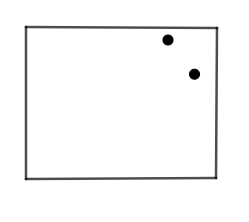
Copy the figure with punched holes and find the axes of symmetry for the following.
Answer
 Verified
627k+ views
Hint: First of all name the vertices of the given square. Then as we can see that the two dots are mirror images of each other so we can draw a line which will act as a mirror along which the two dots will reflect each other.
Complete step-by-step answer:
The below figure contains a square ABCD along with two dots G and G’.
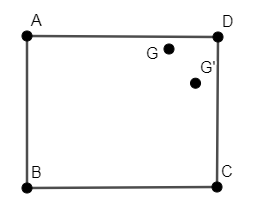
We have to find the axes of symmetry in the above figure. As we can see from the above figure, the two dots G and G’ look like they are mirror images of each other with the mirror passing through the diagonal DB of a square ABCD.
In the below figure, we have drawn a dotted line passing through DB.
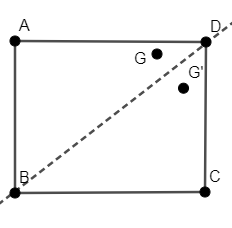
If we carefully see the figure, we will find that DB is acting as a mirror along which dot G’ is the reflection of dot G and vice versa. As we can see that this dotted line is acting as an axis of symmetry because this axis symmetrically divides the whole figure into two parts.
Hence, the dotted line DB is the axis of symmetry of the given figure.
Note: You might think of drawing the axis of symmetry along the diagonal AC but then it won’t divide the whole figure into two equal parts.
Suppose we have drawn the dotted line passing through AC then the figure will look like:
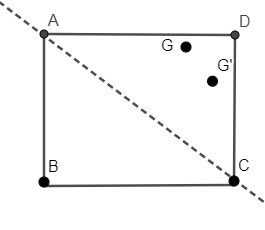
As you can clearly see from the above figure, AC cannot be an axis of symmetry because though square ABCD is divided into two parts but the two dots G and G’ are not reflected along AC.
Complete step-by-step answer:
The below figure contains a square ABCD along with two dots G and G’.
We have to find the axes of symmetry in the above figure. As we can see from the above figure, the two dots G and G’ look like they are mirror images of each other with the mirror passing through the diagonal DB of a square ABCD.
In the below figure, we have drawn a dotted line passing through DB.
If we carefully see the figure, we will find that DB is acting as a mirror along which dot G’ is the reflection of dot G and vice versa. As we can see that this dotted line is acting as an axis of symmetry because this axis symmetrically divides the whole figure into two parts.
Hence, the dotted line DB is the axis of symmetry of the given figure.
Note: You might think of drawing the axis of symmetry along the diagonal AC but then it won’t divide the whole figure into two equal parts.
Suppose we have drawn the dotted line passing through AC then the figure will look like:
As you can clearly see from the above figure, AC cannot be an axis of symmetry because though square ABCD is divided into two parts but the two dots G and G’ are not reflected along AC.

Recently Updated Pages
Three beakers labelled as A B and C each containing 25 mL of water were taken A small amount of NaOH anhydrous CuSO4 and NaCl were added to the beakers A B and C respectively It was observed that there was an increase in the temperature of the solutions contained in beakers A and B whereas in case of beaker C the temperature of the solution falls Which one of the following statements isarecorrect i In beakers A and B exothermic process has occurred ii In beakers A and B endothermic process has occurred iii In beaker C exothermic process has occurred iv In beaker C endothermic process has occurred

Master Class 7 Social Science: Engaging Questions & Answers for Success
Master Class 7 Science: Engaging Questions & Answers for Success
Master Class 7 Maths: Engaging Questions & Answers for Success
Class 7 Question and Answer - Your Ultimate Solutions Guide
Master Class 9 Social Science: Engaging Questions & Answers for Success
Three beakers labelled as A B and C each containing 25 mL of water were taken A small amount of NaOH anhydrous CuSO4 and NaCl were added to the beakers A B and C respectively It was observed that there was an increase in the temperature of the solutions contained in beakers A and B whereas in case of beaker C the temperature of the solution falls Which one of the following statements isarecorrect i In beakers A and B exothermic process has occurred ii In beakers A and B endothermic process has occurred iii In beaker C exothermic process has occurred iv In beaker C endothermic process has occurred
Master Class 7 Social Science: Engaging Questions & Answers for Success
Master Class 7 Science: Engaging Questions & Answers for Success
Trending doubts
Convert 200 Million dollars in rupees class 7 maths CBSE
Full Form of IASDMIPSIFSIRSPOLICE class 7 social science CBSE
List of coprime numbers from 1 to 100 class 7 maths CBSE
How many thousands make a crore class 7 maths CBSE
What is a subcontinent class 7 social science CBSE
Differentiate between map and globe class 7 social science CBSE