




Copper of fixed volume ‘V’ is drawn into wires of length ‘L’. When this wire is subjected to a constant force ‘F’, the extension produced in the wire is ‘$\Delta l'$ .Which of the following graphs is a straight line?
(A ) $\Delta l$ vs 1/l
(B) $\Delta l$ vs $l^2$
(C) $\Delta l$ vs 1/$l^2$
(D) $\Delta l$ vs l
Answer
 Verified
624.6k+ views
Hint:The mechanical properties of materials to measure stiffness of the solid materials is known as the Young’s modulus.
Formula used: To solve this type of question we use the following formula.
$Y = \dfrac{{Fl}}{{A\Delta l}}$ ; This is the formula for young’s modulus. Where, F is the force, l is the original length, $\Delta l$ is changed in length and A is the area.
Complete step-by-step answer:
Volume V is given in the question. This can be written in terms of area and length as below.
V=Al (1)
Let us use Young's modulus formula $Y = \dfrac{{Fl}}{{A\Delta l}}$ and find the expression for change in length.
$Y = \dfrac{{Fl}}{{A\Delta l}}$
$ \Rightarrow \Delta l = \dfrac{{Fl}}{{AY}}$
Now let us substitute the value of area from equation (1).
$\Delta l = \dfrac{{F{l^2}}}{{VY}}$
Let us now, consider all other variables to be constant and find the dependency of $\Delta l$ with length of wire.
$\Delta l \propto {l^2}$
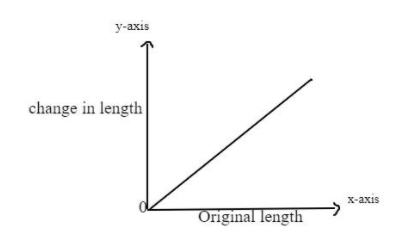
If we plot the graph between the original length that is l versus the change in length $\Delta l$the graph will be a straight-line graph
Hence, option (B) $\Delta l \propto {l^2}$ is the correct option.
Note:
*Young’s modulus is defined as the ratio of stress along an axis to strain along the same axis.
*Young's modulus is a mechanical property that measures the stiffness of solid material and it can be varied concerning the temperature.
*Young's modulus is not always the same in the direction of all materials.
*When stress and strain are nearly zero, the stress-strain curve is linear.
*The relationship between stress and strain is described by Hooke's law that states stress is proportional to strain and the coefficient of proportionality is Young's modulus.
*The higher the young’s modulus, the more stress is needed to create the same amount of strain.
*Young’s modulus is the ability of a material to withstand any changes under lengthwise.
Formula used: To solve this type of question we use the following formula.
$Y = \dfrac{{Fl}}{{A\Delta l}}$ ; This is the formula for young’s modulus. Where, F is the force, l is the original length, $\Delta l$ is changed in length and A is the area.
Complete step-by-step answer:
Volume V is given in the question. This can be written in terms of area and length as below.
V=Al (1)
Let us use Young's modulus formula $Y = \dfrac{{Fl}}{{A\Delta l}}$ and find the expression for change in length.
$Y = \dfrac{{Fl}}{{A\Delta l}}$
$ \Rightarrow \Delta l = \dfrac{{Fl}}{{AY}}$
Now let us substitute the value of area from equation (1).
$\Delta l = \dfrac{{F{l^2}}}{{VY}}$
Let us now, consider all other variables to be constant and find the dependency of $\Delta l$ with length of wire.
$\Delta l \propto {l^2}$
If we plot the graph between the original length that is l versus the change in length $\Delta l$the graph will be a straight-line graph
Hence, option (B) $\Delta l \propto {l^2}$ is the correct option.
Note:
*Young’s modulus is defined as the ratio of stress along an axis to strain along the same axis.
*Young's modulus is a mechanical property that measures the stiffness of solid material and it can be varied concerning the temperature.
*Young's modulus is not always the same in the direction of all materials.
*When stress and strain are nearly zero, the stress-strain curve is linear.
*The relationship between stress and strain is described by Hooke's law that states stress is proportional to strain and the coefficient of proportionality is Young's modulus.
*The higher the young’s modulus, the more stress is needed to create the same amount of strain.
*Young’s modulus is the ability of a material to withstand any changes under lengthwise.
Recently Updated Pages
Master Class 10 English: Engaging Questions & Answers for Success

Master Class 10 Social Science: Engaging Questions & Answers for Success
Master Class 10 Computer Science: Engaging Questions & Answers for Success
Class 10 Question and Answer - Your Ultimate Solutions Guide
Master Class 10 General Knowledge: Engaging Questions & Answers for Success
Master Class 10 Maths: Engaging Questions & Answers for Success
Trending doubts
What is the full form of NDA a National Democratic class 10 social science CBSE
Explain the Treaty of Vienna of 1815 class 10 social science CBSE
Who Won 36 Oscar Awards? Record Holder Revealed
Bharatiya Janata Party was founded in the year A 1979 class 10 social science CBSE
What is the median of the first 10 natural numbers class 10 maths CBSE
Why is it 530 pm in india when it is 1200 afternoon class 10 social science CBSE