



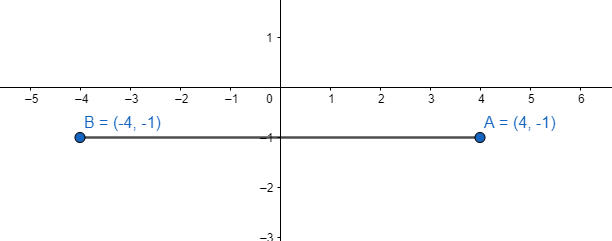
What is the coordinate of point $A\left( 4,-1 \right)$ after it has been reflected over the Y-axis?
Answer
 Verified
528k+ views
Hint: We first try to find the points and their actual equation for Y-axis. We assume the reflection of $A\left( 4,-1 \right)$. The lines will be perpendicular and the points will have their midpoint on the line. We use these tricks to find the equations. We solve them to find the solution.
Complete step by step solution:
We are reflecting $A\left( 4,-1 \right)$ with respect to the Y-axis. The equation of the Y-axis is $x=0$.
Let the image of point $A\left( 4,-1 \right)$ about line $x=0$ be $B\left( \alpha ,\beta \right)$.
We know that any point and its image point are at the same distance from the mirror line.
The mid-point of them will be on the line.
The mid-point of $A\left( 4,-1 \right)$ and $B\left( \alpha ,\beta \right)$ is $M\equiv \left( \dfrac{4+\alpha }{2},\dfrac{-1+\beta }{2} \right)$.
M lies on the line $x=0$ which means the coordinates satisfy the equation.
Therefore, $\dfrac{4+\alpha }{2}=0$.
Simplifying we get
$\begin{align}
& \dfrac{4+\alpha }{2}=0 \\
& \Rightarrow \alpha =-4 \\
\end{align}$
These lines are also perpendicular to each other. $A\left( 4,-1 \right)$ is on the perpendicular line of $x=0$.
The perpendicular line of $x=0$ will be $y=k$ where $k$ is a constant.
$A\left( 4,-1 \right)$ is on the line $y=k$. Putting the value, we get $k=-1$. The perpendicular line becomes $y+1=0$.
The point $M\equiv \left( \dfrac{4+\alpha }{2},\dfrac{-1+\beta }{2} \right)$ is also on $y+1=0$. We have $\dfrac{-1+\beta }{2}+1=0$.
Simplifying we get
$\begin{align}
& \dfrac{-1+\beta }{2}+1=0 \\
& \Rightarrow \beta +1=0 \\
& \Rightarrow \beta =-1 \\
\end{align}$
Solving them we get $\left( \alpha ,\beta \right)=\left( -4,-1 \right)$.
Therefore, the coordinate of point $A\left( 4,-1 \right)$ after it has been reflected over the Y-axis is $\left( -4,-1 \right)$.
Note: The main change at the time of reflection for any point with respect to the Y-axis is the change of the x coordinates of the point. Similarly, change at the time of reflection for any point with respect to the X-axis is the change of the y coordinates of the point.
Complete step by step solution:
We are reflecting $A\left( 4,-1 \right)$ with respect to the Y-axis. The equation of the Y-axis is $x=0$.
Let the image of point $A\left( 4,-1 \right)$ about line $x=0$ be $B\left( \alpha ,\beta \right)$.
We know that any point and its image point are at the same distance from the mirror line.
The mid-point of them will be on the line.
The mid-point of $A\left( 4,-1 \right)$ and $B\left( \alpha ,\beta \right)$ is $M\equiv \left( \dfrac{4+\alpha }{2},\dfrac{-1+\beta }{2} \right)$.
M lies on the line $x=0$ which means the coordinates satisfy the equation.
Therefore, $\dfrac{4+\alpha }{2}=0$.
Simplifying we get
$\begin{align}
& \dfrac{4+\alpha }{2}=0 \\
& \Rightarrow \alpha =-4 \\
\end{align}$
These lines are also perpendicular to each other. $A\left( 4,-1 \right)$ is on the perpendicular line of $x=0$.
The perpendicular line of $x=0$ will be $y=k$ where $k$ is a constant.
$A\left( 4,-1 \right)$ is on the line $y=k$. Putting the value, we get $k=-1$. The perpendicular line becomes $y+1=0$.
The point $M\equiv \left( \dfrac{4+\alpha }{2},\dfrac{-1+\beta }{2} \right)$ is also on $y+1=0$. We have $\dfrac{-1+\beta }{2}+1=0$.
Simplifying we get
$\begin{align}
& \dfrac{-1+\beta }{2}+1=0 \\
& \Rightarrow \beta +1=0 \\
& \Rightarrow \beta =-1 \\
\end{align}$
Solving them we get $\left( \alpha ,\beta \right)=\left( -4,-1 \right)$.
Therefore, the coordinate of point $A\left( 4,-1 \right)$ after it has been reflected over the Y-axis is $\left( -4,-1 \right)$.
Note: The main change at the time of reflection for any point with respect to the Y-axis is the change of the x coordinates of the point. Similarly, change at the time of reflection for any point with respect to the X-axis is the change of the y coordinates of the point.

Recently Updated Pages
Master Class 9 General Knowledge: Engaging Questions & Answers for Success

Master Class 9 Social Science: Engaging Questions & Answers for Success
Master Class 9 English: Engaging Questions & Answers for Success
Master Class 9 Maths: Engaging Questions & Answers for Success
Master Class 9 Science: Engaging Questions & Answers for Success
Class 9 Question and Answer - Your Ultimate Solutions Guide
Trending doubts
Difference Between Plant Cell and Animal Cell
Fill the blanks with the suitable prepositions 1 The class 9 english CBSE
Who is eligible for RTE class 9 social science CBSE
Which places in India experience sunrise first and class 9 social science CBSE
What is pollution? How many types of pollution? Define it
Name 10 Living and Non living things class 9 biology CBSE