



How do you convert \[\theta =\dfrac{5\pi }{6}\] to rectangular form?
Answer
 Verified
579.6k+ views
Hint: In this problem, we have to find the rectangular form of the given polar form. We know the relation between the polar form and the cartesian form. By using the relation between the polar form and the cartesian form we can divide the both x and y value to get a tangent. We can substitute the given angle in the tangent to get the rectangular form.
Complete step-by-step answer:
We know that the given angle is,
\[\theta =\dfrac{5\pi }{6}\]…….. (1)
We also know that the relation between the polar form and the cartesian form is,
\[\begin{align}
& x=r\cos \theta ......(2) \\
& y=r\sin \theta .......(3) \\
\end{align}\]
We can now divide (3) and (2) we get
\[\Rightarrow \dfrac{\sin \theta }{\cos \theta }=\dfrac{y}{x}\]
We can write the above step as,
\[\Rightarrow \tan \theta =\dfrac{y}{x}\]
We can now substitute the given angle (1) in the above step, we get
\[\Rightarrow \tan \dfrac{5\pi }{6}=\dfrac{y}{x}\]
We know that \[\tan \dfrac{5\pi }{6}=-\dfrac{1}{\sqrt{3}}\], we can substitute this in the above step, we get
\[\Rightarrow \dfrac{y}{x}=-\dfrac{1}{\sqrt{3}}\]
We can now multiply x on both left-hand side and the right-hand side of the equation, we get
\[\Rightarrow y=-\dfrac{1}{\sqrt{3}}x\]
Therefore, the rectangular form of the polar form \[\theta =\dfrac{5\pi }{6}\] is \[y=-\dfrac{1}{\sqrt{3}}x\].
We can now plot the graph for the rectangular form.
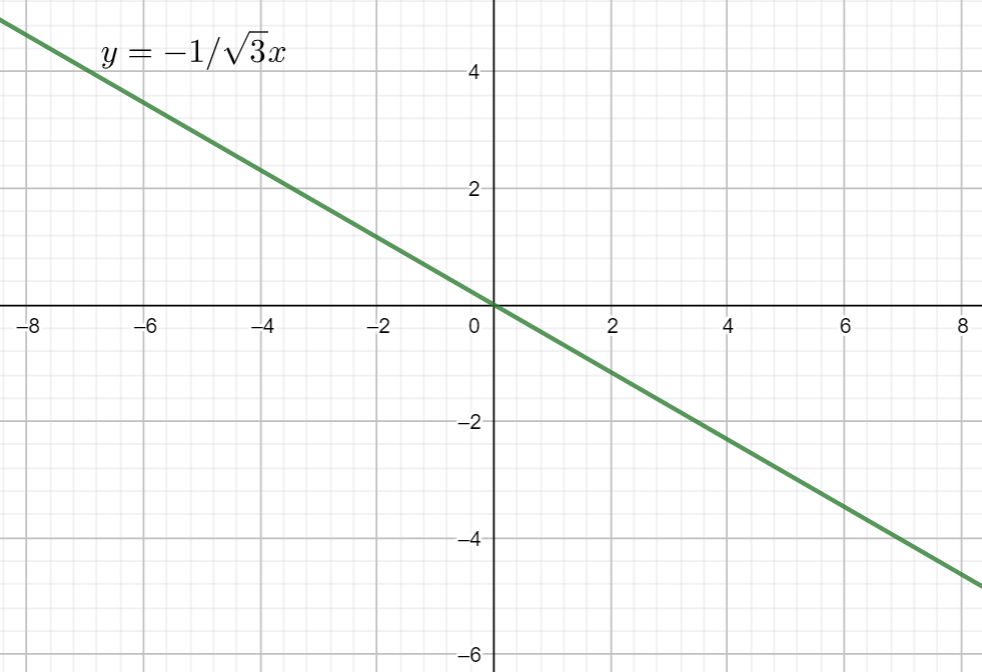
Note: Students make mistakes while writing the tangent value for the given angle. We should know some trigonometric degree values and formulas such as dividing sin and cosine to get a tangent, to be used in these types of problems. We should also remember the relation between the polar form and the rectangular form.
Complete step-by-step answer:
We know that the given angle is,
\[\theta =\dfrac{5\pi }{6}\]…….. (1)
We also know that the relation between the polar form and the cartesian form is,
\[\begin{align}
& x=r\cos \theta ......(2) \\
& y=r\sin \theta .......(3) \\
\end{align}\]
We can now divide (3) and (2) we get
\[\Rightarrow \dfrac{\sin \theta }{\cos \theta }=\dfrac{y}{x}\]
We can write the above step as,
\[\Rightarrow \tan \theta =\dfrac{y}{x}\]
We can now substitute the given angle (1) in the above step, we get
\[\Rightarrow \tan \dfrac{5\pi }{6}=\dfrac{y}{x}\]
We know that \[\tan \dfrac{5\pi }{6}=-\dfrac{1}{\sqrt{3}}\], we can substitute this in the above step, we get
\[\Rightarrow \dfrac{y}{x}=-\dfrac{1}{\sqrt{3}}\]
We can now multiply x on both left-hand side and the right-hand side of the equation, we get
\[\Rightarrow y=-\dfrac{1}{\sqrt{3}}x\]
Therefore, the rectangular form of the polar form \[\theta =\dfrac{5\pi }{6}\] is \[y=-\dfrac{1}{\sqrt{3}}x\].
We can now plot the graph for the rectangular form.
Note: Students make mistakes while writing the tangent value for the given angle. We should know some trigonometric degree values and formulas such as dividing sin and cosine to get a tangent, to be used in these types of problems. We should also remember the relation between the polar form and the rectangular form.
Recently Updated Pages
Master Class 12 Economics: Engaging Questions & Answers for Success

Master Class 12 English: Engaging Questions & Answers for Success
Master Class 12 Social Science: Engaging Questions & Answers for Success
Master Class 12 Maths: Engaging Questions & Answers for Success
Master Class 12 Physics: Engaging Questions & Answers for Success
Master Class 9 General Knowledge: Engaging Questions & Answers for Success
Trending doubts
Which are the Top 10 Largest Countries of the World?
Draw a labelled sketch of the human eye class 12 physics CBSE
Differentiate between homogeneous and heterogeneous class 12 chemistry CBSE
Sulphuric acid is known as the king of acids State class 12 chemistry CBSE
Why is the cell called the structural and functional class 12 biology CBSE
Draw ray diagrams each showing i myopic eye and ii class 12 physics CBSE