




How do you convert $r=4$ into Cartesian form? \[\]
Answer
 Verified
588.9k+ views
Hint: We recall polar and Cartesian representations of a point in the plane. We use the conversion from rule from polar coordinates $\left( r,\theta \right)$ to $\left( x,y \right)=\left( r\cos \theta ,r\sin \theta \right)$ and eliminate $\theta $ to have ${{r}^{2}}={{x}^{2}}+{{y}^{2}}$. We put $r=4$ in the obtained equation and simplify.\[\]
Complete step by step answer:
We know that in the Cartesian coordinate system two perpendicular intersecting lines are taken as reference axes called $x-$axis and $y-$axis. Any point on the plane is denoted as $\left( x,y \right)$ where $x$ is the distance from $y-$axis and $y$is the distance from $x-$axis. \[\]
We know in the polar coordinate system a ray and a point are taken as reference. The ray is called the polar axis and the point is called pole. Any point on the plane at a distance be $r$ and angle subtended ray joining from pole to that point with the polar axis be $\theta $ and the polar coordinates of that point $\left( r,\theta \right)$ where $r$ is called radial coordinate and $\theta $is called angular coordinate.\[\]
If we take positive $x-$axis as the polar axis and origin as the pole then any coordinate any in polar form $\left( r,\theta \right)$ can be converted to Cartesian form $\left( x,y \right)$ using working rule
\[\begin{align}
& x=r\cos \theta \\
& y=r\sin \theta \\
\end{align}\]
We square each of the above equation to have
\[\begin{align}
& {{x}^{2}}={{r}^{2}}{{\cos }^{2}}\theta \\
& {{y}^{2}}={{r}^{2}}{{\sin }^{2}}\theta \\
\end{align}\]
We add respective sides of each equation in order to eliminate $\theta $. We have
\[\begin{align}
& {{x}^{2}}+{{y}^{2}}={{r}^{2}}{{\cos }^{2}}\theta +{{r}^{2}}{{\sin }^{2}}\theta \\
& \Rightarrow {{x}^{2}}+{{y}^{2}}={{r}^{2}}\left( {{\cos }^{2}}\theta +{{\sin }^{2}}\theta \right) \\
\end{align}\]
We use the Pythagorean trigonometric identity ${{\sin }^{2}}\theta +{{\cos }^{2}}\theta =1$ in the above step to have;
\[\Rightarrow {{x}^{2}}+{{y}^{2}}={{r}^{2}}\]
We are given that $r=4$. We put $r=4$ in the above step to have;
\[\begin{align}
& \Rightarrow {{x}^{2}}+{{y}^{2}}={{4}^{2}} \\
& \Rightarrow {{x}^{2}}+{{y}^{2}}=16 \\
\end{align}\]
The above equation represents $\left( x,y \right)$ such that $r=4$. \[\]
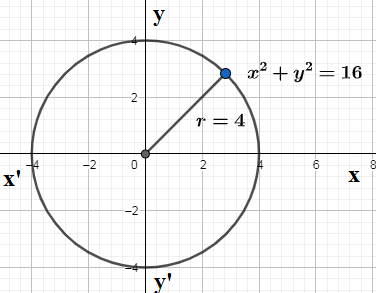
Note: We see that the locus of all the points with $r=4$ in polar form is circle with centre at origin and radius 4. The general equation of circle with centre $\left( a,b \right)$ and radius $r$ is given as ${{\left( x-a \right)}^{2}}+{{\left( y-b \right)}^{2}}={{r}^{2}}$ which in parametric form is $\left( a+r\cos \theta ,b+r\sin \theta \right)$. Here in this problem $\left( a,b \right)=\left( 0,0 \right)$ and all points on ${{x}^{2}}+{{y}^{2}}=16$ in parametric form are $\left( 4\cos \theta ,4\sin \theta \right),\theta \in \left[ 0,2\pi \right)$. We can convert from Cartesian $\left( x,y \right)$ form to polar form $\left( r,\theta \right)$ such that $r=\sqrt{{{x}^{2}}+{{y}^{2}}}$ and $\theta ={{\tan }^{-1}}\left( \dfrac{y}{x} \right)$ with the condition on $\theta $ that $\theta $ will be measured in clockwise or anticlockwise sense from positive $x-$axis (polar axis) to minimize the amount of rotation.
Complete step by step answer:
We know that in the Cartesian coordinate system two perpendicular intersecting lines are taken as reference axes called $x-$axis and $y-$axis. Any point on the plane is denoted as $\left( x,y \right)$ where $x$ is the distance from $y-$axis and $y$is the distance from $x-$axis. \[\]
We know in the polar coordinate system a ray and a point are taken as reference. The ray is called the polar axis and the point is called pole. Any point on the plane at a distance be $r$ and angle subtended ray joining from pole to that point with the polar axis be $\theta $ and the polar coordinates of that point $\left( r,\theta \right)$ where $r$ is called radial coordinate and $\theta $is called angular coordinate.\[\]
If we take positive $x-$axis as the polar axis and origin as the pole then any coordinate any in polar form $\left( r,\theta \right)$ can be converted to Cartesian form $\left( x,y \right)$ using working rule
\[\begin{align}
& x=r\cos \theta \\
& y=r\sin \theta \\
\end{align}\]
We square each of the above equation to have
\[\begin{align}
& {{x}^{2}}={{r}^{2}}{{\cos }^{2}}\theta \\
& {{y}^{2}}={{r}^{2}}{{\sin }^{2}}\theta \\
\end{align}\]
We add respective sides of each equation in order to eliminate $\theta $. We have
\[\begin{align}
& {{x}^{2}}+{{y}^{2}}={{r}^{2}}{{\cos }^{2}}\theta +{{r}^{2}}{{\sin }^{2}}\theta \\
& \Rightarrow {{x}^{2}}+{{y}^{2}}={{r}^{2}}\left( {{\cos }^{2}}\theta +{{\sin }^{2}}\theta \right) \\
\end{align}\]
We use the Pythagorean trigonometric identity ${{\sin }^{2}}\theta +{{\cos }^{2}}\theta =1$ in the above step to have;
\[\Rightarrow {{x}^{2}}+{{y}^{2}}={{r}^{2}}\]
We are given that $r=4$. We put $r=4$ in the above step to have;
\[\begin{align}
& \Rightarrow {{x}^{2}}+{{y}^{2}}={{4}^{2}} \\
& \Rightarrow {{x}^{2}}+{{y}^{2}}=16 \\
\end{align}\]
The above equation represents $\left( x,y \right)$ such that $r=4$. \[\]
Note: We see that the locus of all the points with $r=4$ in polar form is circle with centre at origin and radius 4. The general equation of circle with centre $\left( a,b \right)$ and radius $r$ is given as ${{\left( x-a \right)}^{2}}+{{\left( y-b \right)}^{2}}={{r}^{2}}$ which in parametric form is $\left( a+r\cos \theta ,b+r\sin \theta \right)$. Here in this problem $\left( a,b \right)=\left( 0,0 \right)$ and all points on ${{x}^{2}}+{{y}^{2}}=16$ in parametric form are $\left( 4\cos \theta ,4\sin \theta \right),\theta \in \left[ 0,2\pi \right)$. We can convert from Cartesian $\left( x,y \right)$ form to polar form $\left( r,\theta \right)$ such that $r=\sqrt{{{x}^{2}}+{{y}^{2}}}$ and $\theta ={{\tan }^{-1}}\left( \dfrac{y}{x} \right)$ with the condition on $\theta $ that $\theta $ will be measured in clockwise or anticlockwise sense from positive $x-$axis (polar axis) to minimize the amount of rotation.
Recently Updated Pages
Master Class 11 Social Science: Engaging Questions & Answers for Success

Master Class 11 English: Engaging Questions & Answers for Success
Master Class 11 Maths: Engaging Questions & Answers for Success
Master Class 11 Chemistry: Engaging Questions & Answers for Success
Master Class 11 Biology: Engaging Questions & Answers for Success
Master Class 11 Physics: Engaging Questions & Answers for Success
Trending doubts
One Metric ton is equal to kg A 10000 B 1000 C 100 class 11 physics CBSE
Difference Between Prokaryotic Cells and Eukaryotic Cells
Draw a diagram of a plant cell and label at least eight class 11 biology CBSE
Two of the body parts which do not appear in MRI are class 11 biology CBSE
Which gas is abundant in air class 11 chemistry CBSE
10 examples of friction in our daily life