




How do you convert r = 3 in rectangular form?
Answer
 Verified
562.2k+ views
Hint: We will first find r in terms of x and y. Then we will have a circle with centre as origin. We can draw the circle and join the x – coordinate at the line to x – axis and similarly y – axis.
Complete step by step solution:
We are given that we are required to convert r = 3 in the rectangular form.
Since, we know that in polar form, ${r^2} = {x^2} + {y^2}$.
Taking the square – root of the above equation on both the sides, we will then obtain the following equation:-
$ \Rightarrow r = \sqrt {{x^2} + {y^2}} $
Putting this in the given equation r = 3, we will then obtain the following equation as:-
$ \Rightarrow \sqrt {{x^2} + {y^2}} = 3$
Taking the square of the above equation on both the sides, we will then obtain the following equation:-
$ \Rightarrow {x^2} + {y^2} = {3^2}$
Simplifying the calculations on the right hand side of the above equation, we will then obtain the following equation with us:-
$ \Rightarrow {x^2} + {y^2} = 9$
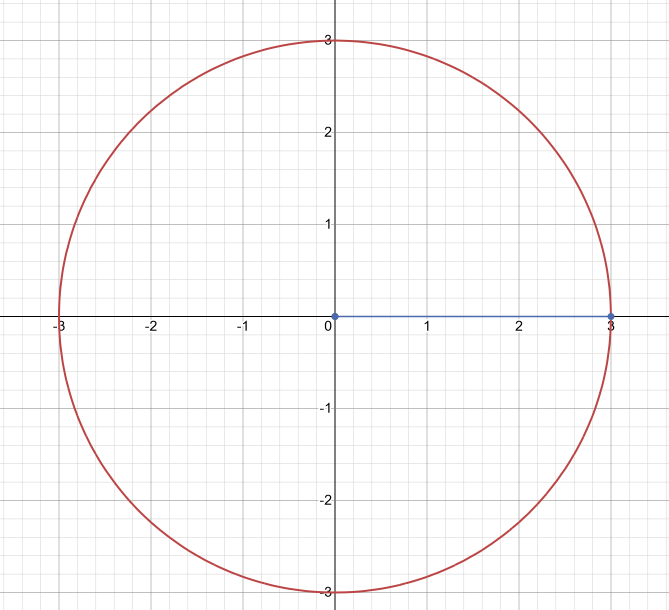
Plotting this circle on the axis, we will then obtain the following equation as:-
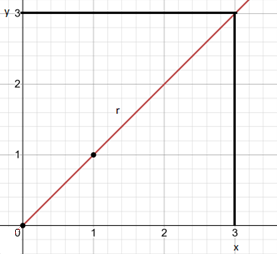
Now, if we wish to convert this in rectangular form, we will then get the following image:-
Thus, we have the required answer.
Note: The students must note that in the rectangular form, we just took the point on the circle and joined it to both the x and y – axis to get the rectangular form.
The students must know that in polar form, we assume that:
$ \Rightarrow x = r\cos \theta $
$ \Rightarrow y = r\sin \theta $
Squaring both the above equations on both the sides, we will then obtain the following equations:-
$ \Rightarrow {x^2} = {r^2}{\cos ^2}\theta $
$ \Rightarrow {y^2} = {r^2}{\sin ^2}\theta $
Adding both the above equations, we will then obtain the following equation as:-
$ \Rightarrow {x^2} + {y^2} = {r^2}{\cos ^2}\theta + {r^2}{\sin ^2}\theta $
Taking ${r^2}$ common from both the terms in the right hand side, we will then obtain the following equation as:-
$ \Rightarrow {x^2} + {y^2} = {r^2}\left( {{{\cos }^2}\theta + {{\sin }^2}\theta } \right)$
Since, we know that we have an identity which states that: ${\cos ^2}\theta + {\sin ^2}\theta = 1$. Thus, we have:-
$ \Rightarrow {x^2} + {y^2} = {r^2} \times 1$
Simplifying the calculations on the right hand side in the above equation, we will then obtain the following equation:-
$ \Rightarrow {x^2} + {y^2} = {r^2}$
Complete step by step solution:
We are given that we are required to convert r = 3 in the rectangular form.
Since, we know that in polar form, ${r^2} = {x^2} + {y^2}$.
Taking the square – root of the above equation on both the sides, we will then obtain the following equation:-
$ \Rightarrow r = \sqrt {{x^2} + {y^2}} $
Putting this in the given equation r = 3, we will then obtain the following equation as:-
$ \Rightarrow \sqrt {{x^2} + {y^2}} = 3$
Taking the square of the above equation on both the sides, we will then obtain the following equation:-
$ \Rightarrow {x^2} + {y^2} = {3^2}$
Simplifying the calculations on the right hand side of the above equation, we will then obtain the following equation with us:-
$ \Rightarrow {x^2} + {y^2} = 9$
Plotting this circle on the axis, we will then obtain the following equation as:-
Now, if we wish to convert this in rectangular form, we will then get the following image:-
Thus, we have the required answer.
Note: The students must note that in the rectangular form, we just took the point on the circle and joined it to both the x and y – axis to get the rectangular form.
The students must know that in polar form, we assume that:
$ \Rightarrow x = r\cos \theta $
$ \Rightarrow y = r\sin \theta $
Squaring both the above equations on both the sides, we will then obtain the following equations:-
$ \Rightarrow {x^2} = {r^2}{\cos ^2}\theta $
$ \Rightarrow {y^2} = {r^2}{\sin ^2}\theta $
Adding both the above equations, we will then obtain the following equation as:-
$ \Rightarrow {x^2} + {y^2} = {r^2}{\cos ^2}\theta + {r^2}{\sin ^2}\theta $
Taking ${r^2}$ common from both the terms in the right hand side, we will then obtain the following equation as:-
$ \Rightarrow {x^2} + {y^2} = {r^2}\left( {{{\cos }^2}\theta + {{\sin }^2}\theta } \right)$
Since, we know that we have an identity which states that: ${\cos ^2}\theta + {\sin ^2}\theta = 1$. Thus, we have:-
$ \Rightarrow {x^2} + {y^2} = {r^2} \times 1$
Simplifying the calculations on the right hand side in the above equation, we will then obtain the following equation:-
$ \Rightarrow {x^2} + {y^2} = {r^2}$
Recently Updated Pages
Master Class 11 Social Science: Engaging Questions & Answers for Success

Master Class 11 Physics: Engaging Questions & Answers for Success
Master Class 11 Maths: Engaging Questions & Answers for Success
Master Class 11 Economics: Engaging Questions & Answers for Success
Master Class 11 Computer Science: Engaging Questions & Answers for Success
Master Class 11 Chemistry: Engaging Questions & Answers for Success
Trending doubts
One Metric ton is equal to kg A 10000 B 1000 C 100 class 11 physics CBSE
There are 720 permutations of the digits 1 2 3 4 5 class 11 maths CBSE
1 Quintal is equal to a 110 kg b 10 kg c 100kg d 1000 class 11 physics CBSE
State and prove Bernoullis theorem class 11 physics CBSE
Difference Between Prokaryotic Cells and Eukaryotic Cells
Discuss the various forms of bacteria class 11 biology CBSE