




How do you convert \[\dfrac{7\pi }{5}\] from radians to degree?
Answer
 Verified
607.5k+ views
Hint: First understand the relation between the real number \[\pi \] and the angle corresponding to it in degrees. To do this, assume a circle of unit radius and use the relation: - \[\theta =\dfrac{l}{r}\] to establish the required relation between radian and degrees. Once the value of \[\pi \] radian is known in terms of degrees, multiply both the sides with \[\dfrac{7}{5}\] to get the answer.
Complete step-by-step solution:
Here, we have been provided with the angle \[\dfrac{7\pi }{5}\] radian and we have been asked to convert it into degrees. But first we need to know the relation between radian and degrees.
Here, we have been provided with the angle \[\dfrac{7\pi }{5}\] radian and we have been asked to convert it into degrees. But first we need to know the relation between radian and degrees.
Now, let us consider a circle with unit radius.
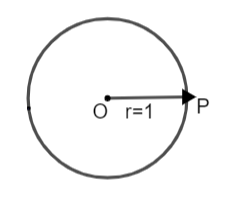
Consider a point P which starts moving on the circumference of this circle. We know that circumference of a circle is given as: - \[l=2\pi r\], here ‘l’ can be said as the length of the arc. Since, the radius is 1 unit, so we have,
\[\begin{align}
& \Rightarrow l=2\pi \times 1 \\
& \Rightarrow l=2\pi \\
\end{align}\]
Using the formula: - \[\theta =\dfrac{l}{r}\], we get,
\[\Rightarrow \theta =\dfrac{2\pi }{1}\]
\[\Rightarrow \theta =2\pi \] radian
Here, \[\theta \] represents the angle subtended by the initial and final position of the point P at the centre of the circle. Now, when this point P will return at the starting point then it will form an angle of \[2\pi \] radian but we know that it will form a complete angle, i.e., 360 degrees. So, we can relate the two units of measurement of angle as: -
\[\Rightarrow 2\pi \] radian = 360 degrees
Dividing both the sides with 2, we get,
\[\Rightarrow \pi \] radian = 180 degrees – (1)
Now, let us come to the question. Here, we have the angle \[\dfrac{7\pi }{5}\] radian. So, it can be written as: -
\[\Rightarrow \dfrac{7\pi }{5}\] radian = \[\dfrac{7}{5}\times \pi \] radian
Using relation (1), we get,
\[\Rightarrow \dfrac{7\pi }{5}\] radian = \[\left( \dfrac{7}{5}\times 180 \right)\] degrees
On simplifying the R.H.S., we get,
\[\Rightarrow \dfrac{7\pi }{5}\] radian = 252 degrees
Hence, \[\dfrac{7\pi }{5}\] radian measures 252 degrees.
Note: One may note that ‘\[\pi \]’ is a real number and its value is nearly 3.14. So, do not get confused. You don’t need to remember the derivation of the relationship between angle in radian and degrees but you need to remember the result, i.e., \[\pi \] radian = 180 degrees. Note that these notations are used in higher trigonometry instead of degrees. There is one more unit of angle measurement that is ‘Grad’ but very few books use this notation so we can ignore it.
Complete step-by-step solution:
Here, we have been provided with the angle \[\dfrac{7\pi }{5}\] radian and we have been asked to convert it into degrees. But first we need to know the relation between radian and degrees.
Here, we have been provided with the angle \[\dfrac{7\pi }{5}\] radian and we have been asked to convert it into degrees. But first we need to know the relation between radian and degrees.
Now, let us consider a circle with unit radius.
Consider a point P which starts moving on the circumference of this circle. We know that circumference of a circle is given as: - \[l=2\pi r\], here ‘l’ can be said as the length of the arc. Since, the radius is 1 unit, so we have,
\[\begin{align}
& \Rightarrow l=2\pi \times 1 \\
& \Rightarrow l=2\pi \\
\end{align}\]
Using the formula: - \[\theta =\dfrac{l}{r}\], we get,
\[\Rightarrow \theta =\dfrac{2\pi }{1}\]
\[\Rightarrow \theta =2\pi \] radian
Here, \[\theta \] represents the angle subtended by the initial and final position of the point P at the centre of the circle. Now, when this point P will return at the starting point then it will form an angle of \[2\pi \] radian but we know that it will form a complete angle, i.e., 360 degrees. So, we can relate the two units of measurement of angle as: -
\[\Rightarrow 2\pi \] radian = 360 degrees
Dividing both the sides with 2, we get,
\[\Rightarrow \pi \] radian = 180 degrees – (1)
Now, let us come to the question. Here, we have the angle \[\dfrac{7\pi }{5}\] radian. So, it can be written as: -
\[\Rightarrow \dfrac{7\pi }{5}\] radian = \[\dfrac{7}{5}\times \pi \] radian
Using relation (1), we get,
\[\Rightarrow \dfrac{7\pi }{5}\] radian = \[\left( \dfrac{7}{5}\times 180 \right)\] degrees
On simplifying the R.H.S., we get,
\[\Rightarrow \dfrac{7\pi }{5}\] radian = 252 degrees
Hence, \[\dfrac{7\pi }{5}\] radian measures 252 degrees.
Note: One may note that ‘\[\pi \]’ is a real number and its value is nearly 3.14. So, do not get confused. You don’t need to remember the derivation of the relationship between angle in radian and degrees but you need to remember the result, i.e., \[\pi \] radian = 180 degrees. Note that these notations are used in higher trigonometry instead of degrees. There is one more unit of angle measurement that is ‘Grad’ but very few books use this notation so we can ignore it.
Recently Updated Pages
Master Class 11 English: Engaging Questions & Answers for Success

Master Class 11 Physics: Engaging Questions & Answers for Success
Master Class 11 Computer Science: Engaging Questions & Answers for Success
Master Class 11 Chemistry: Engaging Questions & Answers for Success
Master Class 11 Social Science: Engaging Questions & Answers for Success
Master Class 11 Accountancy: Engaging Questions & Answers for Success
Trending doubts
Draw a diagram of a plant cell and label at least eight class 11 biology CBSE
Proton was discovered by A Thomson B Rutherford C Chadwick class 11 chemistry CBSE
What is the purity of pure gold in carat class 11 chemistry CBSE
Can anyone list 10 advantages and disadvantages of friction
Lysosomes are known as suicidal bags of cell why class 11 biology CBSE
Derive the equation of motion by the calculus method class 11 physics CBSE