




Convert: Bromobenzene into methyl benzene. Write the name of the reaction.
Answer
 Verified
553.2k+ views
Hint: Conversion of Bromobenzene into methylbenzene is a two-step process. Bromobenzene gets converted to methylbenzene by the reaction of Bromobenzene with methyl bromide with the formation of free radicals in between.
Complete step by step answer:
We know that Benzene having ${C_6}{H_6}$ as its molecular formula is an organic compound that can be easily converted into several compounds in the presence of specific reagents. Now, the conversion of Bromobenzene to methyl benzene can be done by a named reaction, that is, Wurtz-Fittig reaction. Let’s have a look at its mechanism first. Mechanism of Wurtz-Fittig reaction can be explained by radical mechanism. In this reaction, sodium atom is used which acts as a moderator in the formation of aryl or alkyl radical which further reacts to form substituted aromatic compounds.
Mechanism:
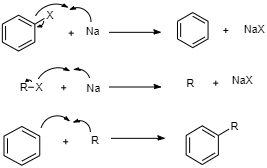
Here, in the first step, first the halide bond will cleave from the halide benzene, and then that halide will react with $Na$ and then as result benzene and sodium halide will be formed.
In the second step, there will be a bond cleavage of $R - X$ and then that halide will react with sodium which is acting as a moderator and then free radical $R$ and $NaX$ will be formed.
And finally, in the last step, benzene from the first step and alkyl halide from the second step will react together, and then finally there will be a formation of alkylbenzene.
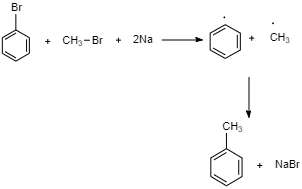
Now, let’s look at the conversion of Bromobenzene to methyl benzene.
Note:
In the conversion process, Wurtz-Fittig reaction is used, where sodium is used as a moderator which leads to the formation of radicals, and further our final product is formed.
Complete step by step answer:
We know that Benzene having ${C_6}{H_6}$ as its molecular formula is an organic compound that can be easily converted into several compounds in the presence of specific reagents. Now, the conversion of Bromobenzene to methyl benzene can be done by a named reaction, that is, Wurtz-Fittig reaction. Let’s have a look at its mechanism first. Mechanism of Wurtz-Fittig reaction can be explained by radical mechanism. In this reaction, sodium atom is used which acts as a moderator in the formation of aryl or alkyl radical which further reacts to form substituted aromatic compounds.
Mechanism:
Here, in the first step, first the halide bond will cleave from the halide benzene, and then that halide will react with $Na$ and then as result benzene and sodium halide will be formed.
In the second step, there will be a bond cleavage of $R - X$ and then that halide will react with sodium which is acting as a moderator and then free radical $R$ and $NaX$ will be formed.
And finally, in the last step, benzene from the first step and alkyl halide from the second step will react together, and then finally there will be a formation of alkylbenzene.
Now, let’s look at the conversion of Bromobenzene to methyl benzene.
Note:
In the conversion process, Wurtz-Fittig reaction is used, where sodium is used as a moderator which leads to the formation of radicals, and further our final product is formed.
Recently Updated Pages
Master Class 12 Business Studies: Engaging Questions & Answers for Success

Master Class 12 Biology: Engaging Questions & Answers for Success
Master Class 12 Chemistry: Engaging Questions & Answers for Success
Class 12 Question and Answer - Your Ultimate Solutions Guide
Master Class 11 Social Science: Engaging Questions & Answers for Success
Master Class 11 English: Engaging Questions & Answers for Success
Trending doubts
Draw a labelled sketch of the human eye class 12 physics CBSE
Name the part of the flower which the tassels of the class 12 biology CBSE
The value of constant k in coulombs law is beginalign class 12 physics CBSE
What is the structural formula of Aspirin A B C D class 12 chemistry CBSE
Why should a magnesium ribbon be cleaned before burning class 12 chemistry CBSE
Quantisation of charge implies a Charge does not exist class 12 physics CBSE