




Conversion of hexane into benzene involves the reaction of:
A. Hydration
B. Hydrolysis
C. Hydrogenation
D. Dehydrogenation
Answer
 Verified
592.2k+ views
Hint: Hexane is a saturated alkane with 6 – carbon atom alkyl chain. The conversion of hexane into benzene involves it being converted into a cyclic structure and then the aromatic compound benzene. For a cyclic or ring structure, it is necessary to remove the hydrogen atoms to make it into a ring. Also aromatic compounds involve unsaturated (double) bonds.
Complete answer:
Hexane is a hydrocarbon and classified as an alkane with saturated single bonds having a chain of 6 carbon atoms with molecular formula, ${{C}_{6}}{{H}_{14}}$. Now, we have to convert it into benzene that has a molecular formula${{C}_{6}}{{H}_{6}}$. Clearly, as we can see there is removal of hydrogen atoms from hexane${{C}_{6}}{{H}_{14}}$to make it benzene ${{C}_{6}}{{H}_{6}}$. So, this will go through a process of removal of hydrogen called dehydrogenation.
The conversion will include treating the hexane molecule with the catalyst that is oxides of metals like vanadium oxide or chromium oxide. This will remove hydrogen atoms from hexane and form a cyclic structure called cyclohexane. The reaction is:
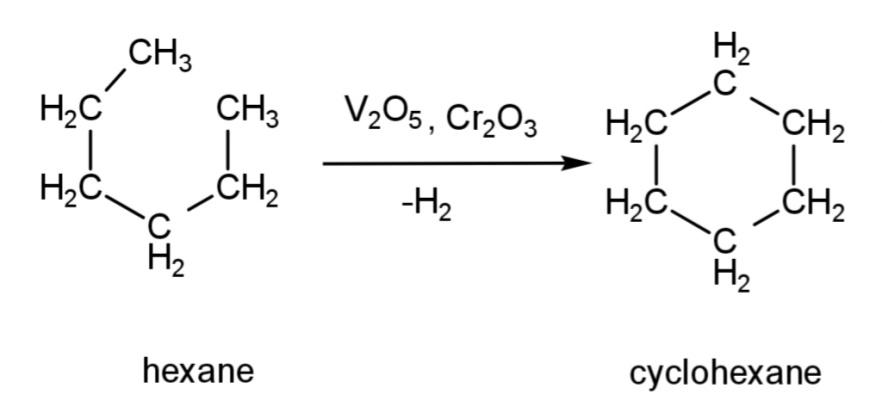
This cyclohexane at a very high temperature loses more hydrogen atoms (3 hydrogen molecules) and undergoes aromatization to form aromatic benzene. The reaction is:
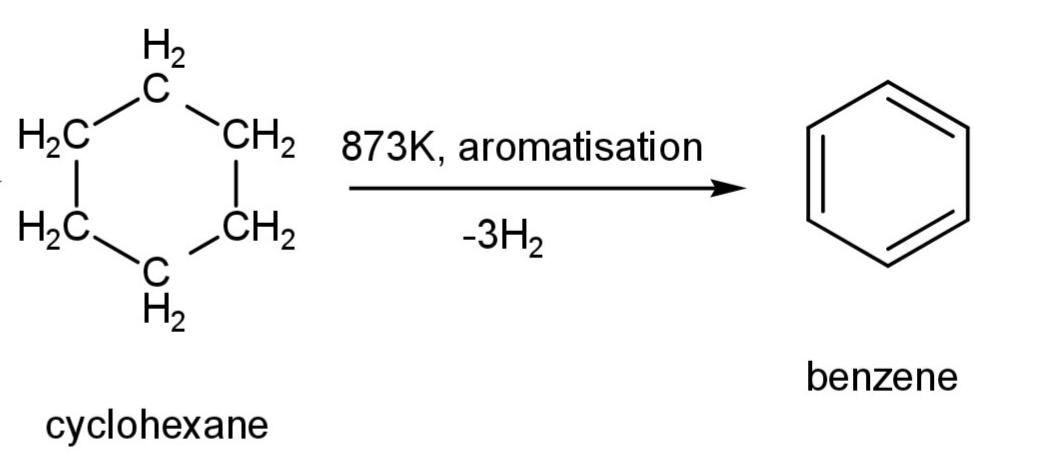
Hence, conversion of hexane into benzene involves the reaction of dehydrogenation, so option D is correct.
Note:
As dehydrogenation removes the hydrogen molecules, hydrogenation is the opposite of it as it is the reaction where an unsaturated compound (alkenes) adds hydrogen and converts to saturated compounds. Hydration is the addition of water molecules, and hydrolysis involves the cleavage of any compound in presence of water.
Complete answer:
Hexane is a hydrocarbon and classified as an alkane with saturated single bonds having a chain of 6 carbon atoms with molecular formula, ${{C}_{6}}{{H}_{14}}$. Now, we have to convert it into benzene that has a molecular formula${{C}_{6}}{{H}_{6}}$. Clearly, as we can see there is removal of hydrogen atoms from hexane${{C}_{6}}{{H}_{14}}$to make it benzene ${{C}_{6}}{{H}_{6}}$. So, this will go through a process of removal of hydrogen called dehydrogenation.
The conversion will include treating the hexane molecule with the catalyst that is oxides of metals like vanadium oxide or chromium oxide. This will remove hydrogen atoms from hexane and form a cyclic structure called cyclohexane. The reaction is:
This cyclohexane at a very high temperature loses more hydrogen atoms (3 hydrogen molecules) and undergoes aromatization to form aromatic benzene. The reaction is:
Hence, conversion of hexane into benzene involves the reaction of dehydrogenation, so option D is correct.
Note:
As dehydrogenation removes the hydrogen molecules, hydrogenation is the opposite of it as it is the reaction where an unsaturated compound (alkenes) adds hydrogen and converts to saturated compounds. Hydration is the addition of water molecules, and hydrolysis involves the cleavage of any compound in presence of water.
Recently Updated Pages
If x a + bt + ct2 where x is in meters and t is in class 11 physics CBSE

A car covers the first half distance between two places class 11 physics CBSE
The resultant of two vectors overrightarrow P and overrightarrow class 11 physics CBSE
Find the value of cos 135 class 11 maths CBSE
A mass M is held in place by an applied force F and class 11 physics CBSE
A solution of glucose in water is labelled as 10 dfracwv class 11 chemistry CBSE
Trending doubts
One Metric ton is equal to kg A 10000 B 1000 C 100 class 11 physics CBSE
Find the value of the expression given below sin 30circ class 11 maths CBSE
What do you mean by retardation What is its SI uni class 11 physics CBSE
Draw a diagram of nephron and explain its structur class 11 biology CBSE
10 examples of friction in our daily life
Difference between physical and chemical change class 11 chemistry CBSE