




Contraction cycle of muscle showing four parts of muscle twitch, find out correct consequence.
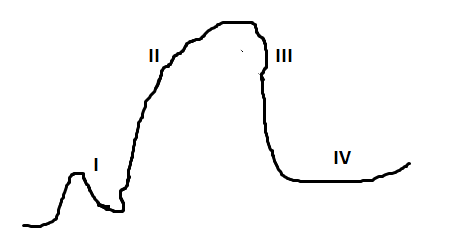
A) (i) Latent period (ii) relaxation period (iii) refractory period (iv) contraction
B) (i) Contraction (ii) latent period (iii) relaxation period (iv) refractory period
C) (i) Latent period (ii) contraction (iii) relaxation period (iv) refractory period
D) (i) Refractory period (ii) relaxation period (iii) latent period (iv) contraction
Answer
 Verified
589.2k+ views
Hint: Muscle twitching refers to contraction in the particular area of muscle. Muscle twitching can be minor or major minor muscle twitching are mostly ignored or left noticed. Some of the muscle twitching are common and normal but some can be the severe symptoms of nervous system disorder.
Complete answer:
The pattern of correct answer is given as under -
Latent period of muscle: This period implies decay and gap between the receipt of the stimulus through the sensory nerve and the response to it is latent period. This is the time period between stimulus to the nerve and contraction to the nerve.
Contraction period: This period implies the time period between the muscles undergoes a process of depreciation and when it starts contracting. In other words, we can say the contraction period tells about the time period of actual muscle contraction.
Relation period: Relation period is the period between the muscle relax as the stimulus is stopped and moved away. The word lesson period implies a relationship between frequency and wavelength.
Refractory period: Refractory period implies the period that is followed by stimulation.
During which the muscle becomes and progressive to further stimulation. During the refractory period the cell is incapable of repeating an action potential.
So, from above we can say that the correct pattern is latent period of muscle followed by contraction period followed by relation period and then refractory period at the last.
Hence, the correct answer is option (C).
Note: The muscle contraction is triggered by calcium and magnesium ion. The actin and myosin filaments facilitate the contraction of muscles. In contraction the calcium ion binds at the active site of the actin. Magnesium ion regulates the contraction cycle.
Complete answer:
The pattern of correct answer is given as under -
Latent period of muscle: This period implies decay and gap between the receipt of the stimulus through the sensory nerve and the response to it is latent period. This is the time period between stimulus to the nerve and contraction to the nerve.
Contraction period: This period implies the time period between the muscles undergoes a process of depreciation and when it starts contracting. In other words, we can say the contraction period tells about the time period of actual muscle contraction.
Relation period: Relation period is the period between the muscle relax as the stimulus is stopped and moved away. The word lesson period implies a relationship between frequency and wavelength.
Refractory period: Refractory period implies the period that is followed by stimulation.
During which the muscle becomes and progressive to further stimulation. During the refractory period the cell is incapable of repeating an action potential.
So, from above we can say that the correct pattern is latent period of muscle followed by contraction period followed by relation period and then refractory period at the last.
Hence, the correct answer is option (C).
Note: The muscle contraction is triggered by calcium and magnesium ion. The actin and myosin filaments facilitate the contraction of muscles. In contraction the calcium ion binds at the active site of the actin. Magnesium ion regulates the contraction cycle.
Recently Updated Pages
Master Class 11 English: Engaging Questions & Answers for Success

Master Class 11 Social Science: Engaging Questions & Answers for Success
Master Class 11 Maths: Engaging Questions & Answers for Success
Master Class 11 Biology: Engaging Questions & Answers for Success
Master Class 11 Physics: Engaging Questions & Answers for Success
Master Class 11 Chemistry: Engaging Questions & Answers for Success
Trending doubts
One Metric ton is equal to kg A 10000 B 1000 C 100 class 11 physics CBSE
Difference Between Prokaryotic Cells and Eukaryotic Cells
Find the value of the expression given below sin 30circ class 11 maths CBSE
Difference between physical and chemical change class 11 chemistry CBSE
Two of the body parts which do not appear in MRI are class 11 biology CBSE
Draw a diagram of a plant cell and label at least eight class 11 biology CBSE