




Contains carbon that are $s{p^2}$ hybridized:
A. ${C_2}{H_6}$
B. ${C_2}{H_4}$
C. ${C_2}{H_2}$
D. ${C_2}{H_5}OH$
E. ${C_3}{H_8}$
Answer
 Verified
576.6k+ views
Hint: In order to answer this question, you must recall the concepts of Hybridization and Chemical Bonding. Use the formula or the concepts for finding the $s{p^2}$ Hybridization among the given option and choose the correct option.
Complete step by step solution:
Hybridization is defined as the concept of mixing two atomic orbitals with the same energy levels to give a degenerated new type of orbitals. This intermixing is based on quantum mechanics. The atomic orbitals of the same energy level can only take part in hybridization and both full-filled and half-filled orbitals can also take part in this process, provided they have equal energy.
$\text{Hybridization = No. of sigma bonds + No. of lone pairs}$
On substituting the values for given compound we get
${C_2}{H_6}$ the carbon is $s{p^3}$ having hybridization number 4.
${C_2}{H_4}$ the carbon is $s{p^2}$ having hybridization number 3.
${C_2}{H_2}$ the carbon is $s{p^2}$ having hybridization number 2.
${C_2}{H_5}OH$ the carbon is $s{p^2}$ having hybridization number 4.
${C_3}{H_8}$ the carbon is $s{p^2}$ having hybridization number 4.
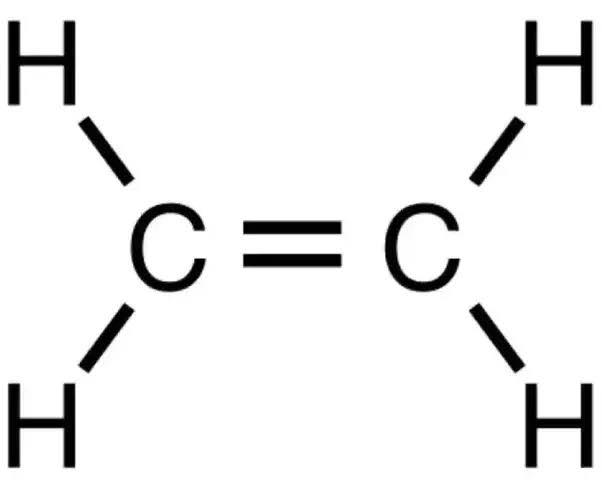
In ethene there are three sigma bonds and zero lone pair therefore the hybridization number is 3 hence the carbon atom is. $s{p^2}$ hybridization is observed when one s and two p orbitals of the same shell of an atom mix to form 3 equivalent orbital.
The new orbitals formed are called $s{p^2}$ hybrid orbitals. Ethene or ${C_2}{H_4}$ is $s{p^2}$ hybridized. Here, each carbon atom has three $s{p^2}$ hybridized orbitals. Two of them form sigma bonds with two Hydrogen atoms. While, the other forms another sigma bond with the second carbon atom.
Hence, we got the required answer i.e. ${C_2}{H_4}$
So, the correct answer is Option B.
Note: Ethene ${C_2}{H_4}$ has a double bond between the carbons. In this case, carbon will $s{p^2}$ hybridize; in $s{p^2}$ hybridization, the 2s orbital mixes with only two of the three available 2p orbitals, forming a total of three sp hybrid orbitals with one p-orbital remaining. The three hybridized orbitals explain the three sigma bonds that each carbon forms.
Complete step by step solution:
Hybridization is defined as the concept of mixing two atomic orbitals with the same energy levels to give a degenerated new type of orbitals. This intermixing is based on quantum mechanics. The atomic orbitals of the same energy level can only take part in hybridization and both full-filled and half-filled orbitals can also take part in this process, provided they have equal energy.
$\text{Hybridization = No. of sigma bonds + No. of lone pairs}$
On substituting the values for given compound we get
${C_2}{H_6}$ the carbon is $s{p^3}$ having hybridization number 4.
${C_2}{H_4}$ the carbon is $s{p^2}$ having hybridization number 3.
${C_2}{H_2}$ the carbon is $s{p^2}$ having hybridization number 2.
${C_2}{H_5}OH$ the carbon is $s{p^2}$ having hybridization number 4.
${C_3}{H_8}$ the carbon is $s{p^2}$ having hybridization number 4.
In ethene there are three sigma bonds and zero lone pair therefore the hybridization number is 3 hence the carbon atom is. $s{p^2}$ hybridization is observed when one s and two p orbitals of the same shell of an atom mix to form 3 equivalent orbital.
The new orbitals formed are called $s{p^2}$ hybrid orbitals. Ethene or ${C_2}{H_4}$ is $s{p^2}$ hybridized. Here, each carbon atom has three $s{p^2}$ hybridized orbitals. Two of them form sigma bonds with two Hydrogen atoms. While, the other forms another sigma bond with the second carbon atom.
Hence, we got the required answer i.e. ${C_2}{H_4}$
So, the correct answer is Option B.
Note: Ethene ${C_2}{H_4}$ has a double bond between the carbons. In this case, carbon will $s{p^2}$ hybridize; in $s{p^2}$ hybridization, the 2s orbital mixes with only two of the three available 2p orbitals, forming a total of three sp hybrid orbitals with one p-orbital remaining. The three hybridized orbitals explain the three sigma bonds that each carbon forms.
Recently Updated Pages
Master Class 11 English: Engaging Questions & Answers for Success

Master Class 11 Social Science: Engaging Questions & Answers for Success
Master Class 11 Maths: Engaging Questions & Answers for Success
Master Class 11 Biology: Engaging Questions & Answers for Success
Master Class 11 Physics: Engaging Questions & Answers for Success
Master Class 11 Chemistry: Engaging Questions & Answers for Success
Trending doubts
Find the value of the expression given below sin 30circ class 11 maths CBSE
Difference between physical and chemical change class 11 chemistry CBSE
Draw a diagram of a plant cell and label at least eight class 11 biology CBSE
Draw a diagram showing the external features of fish class 11 biology CBSE
10 examples of law on inertia in our daily life
Draw a diagram of nephron and explain its structur class 11 biology CBSE