




When constructing an inscribed regular hexagon, how will you choose the arc measurement?
(a) Radius of the circle
(b) Diameter of the circle
(c) Chord of the circle
(d) Circumference of the circle
Answer
 Verified
656.7k+ views
Hint: To solve the given question, we will first find out what a regular hexagon is and what an inscribed regular hexagon is. Then we will derive the relation between each side of a regular hexagon and the radius of the circle in which the regular hexagon is inscribed. On the basis of this relation, we will find out what arc measurement in terms of the radius is.
Complete step by step solution:
Before we solve the question, we must first know what a regular hexagon is. A hexagon is a type of polygon having six sides. A regular hexagon is a type of hexagon in which all the sides are equal. Now, we are given the question that this regular hexagon is inscribed in a circle. This means that the vertices of the regular hexagon will be equally spaced on the circumference of the circle. A rough sketch of the inscribed regular hexagon is shown below.
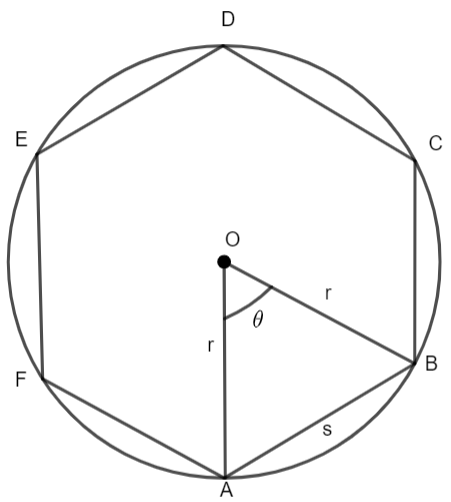
In the above figure, O is the centre of the circle, r is the radius of the circle, s is the length of each side. \[\theta \] is the angle subtended by each side on the centre. Now, we will consider the triangle OAB. Here, we can say that,
\[\cos AOB=\dfrac{{{\left( OA \right)}^{2}}+{{\left( OB \right)}^{2}}-{{\left( AB \right)}^{2}}}{2\left( OA \right)\left( OB \right)}\]
\[\Rightarrow \cos \theta =\dfrac{{{r}^{2}}+{{r}^{2}}-{{s}^{2}}}{2{{r}^{2}}}\]
\[\Rightarrow \cos \theta =\dfrac{2{{r}^{2}}-{{s}^{2}}}{2{{r}^{2}}}\]
\[\Rightarrow \cos \theta =1-\dfrac{{{s}^{2}}}{2{{r}^{2}}}......\left( i \right)\]
Now, each side will subtend \[\theta \] at the centre and there are total of six sides, so,
\[6\theta ={{360}^{\circ }}\]
\[\Rightarrow \theta =\dfrac{{{360}^{\circ }}}{6}\]
\[\Rightarrow \theta ={{60}^{\circ }}\]
Now, we will put this value of \[\theta \] in (i). Thus, we will get,
\[\cos {{60}^{\circ }}=1-\dfrac{{{s}^{2}}}{2{{r}^{2}}}\]
\[\Rightarrow \dfrac{1}{2}=1-\dfrac{{{s}^{2}}}{2{{r}^{2}}}\]
\[\Rightarrow \dfrac{{{s}^{2}}}{2{{r}^{2}}}=1-\dfrac{1}{2}\]
\[\Rightarrow \dfrac{{{s}^{2}}}{2{{r}^{2}}}=\dfrac{1}{2}\]
\[\Rightarrow s=r\]
Hence, the length of the side will be equal to the radius of the circle. Thus, we have to cut the arc AB such that the length of the side AB will be equal to the radius.
Hence, option (a) is the right option.
Note: Here, we have used the radius of the circle for the arc measurement. This does not mean that the length of the arc will be equal to the radius of the circle. This means that the linear distance between the two endpoints of the arc will be equal to the radius of the circle.
Complete step by step solution:
Before we solve the question, we must first know what a regular hexagon is. A hexagon is a type of polygon having six sides. A regular hexagon is a type of hexagon in which all the sides are equal. Now, we are given the question that this regular hexagon is inscribed in a circle. This means that the vertices of the regular hexagon will be equally spaced on the circumference of the circle. A rough sketch of the inscribed regular hexagon is shown below.
In the above figure, O is the centre of the circle, r is the radius of the circle, s is the length of each side. \[\theta \] is the angle subtended by each side on the centre. Now, we will consider the triangle OAB. Here, we can say that,
\[\cos AOB=\dfrac{{{\left( OA \right)}^{2}}+{{\left( OB \right)}^{2}}-{{\left( AB \right)}^{2}}}{2\left( OA \right)\left( OB \right)}\]
\[\Rightarrow \cos \theta =\dfrac{{{r}^{2}}+{{r}^{2}}-{{s}^{2}}}{2{{r}^{2}}}\]
\[\Rightarrow \cos \theta =\dfrac{2{{r}^{2}}-{{s}^{2}}}{2{{r}^{2}}}\]
\[\Rightarrow \cos \theta =1-\dfrac{{{s}^{2}}}{2{{r}^{2}}}......\left( i \right)\]
Now, each side will subtend \[\theta \] at the centre and there are total of six sides, so,
\[6\theta ={{360}^{\circ }}\]
\[\Rightarrow \theta =\dfrac{{{360}^{\circ }}}{6}\]
\[\Rightarrow \theta ={{60}^{\circ }}\]
Now, we will put this value of \[\theta \] in (i). Thus, we will get,
\[\cos {{60}^{\circ }}=1-\dfrac{{{s}^{2}}}{2{{r}^{2}}}\]
\[\Rightarrow \dfrac{1}{2}=1-\dfrac{{{s}^{2}}}{2{{r}^{2}}}\]
\[\Rightarrow \dfrac{{{s}^{2}}}{2{{r}^{2}}}=1-\dfrac{1}{2}\]
\[\Rightarrow \dfrac{{{s}^{2}}}{2{{r}^{2}}}=\dfrac{1}{2}\]
\[\Rightarrow s=r\]
Hence, the length of the side will be equal to the radius of the circle. Thus, we have to cut the arc AB such that the length of the side AB will be equal to the radius.
Hence, option (a) is the right option.
Note: Here, we have used the radius of the circle for the arc measurement. This does not mean that the length of the arc will be equal to the radius of the circle. This means that the linear distance between the two endpoints of the arc will be equal to the radius of the circle.
Recently Updated Pages
Class 10 Question and Answer - Your Ultimate Solutions Guide

Master Class 12 Economics: Engaging Questions & Answers for Success
Master Class 12 Social Science: Engaging Questions & Answers for Success
Master Class 12 English: Engaging Questions & Answers for Success
Master Class 12 Maths: Engaging Questions & Answers for Success
Master Class 12 Physics: Engaging Questions & Answers for Success
Trending doubts
The slogan Jai Hind was given by A Lal Bahadur Shastri class 10 social science CBSE
Identify the feminine form of noun nephew a shenephew class 10 english CBSE
CSIR full form?
Distinguish between coming together federations and class 10 social science CBSE
Draw a diagram of the human eye as seen in a vertical class 10 biology CBSE
Identify the plural form of the word child from the class 10 english CBSE