




Construct the formula of the following compounds using criss crossing valency.
(a) Calcium hydroxide
(b) Ammonium carbonate
(c) Zinc oxide
(d) Aluminium oxide
Answer
 Verified
569.4k+ views
Hint: The Criss Cross valency method is used to write the chemical formula of ionic compounds. In this method, the numeric value of charges present on each element is crossed over and put as the subscript of another ion.
Complete answer:
Ionic compounds are made up of a cationic and an anionic part but the overall compound remains electrically neutral. The Criss Cross valency method is one of the ways to write formulas of such compounds that is discussed below.
(1) - To write the formula of ionic compounds, we start by writing the symbol of cation and anion separately. The action should be written first.
(2) - Then, put only the numeric values of ionic charge of each just below its symbol.
(3) - Then, transpose the charge of cation as a subscript to the anion and the charge of anion will become the subscript of the cation.
(4) - Reduce the formula to its simplest ratio.
(5) - Write the formula of the compound and simply drop the subscript ‘1’, if present.
(6) - If polyatomic ions are present, then put them in curved brackets.
Now, we know how to use the Crisscross method to write the formula of compounds. Let us write the formula of the given compounds by following these steps.
(a) Calcium hydroxide
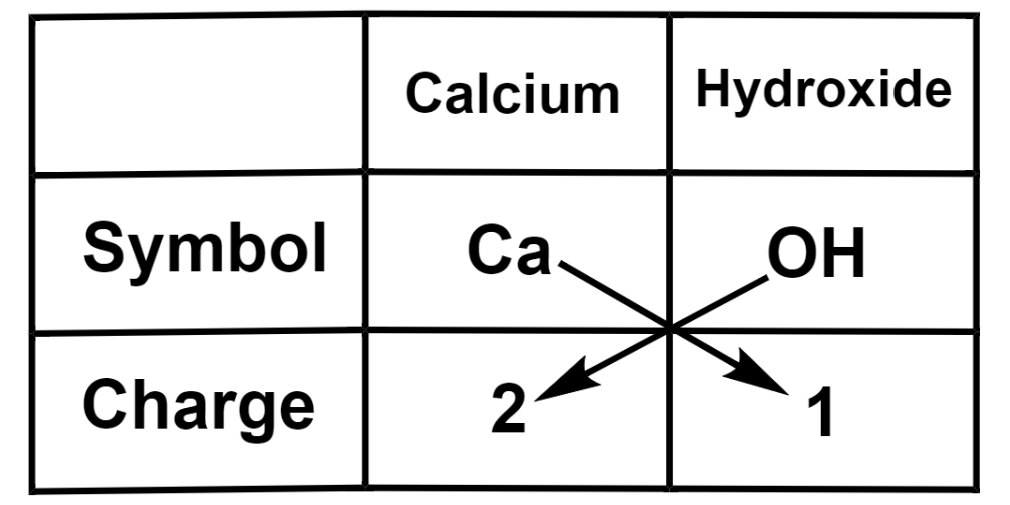
Therefore, we get the formula of calcium hydroxide as $\text{Ca}{{\left( \text{OH} \right)}_{2}}$.
(b) Ammonium carbonate
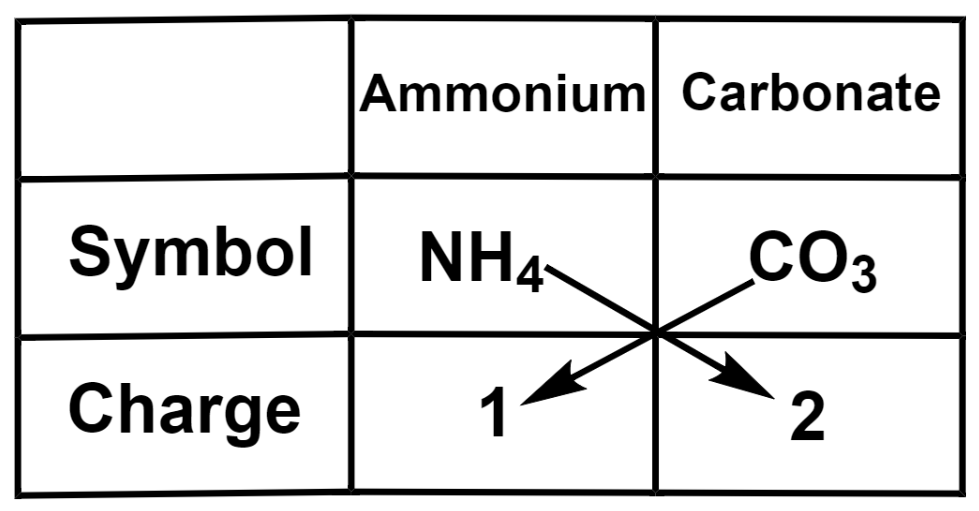
Therefore, we get the formula of ammonium carbonate as ${{\left( \text{N}{{\text{H}}_{4}} \right)}_{2}}\text{C}{{\text{O}}_{3}}$.
(c) Zinc oxide
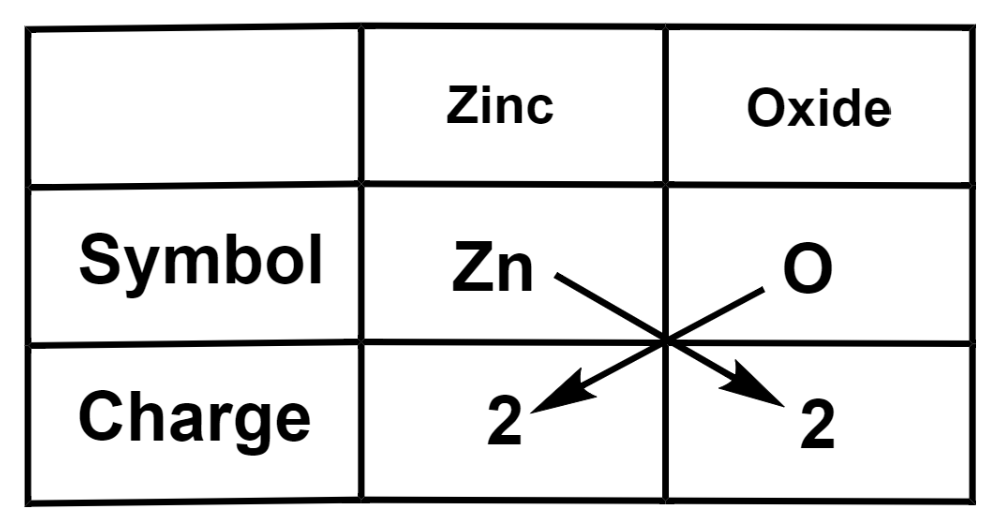
We get the formula of zinc oxide as $\text{Z}{{\text{n}}_{2}}{{\text{O}}_{2}}$. After reducing to the simplest ratio, the actual formula of zinc oxide is ZnO.
(d) Aluminium oxide
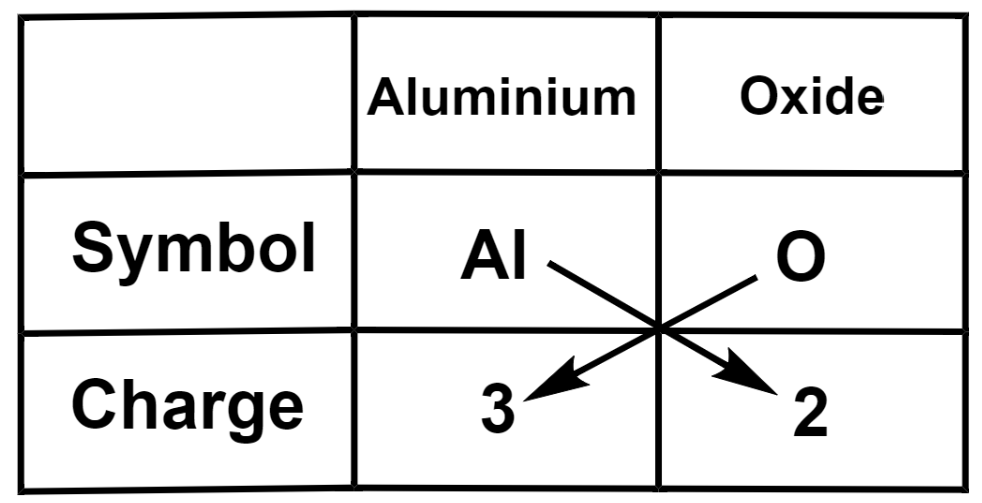
Therefore, we get the formula of aluminium oxide as $\text{A}{{\text{l}}_{2}}{{\text{O}}_{3}}$.
Note:
The ionic compounds exist as a crystal lattice consisting of many ions of cation and anion. The formula of these compounds is thus an empirical formula which only indicates what ratio of anions and cations are present in a compound.
Complete answer:
Ionic compounds are made up of a cationic and an anionic part but the overall compound remains electrically neutral. The Criss Cross valency method is one of the ways to write formulas of such compounds that is discussed below.
(1) - To write the formula of ionic compounds, we start by writing the symbol of cation and anion separately. The action should be written first.
(2) - Then, put only the numeric values of ionic charge of each just below its symbol.
(3) - Then, transpose the charge of cation as a subscript to the anion and the charge of anion will become the subscript of the cation.
(4) - Reduce the formula to its simplest ratio.
(5) - Write the formula of the compound and simply drop the subscript ‘1’, if present.
(6) - If polyatomic ions are present, then put them in curved brackets.
Now, we know how to use the Crisscross method to write the formula of compounds. Let us write the formula of the given compounds by following these steps.
(a) Calcium hydroxide
Therefore, we get the formula of calcium hydroxide as $\text{Ca}{{\left( \text{OH} \right)}_{2}}$.
(b) Ammonium carbonate
Therefore, we get the formula of ammonium carbonate as ${{\left( \text{N}{{\text{H}}_{4}} \right)}_{2}}\text{C}{{\text{O}}_{3}}$.
(c) Zinc oxide
We get the formula of zinc oxide as $\text{Z}{{\text{n}}_{2}}{{\text{O}}_{2}}$. After reducing to the simplest ratio, the actual formula of zinc oxide is ZnO.
(d) Aluminium oxide
Therefore, we get the formula of aluminium oxide as $\text{A}{{\text{l}}_{2}}{{\text{O}}_{3}}$.
Note:
The ionic compounds exist as a crystal lattice consisting of many ions of cation and anion. The formula of these compounds is thus an empirical formula which only indicates what ratio of anions and cations are present in a compound.
Recently Updated Pages
Master Class 11 English: Engaging Questions & Answers for Success

Master Class 11 Social Science: Engaging Questions & Answers for Success
Master Class 11 Maths: Engaging Questions & Answers for Success
Master Class 11 Biology: Engaging Questions & Answers for Success
Master Class 11 Physics: Engaging Questions & Answers for Success
Master Class 11 Chemistry: Engaging Questions & Answers for Success
Trending doubts
1 ton equals to A 100 kg B 1000 kg C 10 kg D 10000 class 11 physics CBSE
Find the value of the expression given below sin 30circ class 11 maths CBSE
What are hard magnetic materials class 11 physics CBSE
Draw a diagram of nephron and explain its structur class 11 biology CBSE
What is the atomic mass of Sodium a 22 gmol b 23 gmol class 11 chemistry CBSE
Lysosomes are known as suicidal bags of cell why class 11 biology CBSE