



Construct an equilateral triangle, given its side and justify the construction.
Answer
 Verified
656.4k+ views
Hint: We know that in an equilateral triangle all sides are equal. First draw the one side of the triangle which will be given in the question. We will use this line end point as two vertices of the triangle. Now our task is to find a third point which has equal distance from both ends. Now draw two arcs from both ends which radii are equal to the length of line. The intersection point of both arcs is our third point. This will have equal distance from both ends. Finally join this point to both ends and we will have the required triangle.
Complete step-by-step answer:
Let’s assume that the side of the equilateral triangle is given ‘a’ cm.
We will be going through the following steps to draw an equilateral triangle of ‘a’ cm.
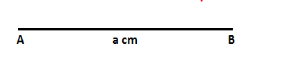
Draw a line segment AB of length ‘a’ cm.
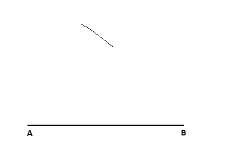
Taking ‘a’ cm as radius, and A as centre, draw an arc.
Taking ‘a’ cm as radius, and B as centre, draw another arc.
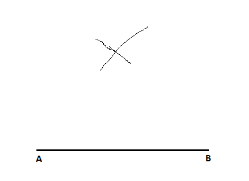
Let C be the point where the two arcs intersect . Join AC and BC and label the sides.
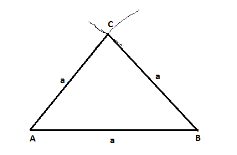
Thus, ABC is the required equilateral triangle.
Justification;
By construction, AB = AC = BC (Radius of equal arcs)
Since, all sides are equal, therefore, ABC is an equilateral triangle.
Note: And altitude of the equilateral triangle bisects its base and opposite angle. By using this information we can also construct an equilateral triangle.
Complete step-by-step answer:
Let’s assume that the side of the equilateral triangle is given ‘a’ cm.
We will be going through the following steps to draw an equilateral triangle of ‘a’ cm.
Draw a line segment AB of length ‘a’ cm.
Taking ‘a’ cm as radius, and A as centre, draw an arc.
Taking ‘a’ cm as radius, and B as centre, draw another arc.
Let C be the point where the two arcs intersect . Join AC and BC and label the sides.
Thus, ABC is the required equilateral triangle.
Justification;
By construction, AB = AC = BC (Radius of equal arcs)
Since, all sides are equal, therefore, ABC is an equilateral triangle.
Note: And altitude of the equilateral triangle bisects its base and opposite angle. By using this information we can also construct an equilateral triangle.
Recently Updated Pages
Master Class 12 Economics: Engaging Questions & Answers for Success

Master Class 12 Social Science: Engaging Questions & Answers for Success
Master Class 12 English: Engaging Questions & Answers for Success
Master Class 12 Maths: Engaging Questions & Answers for Success
Master Class 12 Physics: Engaging Questions & Answers for Success
Master Class 12 Biology: Engaging Questions & Answers for Success
Trending doubts
What does the color green in the national flag of India class 8 social science CBSE
Citizens of India can vote at the age of A 18 years class 8 social science CBSE
One cusec is equal to how many liters class 8 maths CBSE
Which Indian state shares the longest international class 8 social science CBSE
The energy possessed by moving air is called A Tidal class 8 social science CBSE
What is the difference between rai and mustard see class 8 biology CBSE