



Construct a triangle \[PQR\] in which $QR = 6cm$, $\angle Q = 60^\circ $ and $PR - PQ = 2cm$
Answer
 Verified
478.2k+ views
Hint: Here, we need to construct a triangle $PQR$. Let us consider $QR = 6cm$as the baseline of the required triangle. And then using $\angle Q = 60^\circ $, we need to draw a ray. We shall extend the line below the baseline and using $PR - PQ = 2cm$as a radius, we need to draw an arc and join It with $R$. Then we shall draw perpendicular bisectors and join all the required points.
Complete answer:
Here we are given $QR = 6cm$, $\angle Q = 60^\circ $ and $PR - PQ = 2cm$and we need to construct a triangle.
Step $1$: We are given $QR = 6cm$and we shall consider $QR = 6cm$as the base of the required triangle.
So we need to draw a line using a ruler measuring $QR = 6cm$.
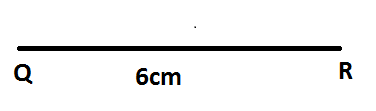
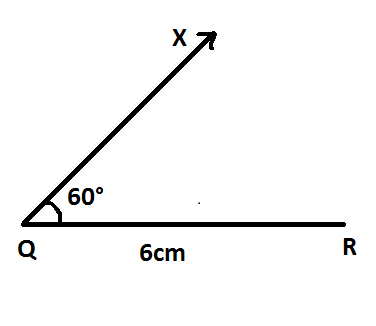
Step $2$: Also, we are given $\angle Q = 60^\circ $. Now, we need to make an angle of $60^\circ $ at $RQX$ using a protractor.
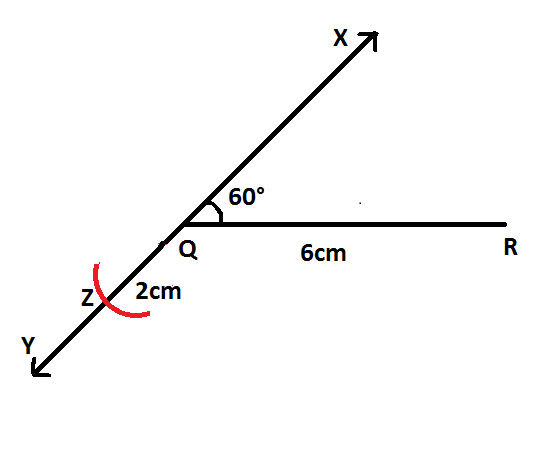
Step $3$: Now, we need to extend the line below $QR$. Next, we shall consider $Q$ as center and radius as $2cm$and we need to draw an arc to intersect the ray $QY$ at $Z$where $QZ = PR - PQ = 2cm$
Here, $PR - PQ = 2cm$$ \Rightarrow PR > PQ$
Also, $PQ - PR$ is negative and so $QZ = PR - PQ = 2cm$will be below the baseline $QR$
Step $4$: Now, we shall join $RZ$.
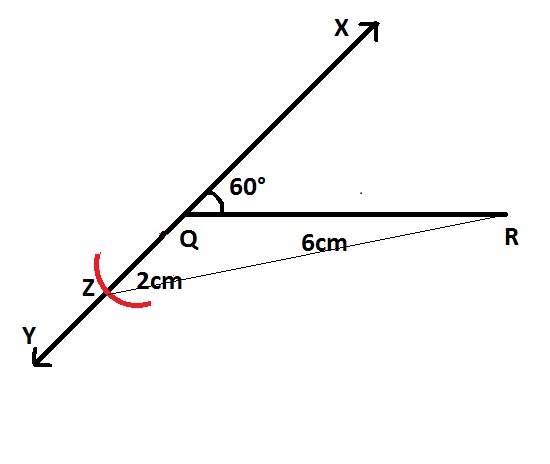
Step $5$: We need to construct a perpendicular bisector of $ZR$. To draw the required perpendicular bisector, with $Z$ and $R$ as center separately and radius greater than half of $ZR$, we shall draw arcs on either side to intersect each other.
Also, we shall join the intersecting points and extend them to meet the ray $QX$ at $P$ .
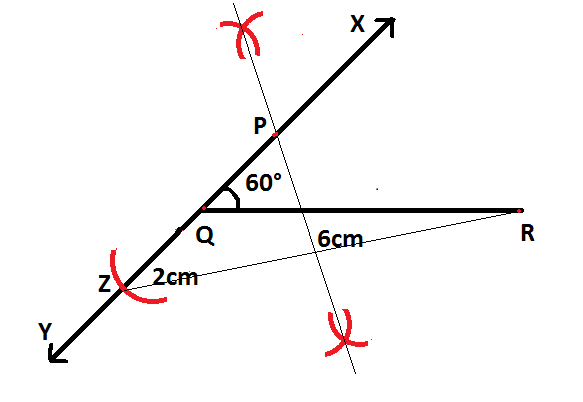
Step $6$: At last we need to join $P$ and $R$. Now, we will obtain the required triangle $PQR$
The required constructed triangle $PQR$is as follows.
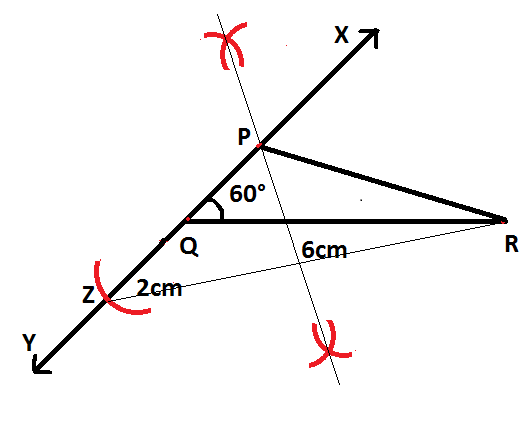
Note: To draw a perpendicular bisector, we need a line segment $ZR$. Then, with a radius a little more than half of the length of $ZR$and \[Z\] as the center, we need to draw arcs above and below the line $ZR$. Again, with a radius a little more than half of the length of $ZR$and $R$ as the center, we need to draw arcs above and below the line $ZR$. Then, using a ruler just draw a line connecting both arcs and we will get the required perpendicular bisector.
Complete answer:
Here we are given $QR = 6cm$, $\angle Q = 60^\circ $ and $PR - PQ = 2cm$and we need to construct a triangle.
Step $1$: We are given $QR = 6cm$and we shall consider $QR = 6cm$as the base of the required triangle.
So we need to draw a line using a ruler measuring $QR = 6cm$.
Step $2$: Also, we are given $\angle Q = 60^\circ $. Now, we need to make an angle of $60^\circ $ at $RQX$ using a protractor.
Step $3$: Now, we need to extend the line below $QR$. Next, we shall consider $Q$ as center and radius as $2cm$and we need to draw an arc to intersect the ray $QY$ at $Z$where $QZ = PR - PQ = 2cm$
Here, $PR - PQ = 2cm$$ \Rightarrow PR > PQ$
Also, $PQ - PR$ is negative and so $QZ = PR - PQ = 2cm$will be below the baseline $QR$
Step $4$: Now, we shall join $RZ$.
Step $5$: We need to construct a perpendicular bisector of $ZR$. To draw the required perpendicular bisector, with $Z$ and $R$ as center separately and radius greater than half of $ZR$, we shall draw arcs on either side to intersect each other.
Also, we shall join the intersecting points and extend them to meet the ray $QX$ at $P$ .
Step $6$: At last we need to join $P$ and $R$. Now, we will obtain the required triangle $PQR$
The required constructed triangle $PQR$is as follows.
Note: To draw a perpendicular bisector, we need a line segment $ZR$. Then, with a radius a little more than half of the length of $ZR$and \[Z\] as the center, we need to draw arcs above and below the line $ZR$. Again, with a radius a little more than half of the length of $ZR$and $R$ as the center, we need to draw arcs above and below the line $ZR$. Then, using a ruler just draw a line connecting both arcs and we will get the required perpendicular bisector.

Recently Updated Pages
Master Class 8 Social Science: Engaging Questions & Answers for Success

Master Class 8 English: Engaging Questions & Answers for Success
Class 8 Question and Answer - Your Ultimate Solutions Guide
Master Class 8 Maths: Engaging Questions & Answers for Success
Master Class 8 Science: Engaging Questions & Answers for Success
Master Class 7 English: Engaging Questions & Answers for Success
Trending doubts
Difference Between Plant Cell and Animal Cell
Fill the blanks with the suitable prepositions 1 The class 9 english CBSE
Which places in India experience sunrise first and class 9 social science CBSE
Who is eligible for RTE class 9 social science CBSE
What is pollution? How many types of pollution? Define it
Name 10 Living and Non living things class 9 biology CBSE