




Construct a triangle of side \[4{\text{ cm}}\] , \[{\text{5 cm}}\] and \[{\text{6 cm}}\] and then a triangle similar to it whose sides are \[\dfrac{2}{3}\] of the corresponding sides of the first triangle. Give the justification of the construction.
Answer
 Verified
522k+ views
Hint: We are going to use the concepts of similarity and construct the diagram. Also, we will learn about the way to construct a triangle, and some rules that have to be followed before constructing a triangle. We will also know a little about the similarity of triangles.
Complete step by step solution:
Generally, in a triangle, the sum of lengths of any two sides is always greater than the third side.
Suppose, if sides of a triangle are of lengths \[a,b{\text{ and }}c\] , then \[a + b > c\] , \[a + c > b\] and \[b + c > a\] .
So, if these conditions are not satisfied, then we cannot construct a triangle.
So, now let’s check the conditions for given sides.
Here, the sides are of length \[4{\text{ cm}}\] , \[{\text{5 cm}}\] and \[{\text{6 cm}}\] .
So, \[4 + 5 > 6\] and \[5 + 6 > 4\] and \[4 + 6 > 5\]
So, all the conditions are satisfied, so a triangle can be constructed.
To construct a triangle, follow these steps:
(1) Draw a line segment \[AB = 6{\text{ cm}}\]
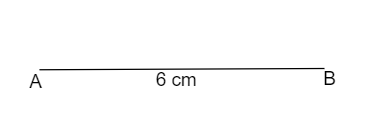
(2) With “B” as centre, draw an arc of radius \[5{\text{ cm}}\] .
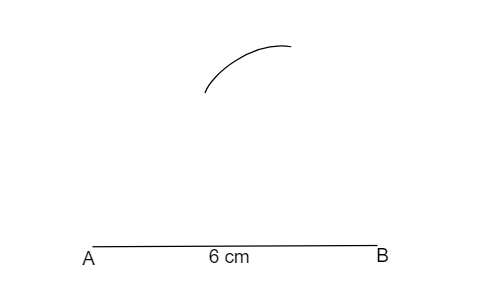
(3) Now, with “A” as centre, draw an arc of radius \[4{\text{ cm}}\] , which cuts the previous arc at “C”.
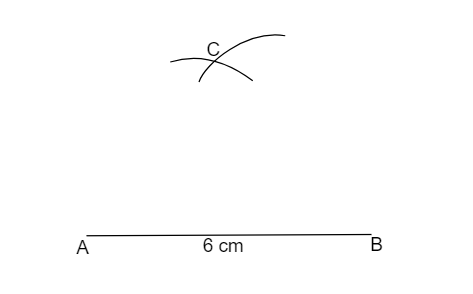
(4) Join A and C, to get \[AC\] and join B and C, to get \[BC\]
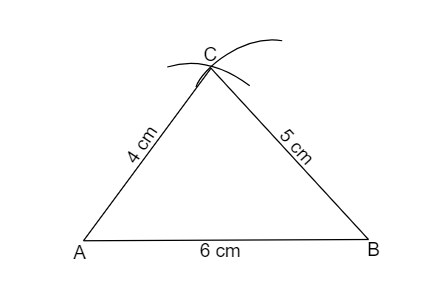
(5) This is the required first triangle.
Now, we need to construct another triangle whose sides are \[\dfrac{2}{3}\] of the corresponding sides of the first triangle.
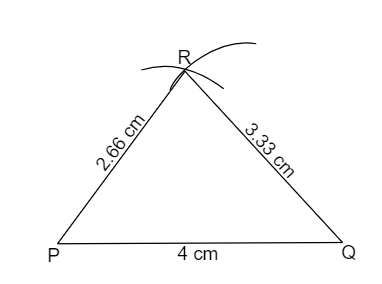
Let the triangle be \[\vartriangle PQR\] where, \[PQ = \dfrac{2}{3}AB\] and \[QR = \dfrac{2}{3}BC\] and \[RP = \dfrac{2}{3}CA\]
\[ \Rightarrow PQ = \dfrac{2}{3}(6) = 4{\text{ cm}}\] and \[QR = \dfrac{{10}}{3}{\text{ cm}}\] and \[RP = \dfrac{8}{3}{\text{ cm}}\]
So, now construct \[\vartriangle PQR\] in the same way, in which we constructed the first triangle.
Draw a line segment \[PQ = 4{\text{ cm}}\] . Then with “Q” as centre, draw an arc of radius \[\dfrac{{10}}{3}{\text{ cm}}\] , then with “P” as centre, draw an arc of radius \[\dfrac{8}{3}{\text{ cm}}\] which cuts the previous arc and you will get the point “R”. Join \[PR\] and \[QR\] . And this is the required triangle similar to the first triangle.
Note: Two triangles are said to be similar, if their corresponding sides are in the same ratio. And also, in similar triangles, the corresponding angles are equal. If the ratios are \[1:1\] , then the corresponding sides are equal and the two triangles are said to be congruent. All congruent triangles are similar, but all similar triangles may or may not be congruent.
Complete step by step solution:
Generally, in a triangle, the sum of lengths of any two sides is always greater than the third side.
Suppose, if sides of a triangle are of lengths \[a,b{\text{ and }}c\] , then \[a + b > c\] , \[a + c > b\] and \[b + c > a\] .
So, if these conditions are not satisfied, then we cannot construct a triangle.
So, now let’s check the conditions for given sides.
Here, the sides are of length \[4{\text{ cm}}\] , \[{\text{5 cm}}\] and \[{\text{6 cm}}\] .
So, \[4 + 5 > 6\] and \[5 + 6 > 4\] and \[4 + 6 > 5\]
So, all the conditions are satisfied, so a triangle can be constructed.
To construct a triangle, follow these steps:
(1) Draw a line segment \[AB = 6{\text{ cm}}\]
(2) With “B” as centre, draw an arc of radius \[5{\text{ cm}}\] .
(3) Now, with “A” as centre, draw an arc of radius \[4{\text{ cm}}\] , which cuts the previous arc at “C”.
(4) Join A and C, to get \[AC\] and join B and C, to get \[BC\]
(5) This is the required first triangle.
Now, we need to construct another triangle whose sides are \[\dfrac{2}{3}\] of the corresponding sides of the first triangle.
Let the triangle be \[\vartriangle PQR\] where, \[PQ = \dfrac{2}{3}AB\] and \[QR = \dfrac{2}{3}BC\] and \[RP = \dfrac{2}{3}CA\]
\[ \Rightarrow PQ = \dfrac{2}{3}(6) = 4{\text{ cm}}\] and \[QR = \dfrac{{10}}{3}{\text{ cm}}\] and \[RP = \dfrac{8}{3}{\text{ cm}}\]
So, now construct \[\vartriangle PQR\] in the same way, in which we constructed the first triangle.
Draw a line segment \[PQ = 4{\text{ cm}}\] . Then with “Q” as centre, draw an arc of radius \[\dfrac{{10}}{3}{\text{ cm}}\] , then with “P” as centre, draw an arc of radius \[\dfrac{8}{3}{\text{ cm}}\] which cuts the previous arc and you will get the point “R”. Join \[PR\] and \[QR\] . And this is the required triangle similar to the first triangle.
Note: Two triangles are said to be similar, if their corresponding sides are in the same ratio. And also, in similar triangles, the corresponding angles are equal. If the ratios are \[1:1\] , then the corresponding sides are equal and the two triangles are said to be congruent. All congruent triangles are similar, but all similar triangles may or may not be congruent.

Recently Updated Pages
Master Class 12 Business Studies: Engaging Questions & Answers for Success

Master Class 12 Biology: Engaging Questions & Answers for Success
Master Class 12 Chemistry: Engaging Questions & Answers for Success
Class 12 Question and Answer - Your Ultimate Solutions Guide
Master Class 11 Social Science: Engaging Questions & Answers for Success
Master Class 11 English: Engaging Questions & Answers for Success
Trending doubts
Convert 200 Million dollars in rupees class 7 maths CBSE
Full Form of IASDMIPSIFSIRSPOLICE class 7 social science CBSE
100 million is equal to begingathered A 1 crore B -class-7-maths-CBSE
List of coprime numbers from 1 to 100 class 7 maths CBSE
The least number which is a perfect square and is divisible class 7 maths CBSE
There are three types of tickets economy business and class 7 maths CBSE