



Construct a triangle ABC in which AB = AC = 5.44 cm and BC = 6 cm. Draw all its lines of symmetry.
Answer
 Verified
595.5k+ views
Hint: In this particular construction problem always have a basic gist of ruler and compass and always construct the given construction step by step, so first draw the given triangle then draw the perpendicular from the intersection of sides which has same length, so use these concepts to reach the solution of the question.
Complete step-by-step answer:
Triangle having sides AB = 5.44 cm, AC = 5.44 cm and BC = 6 cm.
Steps of construction:
$\left( i \right)$ Draw a horizontal line BC of 6 cm using a ruler.

$\left( {ii} \right)$ Now take a compass with pointed end at B and make an arc with pencil end at 5.44 cm above line BC as shown in the below figure.
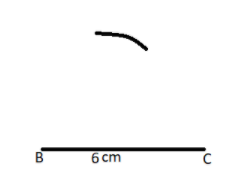
$\left( {iii} \right)$ Now again take a compass with pointed end at C and make an arc with pencil end at 5.44 cm above line BC, which cut the previous arc at point A as shown in the below figure, now join AB and AC.
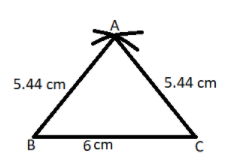
So this is the required triangle of sides AB = AC = 5.44 cm and BC = 6 cm.
Now as we know that line of symmetry divides any shape into two equal halves.
As we know that in a triangle if two sides are equal then it is called an isosceles triangle.
So in an isosceles triangle if we draw the perpendicular from the intersection of sides which have the same length so the triangle is divided into two equal parts.
So in the above triangle draw the perpendicular from A on BC which cuts the BC on point D as shown in the below figure, so ADB and ADC are two equal half’.
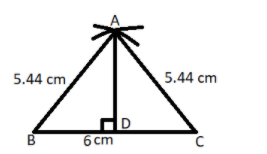
So line AD is called, a line of symmetry.
No other line of symmetry is possible.
So this is the required answer.
Note:Whenever we face such types of questions the key concept we have to remember is that always recall all the steps which is written above these steps are the basis of the construction without these steps which is written above we cannot draw the triangle then always remember that line of symmetry divide any shape into two equal halves, and an isosceles triangle has only one line of symmetry.
Complete step-by-step answer:
Triangle having sides AB = 5.44 cm, AC = 5.44 cm and BC = 6 cm.
Steps of construction:
$\left( i \right)$ Draw a horizontal line BC of 6 cm using a ruler.
$\left( {ii} \right)$ Now take a compass with pointed end at B and make an arc with pencil end at 5.44 cm above line BC as shown in the below figure.
$\left( {iii} \right)$ Now again take a compass with pointed end at C and make an arc with pencil end at 5.44 cm above line BC, which cut the previous arc at point A as shown in the below figure, now join AB and AC.
So this is the required triangle of sides AB = AC = 5.44 cm and BC = 6 cm.
Now as we know that line of symmetry divides any shape into two equal halves.
As we know that in a triangle if two sides are equal then it is called an isosceles triangle.
So in an isosceles triangle if we draw the perpendicular from the intersection of sides which have the same length so the triangle is divided into two equal parts.
So in the above triangle draw the perpendicular from A on BC which cuts the BC on point D as shown in the below figure, so ADB and ADC are two equal half’.
So line AD is called, a line of symmetry.
No other line of symmetry is possible.
So this is the required answer.
Note:Whenever we face such types of questions the key concept we have to remember is that always recall all the steps which is written above these steps are the basis of the construction without these steps which is written above we cannot draw the triangle then always remember that line of symmetry divide any shape into two equal halves, and an isosceles triangle has only one line of symmetry.
Recently Updated Pages
Master Class 11 English: Engaging Questions & Answers for Success

Master Class 11 Maths: Engaging Questions & Answers for Success
Master Class 11 Biology: Engaging Questions & Answers for Success
Master Class 11 Social Science: Engaging Questions & Answers for Success
Master Class 11 Physics: Engaging Questions & Answers for Success
Master Class 11 Accountancy: Engaging Questions & Answers for Success
Trending doubts
What is BLO What is the full form of BLO class 8 social science CBSE
Citizens of India can vote at the age of A 18 years class 8 social science CBSE
Full form of STD, ISD and PCO
Convert 40circ C to Fahrenheit A 104circ F B 107circ class 8 maths CBSE
Advantages and disadvantages of science
Right to vote is a AFundamental Right BFundamental class 8 social science CBSE