




Construct a triangle ABC in which AB + AC = 5.6 cm, BC = 4.5 cm and angle B = 45 degrees.
Answer
 Verified
582k+ views
Hint: Assume the base of the triangle as BC = 4.5 cm and draw with the help of a scale. Now, draw the angle of 45 degrees at point B and elongate the ray. Mark a point on this ray as P such that PB = 5.6 cm. Join PC and draw a perpendicular bisector of PC such that it cuts PB at A. Join AC to get the required triangle.
Complete step by step answer:
Here we have been provided with the information regarding the sides of the triangle ABC such that AB + AC = 5.6 cm, BC = 4.5 cm and the measure of angle B = 45 degrees. We have to construct the triangle ABC. Let us follow the below given steps.
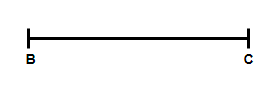
Step 1: - We will consider the side BC as the base and construct a line BC of length 44.5 cm using the scale.
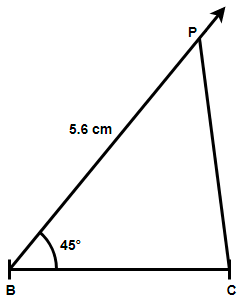
Step 2: - We have to draw an angle of 45 degrees at point B and elongate the ray. Here we will mark a point P using scale such that PB = 5.6 cm and we will join PC.
Step 3: - Finally, we will draw a perpendicular bisector of the line PC that cuts the line PB at A. We will join AC and the triangle ABC is formed.
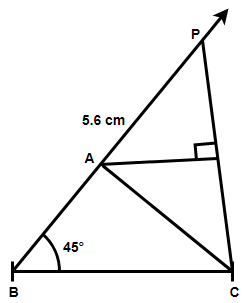
Note: You may note that here we have used the property of an isosceles triangle that its perpendicular bisector divides the triangle into two congruent triangles. Here, triangle PAC is the isosceles triangle. If you want the proof that we have constructed the correct triangle then you may see it is given that AB + AC = 5.6 cm. Since we have taken PB = 5.6 cm so we have PA + AB = 5.6 cm and PA = AC as they are the equal sides of the isosceles triangle PAC. Therefore we get AC + AB = 5.6. Hence our construction is correct.
Complete step by step answer:
Here we have been provided with the information regarding the sides of the triangle ABC such that AB + AC = 5.6 cm, BC = 4.5 cm and the measure of angle B = 45 degrees. We have to construct the triangle ABC. Let us follow the below given steps.
Step 1: - We will consider the side BC as the base and construct a line BC of length 44.5 cm using the scale.
Step 2: - We have to draw an angle of 45 degrees at point B and elongate the ray. Here we will mark a point P using scale such that PB = 5.6 cm and we will join PC.
Step 3: - Finally, we will draw a perpendicular bisector of the line PC that cuts the line PB at A. We will join AC and the triangle ABC is formed.
Note: You may note that here we have used the property of an isosceles triangle that its perpendicular bisector divides the triangle into two congruent triangles. Here, triangle PAC is the isosceles triangle. If you want the proof that we have constructed the correct triangle then you may see it is given that AB + AC = 5.6 cm. Since we have taken PB = 5.6 cm so we have PA + AB = 5.6 cm and PA = AC as they are the equal sides of the isosceles triangle PAC. Therefore we get AC + AB = 5.6. Hence our construction is correct.
Recently Updated Pages
Basicity of sulphurous acid and sulphuric acid are

Master Class 12 Economics: Engaging Questions & Answers for Success
Master Class 12 Biology: Engaging Questions & Answers for Success
Master Class 11 English: Engaging Questions & Answers for Success
Master Class 11 Physics: Engaging Questions & Answers for Success
Master Class 11 Computer Science: Engaging Questions & Answers for Success
Trending doubts
What is the Total Duration of Football Match?
Explain the Treaty of Vienna of 1815 class 10 social science CBSE
In football, which nation is called "La Roja"?
Why is there a time difference of about 5 hours between class 10 social science CBSE
10 examples of evaporation in daily life with explanations
What is the full form of POSCO class 10 social science CBSE