




Construct a triangle ABC, given: BC = 7cm, AB – AC=1 cm and $\angle ABC = {45^o}$. Measure the lengths of AB and AC.
$\left( a \right)$ AB=8.6 cm; AC=7.6 cm
$\left( b \right)$ AB=2.7 cm; AC=1.7 cm
$\left( c \right)$ AB=6.1 cm; AC=5.1 cm
$\left( d \right)$ Data insufficient
Answer
 Verified
594k+ views
Hint: In this particular question the pictorial representation is made possible by the step by step method with the help of the values which are given. The angle is drawn with the help of the compass, and with the help of the bisection method so use these concepts to reach the solution of the question.
Complete step-by-step solution:
Given data:
In a triangle ABC, BC = 7cm, AB – AC=1 cm and, $\angle ABC = {45^o}$.
The steps of construction are given below:
$\left( i \right)$ Draw a line BC of 7 cm using a ruler as shown in the below figure.

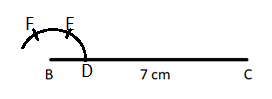
$\left( {ii} \right)$ Now put the pointed end of the compass on point B and make an arc of any appropriate length, which cut the line BC at point D, then put the pointed end of the compass at point D and with same appropriate length cut the big arc with pencil end which cut the big arc at point E, then put the pointed end of the compass at point E and with same appropriate length cut the big arc with pencil end which cut the big arc at point F as shown in the below figure.
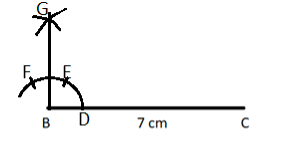
$\left( {iii} \right)$ Now put the pointed end of the compass at point E and make an arc with some appropriate length, then put the compass at point F and make an arc which cut the previous arc at point G, now join B and G, so $\angle GBC = {90^o}$, as shown in the below figure.
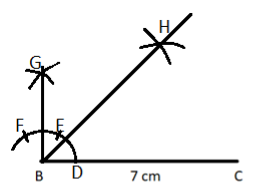
$\left( {iv} \right)$ Now make an arc from point D and the intersection point of line BG and big arc both the arc cut at point H, now join B and H as shown in the below figure, so $\angle HBC = {45^o}$ which is the bisector of angle GBC.
$\left( v \right)$ Now make an arc of 1 cm from point B on line BH which cuts the line BH at the point I, then join point C and I, then draw the bisector of line CI which cut the line BH at point A, then join points C and A, as shown in the below figure.
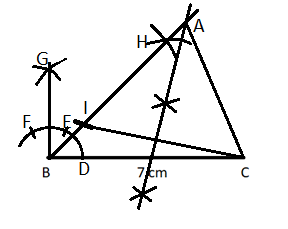
Triangle ABC is the required triangle having, BC = 7cm, and AB – AC = 1cm.
Now when we measure the length of AB and AC by ruler we get, AB = 6.1cm and AC= 5.1cm
So this is the required answer.
Hence option (C) is the correct answer.
Note: Whenever we face such types of problems, we must have adequate knowledge of construction and geometry. Do not try to jump over any step as these steps are the basis of the construction otherwise it will lead us to improper construction and thus eventually lead us to the improper measurements of the sides.
Complete step-by-step solution:
Given data:
In a triangle ABC, BC = 7cm, AB – AC=1 cm and, $\angle ABC = {45^o}$.
The steps of construction are given below:
$\left( i \right)$ Draw a line BC of 7 cm using a ruler as shown in the below figure.
$\left( {ii} \right)$ Now put the pointed end of the compass on point B and make an arc of any appropriate length, which cut the line BC at point D, then put the pointed end of the compass at point D and with same appropriate length cut the big arc with pencil end which cut the big arc at point E, then put the pointed end of the compass at point E and with same appropriate length cut the big arc with pencil end which cut the big arc at point F as shown in the below figure.
$\left( {iii} \right)$ Now put the pointed end of the compass at point E and make an arc with some appropriate length, then put the compass at point F and make an arc which cut the previous arc at point G, now join B and G, so $\angle GBC = {90^o}$, as shown in the below figure.
$\left( {iv} \right)$ Now make an arc from point D and the intersection point of line BG and big arc both the arc cut at point H, now join B and H as shown in the below figure, so $\angle HBC = {45^o}$ which is the bisector of angle GBC.
$\left( v \right)$ Now make an arc of 1 cm from point B on line BH which cuts the line BH at the point I, then join point C and I, then draw the bisector of line CI which cut the line BH at point A, then join points C and A, as shown in the below figure.
Triangle ABC is the required triangle having, BC = 7cm, and AB – AC = 1cm.
Now when we measure the length of AB and AC by ruler we get, AB = 6.1cm and AC= 5.1cm
So this is the required answer.
Hence option (C) is the correct answer.
Note: Whenever we face such types of problems, we must have adequate knowledge of construction and geometry. Do not try to jump over any step as these steps are the basis of the construction otherwise it will lead us to improper construction and thus eventually lead us to the improper measurements of the sides.

Recently Updated Pages
Master Class 7 English: Engaging Questions & Answers for Success

Master Class 7 Maths: Engaging Questions & Answers for Success
Master Class 7 Science: Engaging Questions & Answers for Success
Class 7 Question and Answer - Your Ultimate Solutions Guide
Master Class 9 General Knowledge: Engaging Questions & Answers for Success
Master Class 9 Social Science: Engaging Questions & Answers for Success
Trending doubts
The value of 6 more than 7 is A 1 B 1 C 13 D 13 class 7 maths CBSE
Convert 200 Million dollars in rupees class 7 maths CBSE
List of coprime numbers from 1 to 100 class 7 maths CBSE
AIM To prepare stained temporary mount of onion peel class 7 biology CBSE
The plural of Chief is Chieves A True B False class 7 english CBSE
Write a letter to the editor of the national daily class 7 english CBSE