



Construct a square PQRS of diagonal 6.2cm.
Answer
 Verified
524.4k+ views
Hint: We have to construct a square PQRS and its diagonal is given. Now, to construct the square, we need to find its sides. As all the sides of the square are equal, let the sides of the square be x. Now, using Pythagoras theorem, find the value of x. Now, the steps of construction of the square are discussed below.
Complete step by step solution:
In this question, we have to construct a square PQRS and the length of the diagonal of this square is given.
$ \Rightarrow PR = 6.2cm$
Now, to construct this square, we need to find the length of each side.
Let us draw a rough figure of the square.
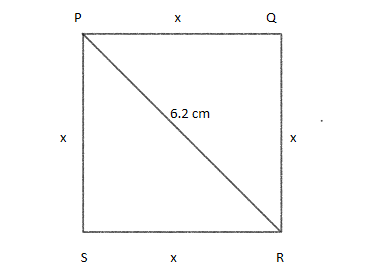
Now, all the sides of a square are equal.
So, let $PQ = QR = RS = PS = x$.
Now, in right $\Delta PSR$, using the Pythagoras theorem,
$ \Rightarrow P{S^2} + S{R^2} = P{R^2}$
Here, $PR = 6.2$ and $PS = SR = x$.
$
\Rightarrow {x^2} + {x^2} = {\left( {6.2} \right)^2} \\
\Rightarrow 2{x^2} = 38.44 \\
\Rightarrow {x^2} = 19.22 \\
\Rightarrow x = \sqrt {19.22} \\
\Rightarrow x = 4.38 \\
$
Hence, $PQ = QR = RS = PS = 4.3$.
Hence, now we have all the data required for constructing our square.
$ \Rightarrow PQ = QR = RS = PS = 4.3$
$ \Rightarrow \angle PSR = \angle SRQ = \angle PQR = \angle SPQ = 90^\circ $
Steps to construct a square:
Step 1:
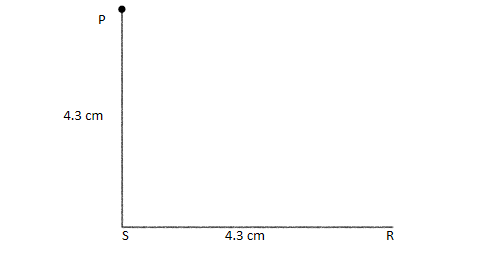
Draw a horizontal line segment SR of length 4.3 cm.

Step 2:
Place the midpoint of the protractor at point S and mark a point at $90^\circ $ and then join that point with the point S. Make sure that the distance between this point and point S is 4.3 cm.
Step 3:
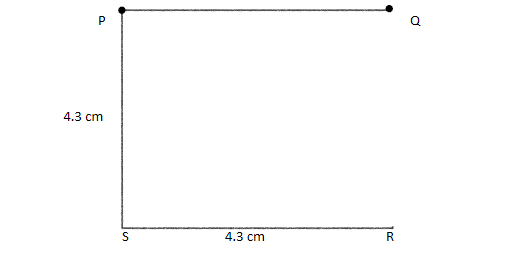
Place the midpoint of the protractor at point P and mark a point at $90^\circ $ and then join that point with the point P. Make sure that the distance between that point and point P is 4.3 cm.
Step 4:
Now, join the points P and R by drawing a line segment. Cross check by measuring the length and angle using a protractor.
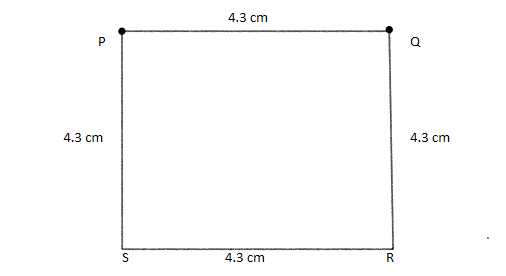
Hence, we have constructed the required square.
Note:
As all the sides of square are equal, the perimeter of the square is given by
$ \Rightarrow $Perimeter of square $ = 4x$
Therefore, the perimeter of a square will be
$ \Rightarrow $Perimeter$ = 4 \times 4.3 = 17.2$cm.
Complete step by step solution:
In this question, we have to construct a square PQRS and the length of the diagonal of this square is given.
$ \Rightarrow PR = 6.2cm$
Now, to construct this square, we need to find the length of each side.
Let us draw a rough figure of the square.
Now, all the sides of a square are equal.
So, let $PQ = QR = RS = PS = x$.
Now, in right $\Delta PSR$, using the Pythagoras theorem,
$ \Rightarrow P{S^2} + S{R^2} = P{R^2}$
Here, $PR = 6.2$ and $PS = SR = x$.
$
\Rightarrow {x^2} + {x^2} = {\left( {6.2} \right)^2} \\
\Rightarrow 2{x^2} = 38.44 \\
\Rightarrow {x^2} = 19.22 \\
\Rightarrow x = \sqrt {19.22} \\
\Rightarrow x = 4.38 \\
$
Hence, $PQ = QR = RS = PS = 4.3$.
Hence, now we have all the data required for constructing our square.
$ \Rightarrow PQ = QR = RS = PS = 4.3$
$ \Rightarrow \angle PSR = \angle SRQ = \angle PQR = \angle SPQ = 90^\circ $
Steps to construct a square:
Step 1:
Draw a horizontal line segment SR of length 4.3 cm.
Step 2:
Place the midpoint of the protractor at point S and mark a point at $90^\circ $ and then join that point with the point S. Make sure that the distance between this point and point S is 4.3 cm.
Step 3:
Place the midpoint of the protractor at point P and mark a point at $90^\circ $ and then join that point with the point P. Make sure that the distance between that point and point P is 4.3 cm.
Step 4:
Now, join the points P and R by drawing a line segment. Cross check by measuring the length and angle using a protractor.
Hence, we have constructed the required square.
Note:
As all the sides of square are equal, the perimeter of the square is given by
$ \Rightarrow $Perimeter of square $ = 4x$
Therefore, the perimeter of a square will be
$ \Rightarrow $Perimeter$ = 4 \times 4.3 = 17.2$cm.
Recently Updated Pages
Master Class 11 Computer Science: Engaging Questions & Answers for Success

Master Class 11 Business Studies: Engaging Questions & Answers for Success
Master Class 11 Economics: Engaging Questions & Answers for Success
Master Class 11 English: Engaging Questions & Answers for Success
Master Class 11 Maths: Engaging Questions & Answers for Success
Master Class 11 Biology: Engaging Questions & Answers for Success
Trending doubts
Difference Between Plant Cell and Animal Cell
Fill the blanks with the suitable prepositions 1 The class 9 english CBSE
Which places in India experience sunrise first and class 9 social science CBSE
Who is eligible for RTE class 9 social science CBSE
What is pollution? How many types of pollution? Define it
Name 10 Living and Non living things class 9 biology CBSE